
Can Kosovo get a “Government of National Unity” without Kurti?
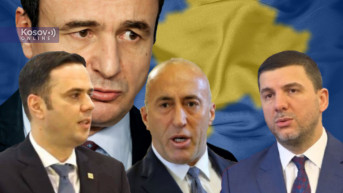
Such proposals existed before, but now there is a concrete reason: the suspension of the U.S.–Kosovo Strategic Dialogue. Could the strained relations between Pristina and Washington unite the opposition? According to former Deputy Prime Minister Edita Tahiri, this is the key reason to form a “government of national unity without Kurti in executive functions.” A coalition of opposition parties is possible, sources told Kosovo Online. Some are convinced that the Self-Determination Movement is aware of this, which is why it is delaying the constitution of the Assembly.
Written by: Djordje Barovic
“It is urgently necessary to find a way out. To form a coalition government with all parties, from the opposition, but also those who are not formally in power, yet are currently holding the government illegally. They should sit together, talk, and find common ground for Kosovo and its people, but also for the alliance with America,” Tahiri said.
The story about a government of national unity is only a continuation of post-election maneuvering after the February elections, when the Self-Determination Movement won 48 seats, while the opposition parties together won 52 (PDK – 24, LDK – 20, and AAK and the Social Democratic Initiative – 8).
To form a new government, at least 61 votes are needed—a “threshold” currently out of reach for everyone.
“The math is very simple—just 19 votes from LDK, I get the rest, and we reach 61. You and I both know the math,” PDK leader Memli Krasniqi said in mid-June.
In the end, nothing came of this “simple math.”
Nor did anything come of the Self-Determination Movement’s claims that it was capable of electing a new Speaker of the Assembly by itself, and then forming a government.
Political expert Melzim Koci believes that since the elections, this party has not shown any willingness to form a parliamentary majority.
“They really did not have a majority, but there was also no expressed will to form one,” Koci explained.
However, Kosovo’s Minister of Culture, Youth, and Sports in a caretaker capacity, Hajrulla Çeku, insists that they are awaiting the final decision of the Constitutional Court, after which the Self-Determination Movement will, within 15 days, form the “Kurti 3” government.
“Anti-Kurti Platform”
Strategic Director at the Center for European Policies, Milos Pavkovic, told Kosovo Online that the idea of forming an opposition coalition has been “in play” since February, and that this option becomes more realistic as the political and constitutional crisis deepens.
“The idea of some sort of ‘anti-Kurti platform’ was mentioned as early as February, after the elections and preliminary results, when it became clear that Kurti could only be removed through a large-scale platform of all the other parties. Since then, seven or eight months have passed, and Kurti has not been able not only to form a government but even to constitute the Assembly. Such scenarios are therefore coming back into consideration. In theory, it is possible, but in practice it will depend on the willingness of opposition parties to cooperate—and so far, that willingness has not surfaced,” Pavkovic explained.
He believes that such an outcome will also depend on the support of international actors, as well as the opposition’s readiness to work together.
“As time passes and the crisis deepens, an ‘anti-Kurti coalition’ or a coalition of ‘national salvation’ without him is increasingly imposed as the only solution,” the analyst emphasized.
However, the question remains whether such a “solution” would include the Serbian List.
“The Serb List has been quite marginalized and targeted in recent years, both because of Banjska and other developments. It is very unpopular for any other Albanian political party to establish cooperation with the Serb List, especially if there is a regime change,” Pavkovic said.
He predicts that Albanian parties will still attempt to form a government without the Serbian List.
“My prediction is that Albanian parties will try to gather enough votes to form a government without the Serbian List, while SL may be an additional partner in such a coalition. But it will not be the decisive factor in bringing down Kurti,” Pavkovic clarified.
Deadlock
For Pristina University professor Mazlum Baraliu, a government of national unity would be the best solution, but he does not believe it will happen because of the “deadlock” between the majority and the opposition parties.
“It would be good if after the elections, a government were formed including all political parties with representatives in the Assembly. That would mean stability for the country, and also the ability to achieve unity when it comes to electing a president, because a two-thirds majority is required. Of course, it would also mean unified decisions on foreign and domestic policy. But that has not happened, and it will not happen,” Baraliu told Kosovo Online.
He explained that the reason lies in the fact that neither the Self-Determination Movement nor the opposition parties can reach a majority in parliament.
“The opposition is not united enough to form a government on its own, though it could, since it has 62 MPs. But they are not, and do not want to be, united. Likewise, the Self-Determination coalition does not have the numbers. So we are in a deadlock,” Baraliu clarified.
He does not believe Edita Tahiri was the right person to propose forming a coalition, since she is not “a figure with influence or decision-making authority.”
“She proved herself while in power, and she and her government made many mistakes—in the strategic dialogue, in Brussels, and in certain aspects of foreign diplomacy,” Baraliu argued.
Fear and Key Issues
Marko Milenkovic, associate at the NGO “New Social Initiative,” believes that the Self-Determination Movement is aware that the opposition could form a new government, which is why, he claims, it is stalling the process of constituting the Assembly.
“It is clear that the opposition could form a government. I think this is the root of the Self-Determination Movement’s fear, and the reason they are delaying the Assembly’s formation, because afterward the process of forming a government would follow. That would mean that if the deadlines for forming a government are not met, the opposition would get the opportunity,” Milenkovic told Kosovo Online.
He added that for this to happen, “more unified positions of the opposition on certain issues” are needed.
“Above all, on key issues concerning overcoming the current situation. And the question is whether such a government would in some sense be transitional, since it would be very difficult to reach consensus on key social or political issues,” Milenkovic said.
He emphasized that such a coalition would also require the support of other communities in Kosovo, including the Serb one.
“The positioning of the leading opposition parties will dictate the very manner and involvement of other actors, including communities beyond the Albanian one,” this analyst specified.
He is convinced that if the Self-Determination Movement continues blocking institutions, a solution will have to be found either through the Constitutional Court or in some other way.
“Certainly, if the politics of unilateral moves and further isolation from the international community continue, the need for such an opposition or transitional government will grow. At some point, political actors will have to reach consensus, form a government, and simply overcome the crisis developing in Kosovo,” Milenkovic stressed.



comments