
Canada’s associate EU membership – Ottawa-Brussels flirtation with no impact on Western Balkans enlargement
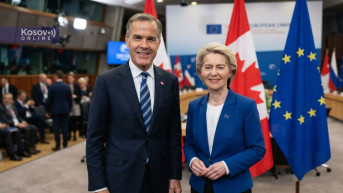
European Commission President Ursula von der Leyen’s proposal for Canada to become the first associate member of the European Union has raised the question of whether, alongside full membership, a new model of relations could eventually be developed between Brussels and countries seeking deeper integration with the EU, but not membership under the current terms. Kosovo Online’s interlocutors say it is still too early to consider applying such a model to the Western Balkans, although they note that it could serve as a guide for enhanced political cooperation.
Written by: Katarina Saicic
“This is not a partnership against anyone else, but one for our common strength,” von der Leyen said in the European Parliament in the presence of Canadian Prime Minister Mark Carney, with her proposal receiving an ovation from MEPs and commissioners in the chamber.
A day later, speaking at the same venue, Carney said that a deeper partnership between Canada and Europe was necessary to protect both from major powers encroaching on the sovereignty of smaller nations, calling for the establishment of an “alliance for the future” between Canada and the EU’s 27 Member States.
It is still too early to predict what that future might look like, while further details of the new relationship are expected to be discussed at the Canada-EU summit in Montreal on October 29 and 30.
Although the concept of “associate membership” is currently neither part of the European treaties nor a formal status within the EU, the initiative has prompted debate about possible new forms of European integration. The issue is particularly relevant to the Western Balkans, which has been waiting for progress in the enlargement process for years, while various initiatives are simultaneously opening the possibility of gradual integration into individual EU policies and parts of the Single Market.
In this context, the question also arises as to how comparable the proposal for Canada’s associate membership is with the idea previously put forward by former Serbian President Aleksandar Vucic and Albanian Prime Minister Edi Rama in an article for the German newspaper Frankfurter Allgemeine Zeitung. They advocated accelerated integration of candidate countries into the Single Market and the Schengen Area without full membership and the political rights that come with it.
Could the Canadian model, if it is given concrete form, become the basis for a new architecture of EU relations with countries seeking deeper economic and political integration, and could such an approach also be applied to the Western Balkans? Kosovo Online’s interlocutors say this would be difficult.
For now, they remain skeptical, but note that EU enlargement in its current form is certainly subject to change as it faces numerous challenges. One of the changes being discussed, which could potentially be linked to von der Leyen’s initiative, is a shift from unanimity to qualified-majority voting, which experts say could facilitate the region’s European integration.
Legislative changes required
Skopje-based analyst Sinisa Pekevski believes that Canada’s associate membership in the EU could take the form of enhanced political cooperation and says it is difficult to assess whether this could eventually become a model for the Western Balkans.
“I think these are still discussions and that it is too early to draw any conclusions. The process does not move that quickly, and I do not believe it will be easy because these are only initial steps requiring changes to legislation and policies, and all of that takes time. In any case, associate membership will probably take the form of enhanced cooperation and greater engagement at the political level. Many of the developments currently taking place globally require greater involvement not only from the EU but also from Canada as a partner, since they hold close or similar positions on many issues,” Pekevski told Kosovo Online.
Asked whether associate membership could be compared with the Vucic-Rama initiative, he said it was too early for any long-term plans because major global developments were affecting the EU, which itself faced restructuring.
“Major changes are taking place in Germany, with the AfD winning in two states. Presidential elections are expected in France next year, where the right is on the verge of what could be described as a victory, which will add further weight to developments within the EU and bring changes whose impact on the Union itself we cannot yet predict. Then there is the war in Ukraine and the conflict in the Middle East, which continue to affect the EU,” Pekevski said.
All of this, he added, was affecting the European Union economically, which is why he expected the EU to focus more on putting its economy in order than on actual enlargement to include new members, particularly from the Western Balkans.
“In essence, that means they will not completely forget this region, but will introduce or offer certain initiatives aimed at maintaining momentum in the process,” the analyst said.
Asked whether associate membership could become a new reality and give EU enlargement fresh impetus, Pekevski recalled that all EU Member States would have to approve any such decision or change.
“That is why it is difficult for them to opt for such an arrangement, because they could lose some of their rights. Unforeseen differences could also arise if you introduce certain rules and then change them and say that different rules apply to certain countries. This could provoke resentment among some countries because they contribute differently to the budget and have different decision-making powers, while some countries currently use their veto over certain decisions. Montenegro’s path, for example, is not that straightforward, as it is expected to meet certain conditions imposed by Croatia. When Serbia’s turn comes, I believe Croatia will again have major demands and use its veto, which means the entire process will be very difficult,” Pekevski concluded.
No impact on the Western Balkans
Nikola Dencic, foreign affairs editor at Radio Belgrade’s First Program, assessed that a privileged partnership between the EU and Canada was possible, but that such cooperation would have no impact on EU enlargement to the Western Balkans.
Dencic views European Commission President Ursula von der Leyen’s initiative as a platform for deeper political consultations, noting that it remains far removed from membership.
“The likelihood of Canada becoming a new EU member or obtaining some privileged status within the EU is roughly on a par with the likelihood of Canada becoming the 51st US state. That is genuinely difficult to imagine,” Dencic told Kosovo Online.
He explained that a privileged partnership could involve agreements of the kind that already exist, arrangements enabling closer economic cooperation or perhaps even deeper political consultations.
“That could happen, particularly given that the response from both the EU and the current Canadian authorities is primarily directed at the approach US President Donald Trump has taken toward both Canada and the Union. I think all of these somewhat sharper or bolder statements, however one chooses to describe them, are primarily aimed in that direction,” Dencic said.
For that reason, he said, such initiatives could have absolutely no effect on the status of any current candidate country.
He added that some movement might have been expected in Iceland’s case, including a possible resumption of Reykjavik’s negotiations with Brussels, but Icelandic citizens rejected the continuation of those negotiations in a referendum.
“We will see what happens on the political scene in EU countries by the end of the year or perhaps over the next year. It depends on which political forces win elections and what direction the Union itself takes, but agreements or talks of any kind with Canada will not affect that. The accession process will most likely continue along its current course. Montenegro is currently clearly the only, or one of the very few, candidates making genuine progress in the fullest sense. Albania was said to have made substantial progress, but there is now a certain slowdown there,” Dencic explained, recalling that Serbia had not opened a new cluster for a long time.
He is convinced that, before any decisions of a geopolitical nature such as talks with Canada, the status of accession negotiations in the coming period will primarily be shaped by political relations within the EU, particularly within its most powerful Member States.
Asked whether the Canada-EU case could be compared with the Vucic-Rama initiative for gradual accession to the Schengen Area, Dencic said it would be difficult to implement ideas for integration outside the established methodology—first completing formal accession negotiations and then becoming a full Member State—because all EU countries would have to agree.
“The question is how willing they would be to do that. There are ideas, and the Growth Plan for the Western Balkans has in fact enabled candidate countries to become involved, whether through some preferential position in relation to the Single Market or certain customs protocols. It has also been considered that, if a candidate makes substantial progress, it could participate in some way in the work of EU institutions, but without voting rights,” Dencic said.
A “multi-speed” EU
Dencic nevertheless noted that the idea of a European Union organized in “several circles” or at “different speeds” had been raised by certain European officials, particularly French President Emmanuel Macron, but had never secured consensus, making it questionable whether such an arrangement would currently be feasible.
“When it comes to joining Schengen, judging by what we have heard from certain EU leaders, it may even be easier to become an EU member than to join Schengen. Not every EU Member State is part of the Schengen Area. As for the initiative by President Vucic and Prime Minister Rama, it was certainly primarily a message they wanted to send to the European institutions. They wanted to convey that the two countries were ready to advance toward membership, but achieving concrete formal results from that at this point would be quite difficult,” Dencic concluded.
Ottawa turns toward Brussels
Diplomat and former Kosovo Ambassador Albert Prenkaj assessed that the possibility of Canada becoming an associate member of the EU could not be compared with the Western Balkans, but said that the idea of integrating the Western Balkans as a package would be of geostrategic importance to the EU, enabling it to complete the economic and security architecture of the emerging world order.
In a written response to Kosovo Online, Prenkaj said that growing trade tensions between the United States and Canada had forced Ottawa to diversify its strategic and economic dependencies.
“European Commission President Ursula von der Leyen’s initiative, formally offering Canada the status of the first ‘associate member’ in EU history, was welcomed by Canadian Prime Minister Mark Carney, who described this strategic shift as an ‘alliance for the future.’ Ottawa is turning toward Brussels with the intention of reducing its economic and geopolitical dependence on Washington,” Prenkaj said.
“The question of whether this shift in EU cooperation could serve as a model for Western Balkan countries negotiating integration, particularly the initiative by Albania and Serbia to gain access to the Single Market and the Schengen Area, is a very interesting subject for consideration. While Canada is experiencing economic tensions with the United States, the Western Balkans faces domestic problems within individual states as well as disagreements among countries in the region,” Prenkaj noted.
Regarding Albania, he recalled that it had managed by the middle of the year to open all key negotiating clusters and receive a positive Interim Benchmark Assessment Report (IBAR), formally placing it in the final stage of negotiations, with the ambition of closing all chapters and aiming for full EU membership. Montenegro, meanwhile, had experienced procedural delays in closing additional negotiating chapters “due to complex technical procedures and the need for internal consultations among Member States.”
“Serbia’s stalemate consists of its long-standing failure to align its foreign policy with Brussels, including its refusal to impose sanctions on Russia, as well as insufficient progress in the rule of law and judiciary. In Bosnia and Herzegovina, dialogue with the EU has primarily been slowed by internal political divisions along ethnic lines, institutional dysfunction and the unwillingness of domestic leaders to implement key reforms,” Prenkaj said.
North Macedonia’s European integration process, he added, had also slowed and remained in a long-standing deadlock, primarily because of the bilateral dispute with Bulgaria, which had formally become part of the EU negotiating framework, while the pace of domestic reforms was another factor.
“And despite formally applying for EU membership in December 2022 and currently holding potential-candidate status, Kosovo continues to face domestic problems in establishing state institutions, as well as a lack of coordination with the international community that has resulted in EU measures and the suspension of the Strategic Dialogue with the United States,” Prenkaj said.
According to him, beyond internal shortcomings or weaknesses, the Western Balkans is also characterized by difficult interstate relations—“tensions between Kosovo and Serbia, mutual obstruction of negotiations, disagreements between Montenegro and Croatia over Prevlaka, Bulgaria’s insistence on constitutional amendments in North Macedonia, allegations of Serbian interference in Bosnia and Herzegovina’s internal affairs, and strained relations between Montenegro and Serbia involving accusations of interference and destabilization.”
He therefore concluded that it was extremely difficult to compare Canada with the Western Balkans, which he described as a region “that remains fragmented in terms of relations among its countries, as well as in its relationship with Brussels itself.”
“As I mentioned in one of my public appearances, the idea of integrating the Western Balkans as a package—‘standards with status’—is of geostrategic importance to the European Union itself, as it would complete the economic and security architecture of the new world order,” Prenkaj concluded.



0 comments