
The Community of Serb-Majority Municipalities between Pristina’s political will and pressure from Belgrade – Does Brussels have a “practical solution”?
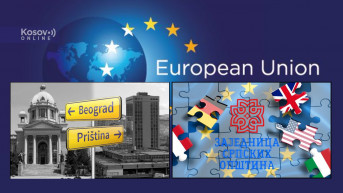
The announcement that the EU could seek “practical solutions” through dialogue for the establishment of the Community of Serb-Majority Municipalities (CSM) has raised the question of a new approach by Brussels to this process. Analysts from Belgrade told Kosovo Online that there are ways to avoid submitting the draft statute to the Constitutional Court, but they warn of the lack of political will on the part of Albin Kurti. They assess that EU messages should be read between the lines, emphasizing that the key lies in the Union’s readiness to fully utilize its political and financial mechanisms. However, part of the expert community in Pristina believes that the first steps have already been taken.
Written by: Petar Rosic
Former EU Ambassador to Kosovo Aivo Orav indicated in a farewell interview with a group of Serbian-language media outlets that the EU could seek alternative ways to establish the CSM without submitting the draft statute to Kosovo’s Constitutional Court.
“We cannot wait indefinitely. Practical solutions must be found through dialogue,” Orav said.
Former EU Special Representative for Kosovo Wolfgang Petritsch also noted, when discussing the draft statute of the CSM, that nothing has been definitively defined and that everything remains subject to negotiation.
Diplomat Albert Prenkaj assessed that the meeting between French President Emmanuel Macron and Albin Kurti could provide a green light for launching processes that have remained sidelined for Kosovo, but that the next step could be a focus on establishing the CSM.
“We expect that in the near future there will be a meeting between the President of Serbia and Prime Minister Kurti, with possible additional pressure for Kosovo to accept the establishment of the Community,” Prenkaj stated.
A Question for the EU, Not Kurti
Director of the Institute for European Studies Slobodan Zecevic assessed for Kosovo Online that the establishment of the CSM is primarily a matter of political decision-making in Pristina and the EU’s readiness to exert political and financial pressure to finally initiate the process.
“I think they are aware that a lot of time has passed, and the EU ambassador’s statement itself shows that they understand that much time has passed without results and that it is time for something to be done,” Zecevic said.
He added that the European Union possesses mechanisms through which it could influence Pristina.
“What technical options do they have? They have political leverage, and they have financial leverage when it comes to institutions in Pristina. Are they willing to use them? That is now a question for the European Union, rather than for Kurti,” he emphasized.
He believes that the political situation in Kosovo is chaotic, but that a solution could still be reached if there were political will.
“Kurti could complete the work on the statute of the Community of Serb-Majority Municipalities if he had the political will. Clearly, he does not, and that is the problem. It is therefore up to the European Union to determine how to deal with Kurti and his stance toward the CSM,” the Director of the Institute for European Studies stated.
If Europe Will Not, Who Will?
Commenting on the meeting between Macron and Kurti, Zecevic expressed hope that the CSM had also been on the agenda.
“Serbia has insisted on this multiple times, and France, as a friendly country, certainly understands that this concerns the fate of the Serbian and Christian population in Kosovo. Without the Community of Serb-Majority Municipalities, they have no chance of survival in that area, given the current situation,” he said.
He stressed that Europe must preserve its tradition, culture, and the members of its civilization.
“The Community of Serb-Majority Municipalities is the only condition for the survival of Serbs in Kosovo. If Europe does not support this, I do not know who else would. The policy of Kurti’s government is focused on expelling Serbs from Kosovo and relocating them to Serbia. That is his focus. Europe, on the other hand, should be protecting the Christian population,” Zecevic stated.
The Constitutional Court as a Pretext
Assistant Professor at the Faculty of Political Sciences in Belgrade Stefan Surlic told Kosovo Online that the messages of Aivo Orav regarding “practical solutions through dialogue” do not represent a fundamental shift in Brussels’ approach, but rather signal continuity in EU policy toward the CSM.
Surlic believes that such a statement is part of Orav’s “exit strategy,” but also a message from the European Union itself.
“I think that was his exit strategy, given that he no longer holds the ambassadorial post, and in a kind of farewell message he wanted to emphasize that a solution must be found. However, it should be read between the lines as a message from the European Union that it is not abandoning the CSM and that it must be established sooner or later,” he said.
He points out that this stance is also visible at the international level.
“We see that Germany and other key EU countries have stated that there will be no membership for Pristina in the Council of Europe without the establishment of the CSM. They maintain this position, and we see no progress or any greater international recognition of Kosovo’s independence. In that sense, if the matter does not go to the Constitutional Court, there is a high probability that one of the governments—since the statute is adopted through a government decree—will adopt such a decree without constitutional review,” he stated.
He adds that he currently sees no willingness on the part of the authorities in Pristina to initiate this issue.
“It depends on the level of international pressure. It is certain that the government of Albin Kurti will not do this voluntarily. At this moment, I see no readiness on the part of the government in Pristina, led by Albin Kurti, to establish the CSM. They are not even obliged to submit that statute. That was used as an excuse during the dialogue—that it had to be sent to the Constitutional Court in Pristina for review. They insisted on this in Brussels documents, but it is not a binding requirement,” he said.
As he emphasizes, any potential progress is possible only with stronger international engagement.
“If negotiations move in a different direction, and if international pressure becomes strong enough, a government decree—without constitutional review, provided no other political actor demands it—would be sufficient to adopt the statute of the Community of Serb-Majority Municipalities and initiate its formation,” he noted.
Kurti’s Strategy
He states that the strategy of the Kosovo Prime Minister is clear—first to integrate all institutions operating within Serbia’s system.
“He said this already during his first mandate, and we see that he continues to adhere to it in his third term—that he aims first to integrate all institutions within the Serbian system that exist in Kosovo into the Kosovo system, that is, under the institutions in Pristina,” Surlic said.
He explains that Kurti’s goal is to minimize any influence of Belgrade over existing institutions, and then to offer a form of the Community of Serb-Majority Municipalities without executive powers, essentially at the level of a Community.
“In that sense, I truly do not see the possibility that, without international pressure, Albin Kurti will in the foreseeable future create and endorse a functional Community of Serb-majority Municipalities,” Surlic concluded.
Unlike analysts in Belgrade, part of the expert community in Pristina believes that the first steps have already been taken.
Political analyst Armend Demaku considers that the implementation process of the CSM has already begun and told Kosovo Online that the turning point was the meeting between Kurti and Macron.
“As far as the implementation of the Community of Serb-Majority Municipalities is concerned, I believe that Mr. Albin Kurti has already begun implementing it following his meeting in Paris with Emmanuel Macron. The European Union has clearly stated that it would meet with Kurti only once the implementation of the Community had begun, which indicates that the process is already underway,” Demaku said.
He notes that the political rhetoric of both the Self-Determination Movement and the Serb List has a strong populist character, but also elements of what he describes as mutual coordination.
“By creating rivalry between themselves, these two parties are contributing to the realization of the CSM,” he assessed.
According to him, the model being implemented goes beyond the framework of the 2013 and 2015 agreements.
“This is not only about the Community, but about expanded autonomy within the Republic of Kosovo,” Demaku emphasized, recalling that Kurti had previously consistently denied such a possibility.


0 comments