
Cooperation with Self-Determination: A benefit or a liability for the opposition?
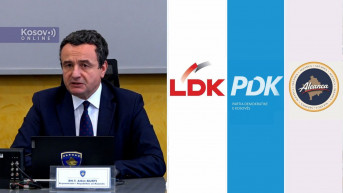
A new round of talks between Lumir Abdixhiku, leader of the Democratic League of Kosovo (LDK), and Albin Kurti, leader of the Self-Determination Movement (Vetevendosje) and acting Prime Minister, on the formation of Kosovo's institutions is scheduled to take place today. Should Abdixhiku ultimately decide that the LDK will enter a governing coalition with Vetevendosje, analysts interviewed by Kosovo Online believe it could prove to be a double-edged sword. On the one hand, it would bring the LDK back into government after years in opposition; on the other, they argue, it could amount to political suicide for the party in the long run.
Written by: Dusica Radeka Djordjevic
The Democratic League of Kosovo is the only one of the three Albanian opposition parties to respond positively to Albin Kurti's invitation for talks on the constitution of the new institutions and the election of the president.
Last week, commenting on the talks with the LDK, Kurti said that although the outcome could not be predicted, there was interest, willingness, and readiness on both sides.
That willingness was also reflected in a statement by Jehona Lushaku Sadriu, a member of the LDK Presidency, who said that the party does not rule out the possibility of reaching a political agreement with Vetevendosje.
At the same time, she stressed that such an agreement cannot be reached "under every condition set by the election-winning party."
Yesterday, however, the Alliance for the Future of Kosovo (AAK) and the Democratic Party of Kosovo (PDK) swiftly rejected Kurti's invitation to talks.
Even before Kurti's latest appeal to the opposition, PDK member Eman Rrahmani warned that any opposition party entering into an agreement with Vetevendosje solely to secure the position of president would ultimately emerge as the loser.
According to him, any cooperation or participation in government would amount to accepting that what he described as poor governance over the past six years had become "something normal."
Would the LDK become the loser if it entered into an agreement with Vetevendosje? Would it risk losing part of its electoral base, or would such a move breathe new life into the party, as political analyst Fatmir Cholaku believes?
The LDK walking a tightrope
Political analyst Artan Muhaxhiri told Kosovo Online that negotiations between Vetevendosje and the LDK could lead Albin Kurti to make certain adjustments within the government, provided he secures a presidential candidate who meets his criteria and supports his political vision. However, Muhaxhiri believes that such an arrangement would amount to political suicide for the LDK because it would strengthen Kurti while weakening the LDK.
"In the long term, it would be a disaster because sharing power would not benefit either Mr. Abdixhiku or the LDK," Muhaxhiri said.
He added that Abdixhiku is already facing considerable internal challenges within his own party and therefore must first resolve those issues before attempting to reach an agreement with Kurti.
"I do not believe he can count on the support of all 18 LDK MPs. That makes the situation even more complicated, which is why realism leaves room only for pessimism. Ultimately, everything comes down to securing 80 votes in parliament. Without the support of the PDK and the Alliance, I do not believe that will be possible. No one will vote for a candidate who lacks broad acceptance among Kosovo's political parties," Muhaxhiri said.
According to him, obtaining the 80 votes required to elect the president is an almost impossible task.
"It is clear that a broader coalition is necessary because of both the symbolic importance of the presidency and the practical requirement of obtaining 80 votes. It will therefore be extremely difficult. I do not believe there are good prospects for success because the differences remain substantial and there is no genuine willingness on all sides to reach an appropriate compromise," he added.
If LDK leader Lumir Abdixhiku ultimately decides to form a coalition with Vetevendosje, security studies researcher Nikola Vujinovic believes it would, in the long run, spell the end of the LDK as the party originally established by Ibrahim Rugova.
According to Vujinovic, the LDK currently appears inclined to consider a coalition with Kurti's party.
"It seems to me, especially after the party's extraordinary assembly, that this is primarily about the personal interests of Mr. Abdixhiku, President Vjosa Osmani, and perhaps some figures within the LDK who have simply grown tired of being in opposition. The LDK has spent five years outside government and has struggled to adapt to life without control of the institutions. Opposition politics places considerable strain on the party's organizational structure because it requires finding alternative sources of funding," Vujinovic told Kosovo Online.
In his opinion, considering a coalition with Vetevendosje would ultimately damage both the LDK's founding principles and the party itself.
"There are two key indicators. First, despite improving slightly in percentage terms compared with December, the LDK actually received fewer votes in absolute numbers in the third extraordinary election. Moreover, it cannot rely on votes from the diaspora, meaning that only Kosovo's residents constitute its electoral base. Secondly, the party is experiencing internal turmoil, with a large majority of its key figures opposing Mr. Abdixhiku. These are the people who have traditionally represented the LDK," he said.
Vujinovic recalled that Abdixhiku survived the extraordinary party congress by a margin of only around twenty delegates, which he regards as a political defeat.
"Whether his potential cooperation with Vetevendosje is intended to preserve his own position or to secure some political success either for himself or for Ms. Osmani remains to be seen," he added.
No major gains or losses for the Alliance
Considering that the Alliance for the Future of Kosovo has already outlined the conditions under which it would contribute to securing a quorum for the election of the president, Vujinovic believes the party has adopted a principled position that will neither significantly benefit nor harm it.
"They have repeatedly stated that they want their six conditions to be fulfilled before they would even consider supporting a quorum for the presidential election. They have no intention of joining the government, they understand their political weight, and they have been very clear about that. In essence, there is neither significant risk nor significant gain for them because they are not the decisive factor," he said.
As for the PDK, Vujinovic noted that the party has already announced its intention to remain in opposition and has yet to clarify its position regarding the quorum required for the presidential election.
According to the results of the extraordinary parliamentary elections held on June 7, the Self-Determination Movement won 53 seats, the Democratic Party of Kosovo 22, the Democratic League of Kosovo 18, and the Alliance for the Future of Kosovo seven.



0 comments