
Could Belgrade pay salaries and pensions to the Serbs in Kosovo in euros, and what political connotations would that have?
Despite the three-month transition period set by the authorities in Pristina upon the enactment of the Central Bank of Kosovo's regulation banning transactions in dinars on February 1st, for the month and a half that has passed, it is not clear what Pristina has offered as a solution to the problems caused by this regulation in the daily lives of the Serbs. Some analysts suggest that the crisis could be overcome if Serbia were to pay salaries, pensions, and social assistance in euros...
Economists warn, however, that such a solution would require changes to regulations in Serbia and that attention should be paid to the potential political consequences of such a solution.
Deputy Assistant Secretary of State for the Western Balkans Gabriel Escobar stated yesterday that there was concern about the speed of the implementation of the CBK decision. He gave a very illustrative example: It took France a year to introduce the euro, while Kosovo is implementing the CBK measure in three weeks in the north.
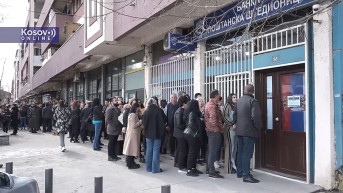
Truth be told, during the transition period, the CBK sent SMS messages to citizens' mobile phones urging them to open euro-denominated bank accounts free of charge, and it also introduced toll-free phone lines and email for complaints. However, the queues in front of branches and ATMs of the Postal Savings Bank where dinars can be withdrawn have not diminished.
Economist Mihailo Gajic says that the Foreign Exchange Law and other monetary regulations do not allow Serbia to make payments to Kosovo in any currency other than the dinar because the territory of Kosovo and Metohija is considered part of Serbia even though it is not administered from Belgrade.
In order for Serbia to be able to make payments in euros to Serbian institutions in Kosovo, as Gajic explains, these regulations would need to be changed so that Kosovo is included in international payment transactions as an option where payments can be made in euros.
"The National Bank of Serbia would have to negotiate with the Central Bank of Kosovo to establish a mechanism for converting dinars into euros and euros into dinars when making payments between each other, and this is a political rather than an economic issue. The NBS has such payment systems with all neighboring countries. Therefore, existing solutions should be applied, but it is also necessary to change Serbia's legal framework," Gajic says for Kosovo Online.
However, he points out that previous agreements from the dialogue envisaged resolving the issue of financing Serbian institutions in Kosovo after the establishment of the Community of Serb-majority Municipalities, but with a unilateral decision by Pristina, it was "resolved" before the formation of the CSM.
"This was done in a way that is legally questionable, but de facto, Kosovo has the right to decide what their national currency is, just as the dinar is the legal means of payment in Serbia," Gajic says.
Apart from legal regulations in Serbia, he also mentions that there is a problem in Kosovo because a large part of Serbian institutions often operate outside the framework of Kosovo institutions.
"Kosovo does not recognize them because they are not registered in accordance with their laws. In order to officially receive money into your bank account, if you are a school or a health center, you need to have a foundation, meaning you must be established within the administrative framework of Pristina. And this step needs to be resolved. So even if Serbia starts paying in euros, which I think will be the final result of any negotiations that will take place, there may still be some problems in that payment process," Gajic says.
The solution to the situation, according to the assessment of the former Secretary General of the Association of Serbian Banks, Vladimir Vasic, should be sought through dialogue at a technical level without entering the zone of de facto recognition of the Central Bank of Kosovo and the territory of Kosovo as an independent state.
As Vasic says for Kosovo Online, there is never enough time for adaptation, and everything has been done hastily.
"For me as an economist, banker, this all came at once. Of course, the euro has been there since 2001, 2002, when the German mark was replaced, so it's not surprising, but it's not a way to change a whole system overnight, without knowing what needs to be done, or at least without us on this side having enough information about what could be done for people to receive their money. 'It is easiest' to cut something off, but on the other hand, we see how people cannot access their money and cannot live. Time is ticking away, and we need a solution as soon as possible," Vasic says.
In this whole matter, as he says, there are two dimensions – political and human, or how to help people in Kosovo receive their earnings, whether in euros or dinars.
"We would certainly prefer them to be dinars because the territory of Kosovo is an integral part of Serbia. However, we see that people in Kosovo have problems getting dinars. A way should be found at least at a technical level for individuals to receive what they are entitled to, whether by our state depositing euros into an account and then our people withdrawing the money. For the elderly, the solution might be something like cards, for them to receive them and for the account to be linked to an account somewhere in central Serbia, although for these elderly people, the problem would probably be how to pay with cards," Vasic says.
The second dimension, he adds, relates to how the National Bank of Serbia can establish communication with the CBK at a technical level because "this is where the solution lies in how to implement this in practice."
Vasic also believes that transferring money for public enterprises and institutions receiving money from the Serbian budget will be a greater challenge than for individuals because it is questionable whether these institutions would have to register with the Kosovo Business Registration Agency.
Professor at the Center for Geopolitics at the University of Cambridge, Timothy Less, says for Kosovo Online that he does not believe that the ban on the dinar in Kosovo fundamentally undermines the position of the Serbs living in Kosovo who can use euros and continue to live their lives more or less as before, provided that Serbia is willing to pay pensions and social assistance in euros, which he believes it is in a position to do.
"This issue is not so much the practical one, because I think there is a solution; it is more a matter of Serb resentment to accept Kosovo's move, which on a symbolic level sends a message that Kosovo is not a part of Serbia, and the proof of this is that Kosovo does not use the dinar, which is of course not something that Serbs accept, particularly not the Serbs living in northern Kosovo who want to remain part of Serbia and still see themselves as a part of Serbia," Less says.
According to Pristina analyst Azem Vllasi, Serbia converting the amount of dinars it provides for the Serbs in Kosovo into euros would not be a problem. In his view, the Serbs living in Kosovo benefit more from the euro, which is used for all their life needs, than from the dinar.
"The story regarding the dinar is being used by both sides for other purposes. Specifically, Vucic is not in a hurry for dialogue because he does not want the implementation of the Agreement from February 27 and the Annex from Ohrid of March 18, 2023. Brussels has been informed about this, namely Josep Borrell and Miroslav Lajcak, through an official letter from Prime Minister Ana Brnabic. And Prime Minister Albin Kurti finds it convenient to avoid the formation of the Community of Serb-majority municipalities that Vucic would want," Vllasi stated for Kosovo Online.
He adds, "If Vucic really cares about Kosovo Serbs, there should be no hesitation about the dinar."
"But he finds it more important to use the issue of the dinar for pressuring international factors on Kurti than to address the actual interests of the Serbs in Kosovo," Vllasi believes.
Due to the decreasing presence of the dinar in Kosovo following the decision of the CBK, as Kosovo authorities have twice banned the entry of dinars into Kosovo in the past month, the Postal Savings Bank has set up makeshift branches near the Jarinje, Brnjak, Konculj, and Merdare crossings on the Serbian side so that their clients can have closer access to tellers and ATMs and avoid having to travel to branches in Raska, Novi Pazar, Kursumlija, or Vranje to withdraw their earnings.

comments