
Ambassadors in the UN Security Council: The decision of the Central Bank of Kosovo raises concerns
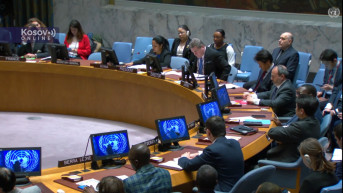
Ambassador Linda Thomas-Greenfield of the United States at the United Nations called on Kosovo to immediately postpone the decision of the Central Bank to ban the dinar. She also pointed out that the United States believed that the place to resolve the issues between Kosovo and Serbia was through dialogue, mediated by the EU, rather than the UN Security Council.
She emphasized that the United States remained committed to peace and stability in the Western Balkans, including support for the KFOR mission in its full mandate.
She added that the goal of the United States, along with European partners and other interested parties, was to foster democracy, economic integration, multi-ethnic societies, and the rule of law.
"We urge Kosovo and Serbia to refrain from uncoordinated actions that contribute to escalation and call on them to return to the dialogue mediated by the EU, which we strongly support," Thomas-Greenfield said.
She stated that it was clear to the United States that the dialogue mediated by the EU, not the Security Council, should be the place to address issues in order to progress on the path to normalizing relations between Kosovo and Serbia, including solutions that respected all communities.
She highlighted Washington's concern over the decision of the Central Bank of Kosovo regarding the regulation of financial transactions, as it was made without preparation and consultation with the local population.
"Once again, we call for the decision to be immediately postponed until European standards are ensured and the practice of good governance is applied, and until the population is adequately educated," she said.
She also pointed out that the suspension of the distribution of payments and social benefits from Serbia must be minimized until the transition period was completed, and urged the Serbian Government to cooperate in this regard.
She criticized Kosovo for the Kosovo Police raids on the offices of institutions supported by Serbia in municipalities in western Kosovo, as well as on the premises of a non-governmental organization for peace and tolerance in Pristina.
She also pointed out that attention should be drawn to the fact that threats to stability in Kosovo came from "outside".
She condemned, as she said, the coordinated violent action of a Serbian paramilitary organization against the Kosovo Police in Banjska, which "resulted in the tragic death of a police officer".
She called on Serbia to uncover and punish the perpetrators and those responsible for the attack so that such incidents would not be repeated.
Representative of the Russian Federation, Dmitry Polyanskiy, pointed out that in addition to the conflict between Israel and Palestine, there was a danger of another hotspot emerging in the Balkans, where in Kosovo, Pristina was implementing a regime against ethnic Serbs, whom Kurti had just labeled as terrorists and criminals in the hall where the session was being held.
"The survival of the Serbs in Kosovo is directly threatened," Polyanskiy said, adding that Pristina and the Pristina regime were terrorizing them to create unbearable conditions for the Serbs to live and ensure that they leave their homes forever.
He pointed out that the West, namely the US and the EU, were ignoring the actions of the Pristina institutions.
"As a result of Pristina's actions, about 14% of the Serbs have left Kosovo and Metohija," Polyanskiy said.
Regarding the decision of the Central Bank of Kosovo to abolish transactions in dinars, he says that it is illegal and criminal and serves to make life difficult. It is not an economic but a politically discriminatory measure.
"As a result, new tensions could arise in the Balkans," Polyanskiy said.
He points out that violence against the non-Albanian population is increasing in Kosovo, against their property, and that there is a campaign to rewrite history and attempt to Albanize the cultural and religious heritage of the Serbs.
Another shocking thing, as he notes, is that Pristina has not formed the Community of Serb-majority Municipalities for 11 years, as it committed to do so in the Brussels Agreement.
He also recalled the bombing of the FR Yugoslavia in 1999 and the use of uranium.
"In order to understand how to achieve lasting peace in this Serbian territory, we must understand the aggression of NATO almost 25 years ago, which resulted in casualties and long-term damage to people's health, which former Secretary of State Madeleine Albright referred to as collateral damage," Polyanskiy said.
He emphasizes that today the US openly talks about arming Kosovo with Javelin missiles, which, as he notes, is contrary to Resolution 1244.
He called on everyone to take urgent measures to stop the terror against the Serbs in Kosovo and to respect Resolution 1244.
The diplomatic representative of Great Britain called on Serbia and Kosovo to avoid unilateral actions and to progress in the dialogue.
"Next week marks the 19th anniversary of Kosovo's independence. Great Britain welcomes the progress Kosovo has made as a sovereign state. The lack of normal relations between Kosovo and Serbia has consequences for regional stability and communities in both countries," he emphasized.
He said that the current tensions showed the need to engage in dialogue and progress towards normalization of relations.
Great Britain, as he emphasized, would continue to support achieving that goal.
"To achieve this goal, it is crucial for Kosovo and Serbia to avoid unilateral actions and to implement agreed agreements. Kosovo should exercise its sovereign rights in a manner consistent with the constitution and the commitment to multi-ethnic democracy," he stated.
He pointed out that the Kosovo authorities, in implementing the regulation of the Central Bank of Kosovo, should have a clear plan on how to ensure that Serbs continue to receive their salaries and key services until a permanent solution is found.
Great Britain called on Serbia to ensure that those responsible for Banjska were brought to justice.
He emphasized the need to create an environment that would enable further progress in the dialogue.
The diplomatic representative of Malta, the country chairing the OSCE, emphasized that the decision to ban the dinar and to close Serbian institutions such as the Center for Tolerance and Peace had caused concern.
He stressed that unilateral measures without consultation, which directly affected minorities and destabilized the situation, must be avoided.
Malta called on both sides to avoid escalating tensions and to refrain from unilateral actions.
"Positive steps leading to reconciliation and good neighborliness are necessary. Normalization of relations is the only way to ensure peace and dialogue is crucial in this regard. Progress would have a positive effect on the Western Balkans," he emphasized.
Malta called on both sides to respect and implement the agreements reached.
In this regard, it was emphasized that the establishment of the CSM was an important instrument in the normalization of relations, adding that progress was expected in the coming months.
The diplomatic representative of China emphasized that the decision to ban the dinar and to close institutions, as well as violent searches in the north, were unilateral actions that had enormous negative consequences for the Serbs.
China, he added, was very concerned.
They called on the Central Bank of Kosovo to withdraw its unjustified measures, and Kosovo to abandon unilateral actions in order to restore normalcy for the Serbian community.
"Unilateral actions do not contribute to resolving the Kosovo issue, nor do they contribute to regional peace and stability. We support the parties in their efforts to achieve an acceptable solution within the framework of dialogue. The sovereignty, independence, and territorial integrity of Serbia must be respected," the diplomatic representative of China emphasized.
He stressed that tolerance, reconciliation, and harmonious coexistence would be beneficial for all parties and that confrontation did not contribute to that.
China called on the parties to find a solution through a pragmatic approach.
The President of the UN Security Council, Guyana, called for the continuation of dialogue in favor of regional stability.
"We are concerned about recent events in Kosovo and the possible consequences for the lives of the Serbs. It is imperative that all parties act responsibly while respecting the rights of all. We welcome the EU's efforts to mediate the dialogue and believe that this mechanism is crucial for finding a final solution that can enable peaceful coexistence," the Ambassador of Guyana stated.
She encouraged progress in the dialogue, adding that she was concerned about the stagnation and non-implementation of the agreements reached.
"Guyana supports a multi-ethnic Kosovo that will become a full member of the multilateral global system, which can only be achieved through dialogue and respect for the rule of law," she stated.

comments