
Daily progress and “behind-the-scenes” developments: What does Sørensen consider a success in the dialogue?
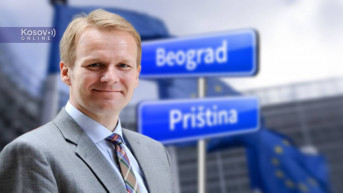
For the EU Special Envoy for the Belgrade–Pristina Dialogue, Peter Sørensen, tangible proof that the dialogue is working lies in the fact that “every day, people, vehicles, and goods move freely between Kosovo and Serbia,” as well as that “people pay for the energy they consume under agreed conditions,” while many things are being resolved “behind the scenes.”
Interviewed by Kosovo Online, analysts assess Sørensen’s statement as an attempt to present the dialogue process as a success under his leadership, while noting that the Community of Serb-majority Municipalities (CSM) will be the first issue on the agenda for Kosovo’s new government.
Written by: Milena Miladinovic
Since assuming the role of EU Special Envoy for the Belgrade–Pristina Dialogue, Sørensen has met three times in Brussels with the chief negotiators of both sides — Petar Petkovic for Serbia and Besnik Bislimi for Kosovo. The first meeting took place on 2–3 July, when Sørensen announced that a trilateral meeting would soon follow.
Just a week later, the first trilateral meeting was held, where it was agreed that the talks would continue.
The discussions resumed on 11 September. The conclusion from both sides was that there had been no significant progress, while the EU reiterated that it expected a final outcome in the normalization process.
Apart from meetings in Brussels, Sørensen has visited both Belgrade and Pristina multiple times — most recently, in Kosovo, away from the public eye.
Although both Belgrade and Pristina have stated after each Brussels round that no substantial progress was made, Sørensen told Italy’s Nova agency that normalization of relations between Kosovo and Serbia is not a one-time outcome achieved after a meeting, but a continuous process unfolding every day.
According to him, a large part of that process takes place “behind the scenes.”
Opinions Divided on Sørensen’s Statement
Reactions to Sørensen’s remarks are mixed.
Assistant Professor at the Faculty of Law, University of North Mitrovica, Duško Celic, called the statement “boastful” and lacking substance, while analyst Shkëlzen Maliqi pointed to the role of working groups that deal with technical and disputed issues.
Celic told Kosovo Online that Sørensen’s comments appear to be an attempt to portray the dialogue as a successful process under his leadership.
However, he warned that if it is true that much is happening “behind the scenes,” then there should be concern about the lack of transparency in the dialogue process.
“If what Mr. Sørensen says is true — that things are happening behind closed doors — then we all have reason to be worried. That would mean a lack of transparency in the negotiations, implying that some decisions might catch us by surprise,” Celic said.
He added that Sørensen’s intent seems to be to “present the Brussels process as successful and his own leadership as effective.”
“We all know, unfortunately, that the process has reached a dead end for several reasons — first, due to the political crisis in Pristina, and second, because of Pristina’s unilateral moves. Therefore, I would interpret his statement as a form of self-praise without substance,” Celic concluded.
The CSM as the First Obligation of the New Kosovo Government
Analyst Shkëlzen Maliqi said that the new Kosovo government’s first obligation in relation to the dialogue with Belgrade will be the establishment of the Community of Serb-majority Municipalities (CSM). He interpreted Sørensen’s statement about things happening “behind the scenes” as a reference to technical working groups resolving outstanding issues.
“Two years ago, the entire package of agreements was ready. Some details were still unresolved, but both the Ohrid and Brussels Agreements outlined a gradual, package-based path toward solutions. There was little left to finalize, and the working groups were likely addressing remaining issues — for example, concerning missing persons. Around 40 agreements are either being implemented or ready for implementation,” Maliqi told Kosovo Online.
According to him, the key issue remains the CSM, which has long been the main point of contention. Maliqi said Sørensen views the CSM and its founding agreement as a done deal — only awaiting implementation by both sides.
“That’s where the real dispute lies, but there is already an agreement in place. The EU believes it simply needs to be implemented. However, because of elections in Serbia — and now in Kosovo — the process was postponed. This delay suited both Vucic and Kurti. Kurti didn’t want to form the CSM while in power since he had opposed it for ten years. The first task of the new government will likely be to begin implementing that agreement. In that sense, Sørensen’s statement implies that it’s a finished matter — it just needs to be enforced,” Maliqi added.
The Role of the EU and the U.S. in the Dialogue
Maliqi believes that the EU may still be determined to “push the dialogue forward,” and that there is plenty of material for negotiation and resolution.
“We see the EU pushing processes forward — in Bosnia, Montenegro, and across the region. There might be some reason for optimism. Everyone says the dialogue has failed, but I believe there’s enough groundwork to continue negotiations and bring them to a close. It won’t be ideal, but it will be better than the current state,” he concluded.
On the other hand, Celic argued that the EU has lost credibility, and that tangible results in the Belgrade–Pristina dialogue can be expected only when the United States re-engages.
“The EU has lost credibility — not only in leading the Brussels process between Belgrade and Pristina but more broadly. The Union is preoccupied with the war in Ukraine, so we simply have to wait. Whether we’re waiting for Godot or for the United States, we’ll see. The truth is, negotiations have always taken place under U.S. influence — all major agreements were reached with Washington’s involvement. I expect results only once the U.S. becomes actively involved again. From the EU, Serbs in Kosovo and Metohija cannot expect anything positive or concrete at this moment,” Celic concluded.
Celic’s position aligns with that of Michael Carpenter, Senior Director for Europe at the U.S. National Security Council and former Deputy Assistant Secretary of Defense for Russia, Ukraine, and Eurasia, who is equally pessimistic about the prospects for progress.
According to Carpenter, the EU and the U.S. are currently on different sides, making it very difficult to bring the dialogue back on track.
“I think in the past we had a real opportunity to steer the dialogue — not toward mutual recognition, but toward normalization of relations between the two sides. Unfortunately, I don’t think diplomacy has been particularly skillful. I’m thinking especially of spring 2023, when the U.S. and EU were loosely aligned, but now I believe they are on opposite sides — which means it will be very difficult to restore the dialogue to a productive path,” Carpenter emphasized.


comments