
Defense of Thaçi and other former KLA leaders in The Hague: What can the “big names” testify to?
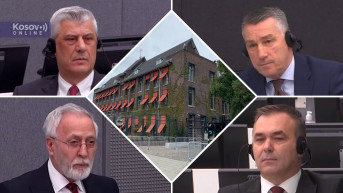
Before the Specialist Court in The Hague, the defense of former KLA leader Hashim Thaçi will begin presenting evidence tomorrow. One of the defense witnesses will be James Rubin, former aide to then–U.S. Secretary of State Madeleine Albright, and Thaçi’s lawyers have previously mentioned Wesley Clark, Bernard Kouchner, William Walker, among others, as possible witnesses. These former international officials could testify about their perception of the KLA’s role—subjective value judgments—but they will not shed light on the facts regarding the specific crimes the accused are charged with, Kosovo Online’s interlocutors assess.
Written by: Dusica Radeka Djordjevic
In the “Thaçi and Others” case, the prosecution completed presenting its evidence in April, and now it is the defense’s turn.
According to media reports, Thaçi’s defense obtained permission for several American witnesses, as well as a witness from the United Kingdom.
The four former KLA leaders—Hashim Thaçi, Kadri Veseli, Rexhep Selimi, and Jakup Krasniqi—are charged on the basis of individual criminal responsibility with crimes against humanity: persecution, imprisonment, other inhumane acts, torture, murder, and enforced disappearances, as well as with war crimes: unlawful and arbitrary deprivation of liberty and detention, cruel treatment, torture, and murder.
According to the indictment, these crimes were committed between March 1998 and September 1999, in several locations across Kosovo, as well as in Kukës and Cahan in northern Albania.
So far, 127 witnesses have testified: 125 prosecution witnesses and two victim representatives, while 137 witness statements were admitted in written form.
One protected witness testified before the court that the KLA arrested, detained, and mistreated him in the winter of 1998 because he was an official of Ibrahim Rugova’s party. Another said he was tortured by KLA officials and held in Albania for more than two months, beaten three times and stabbed; a third testified that KLA members tied him up and beat him with wooden sticks and chains all over his body.
What might be heard in The Hague from former international officials testifying for the defense?
If the witnesses include previously mentioned figures such as Wesley Clark, the American general who led NATO’s air campaign against the FRY, Bernard Kouchner, former head of UNMIK, or William Walker, former head of the OSCE Verification Mission, lawyer Amer Alija from the Humanitarian Law Center told Kosovo Online that their testimonies could be significant in several respects: to present the context of the conflict and the perception of the KLA’s role at the time, to highlight international community views on the KLA’s command structure, and to confirm possible contacts and cooperation between the accused and international representatives.
As NATO, UNMIK, and OSCE representatives, Alija explained, they had a broad picture of the political, security, and humanitarian circumstances in Kosovo, and the court will assess the relevance and weight of these potential witnesses differently from those who can testify about the actual events on the ground.
Attorney and former military prosecutor Dragan Pasic believes that any testimony from Clark, Kouchner, or Walker will not contribute to clarifying the facts, since they lack direct knowledge of how the KLA functioned and the role of the four accused in crimes against humanity with which they are charged.
“It is expected that they will stick to their reports and the information already known to the public, so they cannot provide direct observations like the prosecution witnesses and the families of victims did. I think their testimony will not contribute to clarifying the facts, but of course the defense has the right to request it, and the court accepted the proposal because international legal standards, as well as applicable Kosovo laws under which the four are being tried, grant the defense the right to propose evidence,” Pasic told Kosovo Online.
If former NATO, UNMIK, and OSCE representatives do appear as defense witnesses, Pasic believes they will testify in person in court.
“This will ensure adversarial proceedings, meaning that the prosecution, not only the defense, has the right to question them. There is direct and cross-examination, and then a full picture of their knowledge about the crimes the four are charged with emerges,” Pasic noted.
Neither Pasic nor Dusko Celic, an assistant professor at the Faculty of Law in North Mitrovica, expect a large number of defense witnesses in this case.
Celic told Kosovo Online that “the defense is in a hurry” because the accused have been in detention for several years, and he believes the defense’s interest is to conclude the case as soon as possible.
“I also assume that from their point of view, they believe the verdict will be an acquittal. So I don’t expect a large number of defense witnesses; rather, I would expect a handful of international, former, active, or retired officials to appear as defense witnesses who would, so to speak, overshadow the facts and reality with their titles. I assume that is the defense’s tactic here, rather than a large number of witnesses,” said Celic.
Celic said he does not see what procedural value Clark, Kouchner, or Walker’s participation would have in this case, apart from giving general statements in favor of the accused.
He added he is not sure how credible they would be as witnesses for several reasons.
“With their activities, first during the NATO aggression and even before, they sided with the so-called Kosovo Liberation Army and with the Albanian separatists. Particularly their actions after the NATO aggression—and here I especially point to William Walker, his regular visits to so-called Kosovo and highly biased statements on various events—show that if the court were to accept the defense’s request for them to testify, they would not be credible witnesses because they openly took one side. Their statements are not statements of fact but extremely subjective value judgments in favor of one side,” said Celic.
He specified that the first procedural obstacle to their being witnesses is that their past conduct shows they are not credible.
“Second, from the positions they held at the time, they could not have had insight into what the accused in this case were doing, or what the KLA forces were doing, which crimes they committed, where the camps were, who was in those camps, and what crimes were being committed systematically and on a large scale at the time,” Celic said.
Attorney Artan Qerkini told Kosovo Online that under the rules of procedure and evidence, once the prosecution concludes its case, it is the defense’s turn to present its theory through its witnesses, which is what Thaçi’s defense has done.
“They called nine witnesses through whom they seek to convince the court that Mr. Thaçi was not part of any joint criminal enterprise,” said Qerkini.
Given that former U.S. Secretary of State Madeleine Albright, who had been mentioned as a possible witness, has since passed away, Pasic explained that in such cases it is possible that her statement was taken earlier.
“If the statement of a deceased person was lawfully obtained, either by the defense or the prosecution, then such a statement can be presented to the court, which decides whether it will be admitted as evidence. In any case, such a possibility exists,” he explained.
0 comments