
Disagreements between the Presidency and the Government of Kosovo: Dispute over the Community of Serb Municipalities or a power struggle?
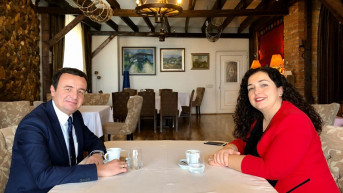
Disagreements and differing stances on important issues are a common occurrence in the communication between the Presidency and the Government of Kosovo. One of the contentious issues between Prime Minister Albin Kurti and President Vjosa Osmani is the draft of the Association of Serb Municipalities (CSM). The latest incident of this "noisy cacophony" occurred when Foreign Minister and Diaspora Donika Gërvalla sent a letter of guarantee to the Parliamentary Assembly of the Council of Europe (PACE) before the vote on Kosovo's membership in the Council of Europe, a letter Osmani was not aware of. Political observers believe that the "conflict" between Kurti and Osmani has been ongoing for some time, and within Kosovo's political circles, the question arises whether Osmani is still "needed" on the Kosovo political scene.
Despite Gërvalla's letter to the Parliamentary Assembly of the Council of Europe, in which it was emphasized that Kosovo would send the draft CSM to the Constitutional Court by the end of May, the Council of Europe's ministers did not approve Kosovo's membership.
After the voting results, the draft CSM was not sent to the Constitutional Court for review, leading to another conflict between the leaders of Kosovo's institutions.
Specifically, the President of the Assembly of Kosovo, Glauk Konjufca, stated that Osmani was not informed about the letter's dispatch because she was not in Kosovo at the time. Osmani called Konjufca's statement ridiculous, given that modern times offer many communication methods, such as phones.
Kurti took more time to speak about his relationship with Osmani, waiting a week after her statement to say that he has a close cooperation with her, that discussions and disagreements on political views are normal, but the differences are not insurmountable.
While Kurti talks about close cooperation, political observers believe that the conflict between the two leaders has been ongoing for a long time, and that sending the letter to PACE only culminated it. They emphasize that Kurti's and Osmani's opinions differ mainly on the CSM issue and the approach to the international community, but also that Kurti is "aiming" for the presidential position.
Demo Berisha, President of the Association of Albanians in Serbia, told Kosovo Online that the conflict between the Kosovo Government and the Presidency began with Kurti's visit to the United States and the refusal of American officials to meet with him.
"The conflict between Kurti and Osmani has been ongoing for a long time, ever since Kurti's fiasco in America when none of the officials received him. Kosovo President Vjosa Osmani represents foreign policy and has undertaken certain obligations on behalf of the Kosovo Government and herself towards the US Government to change certain things Kurti is doing. It is well known that he invents certain situations daily, from administrative to physical attacks on Serbs. We see this every day, and Osmani, at the request of the Americans, tried to mitigate this relationship," Berisha said.
By sending the letter to PACE, Berisha points out, Osmani realized that she is no longer on the same line with her political partners regarding Kosovo's foreign policy.
"The culmination occurred during the vote in the Council of Europe when Kurti's government, through the ministry, sent a letter of guarantee. This was done while Osmani was not in Kosovo, leading her to conclude that they are no longer aligned on foreign policy," Berisha emphasized.
Osmani, by leaving the Democratic League of Kosovo (DSK), took a certain number of voters with her, leaving no room to return. Now, Berisha adds, she has also come into conflict with members of the Guxho party she formed, such as Donika Gërvalla and Faton Peci, indicating that she might retire from politics after her presidential term ends.
Political analyst Artan Muhaxhiri believes that Kurti and Osmani wanted to present a harmonious image upon taking office. According to him, this was not possible as they come from different backgrounds.
"At the beginning, Prime Minister Kurti and President Osmani wanted to show that they were 100 percent in harmony and working together, but of course, this was artificial because they come from different backgrounds. Now these divisions have become much more visible. I think the most important division is in relations with the international community. Prime Minister Kurti has a more radical approach to dealing with the international community, the United States, and the most important EU member states such as Germany, France, and Italy. President Osmani has a more realistic and pragmatic approach," Muhaxhiri said.
Another significant division between Kurti and Osmani is over the draft of the Association of Serb Municipalities, according to Muhaxhiri.
"Especially when it comes to the Association of Serb Municipalities, there is a big difference. The Prime Minister had the opportunity to send the draft to the Constitutional Court but did not do so. President Osmani was more in favor of this step and Kosovo's entry into the Council of Europe, and I think that is the most significant division," added Muhaxhiri.
He emphasized that Osmani, upon joining the Self-Determination Movement, brought her voter base with her, so a conflict with Kurti, as the party's leader, could mean a loss of 300,000 votes for the Self-Determination Movement, which Osmani secured in the presidential elections.
"When President Osmani, as a politician, joined the Self-Determination Movement, she brought her votes with her. That's why she received 300,000 votes, while the DSK received 12.7 percent. It is clear that she took votes from the DSK and sent them to the Self-Determination Movement. Those are her votes, so if she is not on good terms with the Self-Determination Movement, those voters will not vote for that party again," Muhaxhiri emphasized.
Kurti and Osmani projected the image of a young generation of leaders ready to cooperate, says Muhaxhiri, adding that their conflict damages their image and disappoints their voter base.
"There is also a significant problem with Kurti's image, as well as the relationship between Kurti and Osmani. After the 2021 elections, they created the image of young leadership, a new generation of leaders who are more constructive and willing to cooperate with each other compared to the older generation. Now, the same thing is happening to them. This will be a big disappointment for voters in Kosovo, as they hoped for a new step forward, a new era of political leadership. This conflict brings them back to the mediocre political games we have seen over the past 25 years," concluded Muhaxhiri.
Ognjen Karanovic, an analyst at the Center for Social Stability, believes the conflict between Kurti and Osmani arises from Kurti's ambition for the presidential position, and that it is being reconsidered whether Osmani is needed in the new government after the elections.
Karanovic emphasizes that political parties in Kosovo do not have autonomy in making important decisions, as the strategic policies of all political parties are designed by Western countries.
He adds that the Guxho party, formed by Osmani, lacks political significance, which is why the President of Kosovo is moving closer to the stances of the DSK, of which she was once a member.
"Let's not think that they are fighting over substantial issues. Absolutely not. Whether it’s the Self-Determination Movement, Guxho, the DSK, or the DPK, their strategic policies are designed by Western countries. They do not have special autonomy in the decision-making process. But we must be aware that general elections will be held next February. There will be new positioning and the creation of a new constellation of political relationships. Guxho is essentially a splinter group from the DSK. Osmani is moving closer to DSK positions again because Guxho is an insignificant partner for Self-Determination and lacks political strength. It has no foothold in the electorate, its political strength is minor, and it will perform poorly in the elections," Karanovic stated.
He believes Kurti "dreams" of the position of Kosovo President.
"Given his maniacal political profile, he likely dreams of the position of President of so-called Kosovo and even dreams of being the leader of all Albanians, replacing Edi Rama," he adds.
Although the Presidency and the Government of Kosovo cite technical details as reasons for the strained relationship, Karanovic points out that the essence of the Kurti-Osmani conflict is not about the CSM but is of an internal nature.
"Osmani is trying to position herself within the American diplomatic framework as an important political factor. Even the Americans have indicated that she is a guarantor of stability for so-called Kosovo. The main issue is not the CSM; neither Osmani nor Kurti want it, and the political West does not genuinely want it either. Let's not deceive ourselves into thinking that Kurti is a significant political factor who can resist the will of his mentors who created him. This is an internal power struggle over who will be in power and whether Osmani will be needed in that power structure after February 2025 or not," concluded Karanovic.


0 comments