
Does the EU have multiple foreign policies, on whose behalf does Von der Leyen speak?
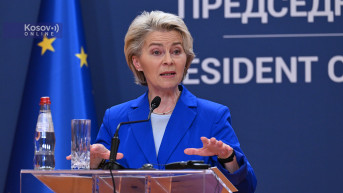
In official documents of the European Commission, Kosovo is marked with an asterisk and a footnote explaining that its status is not prejudiced, however, during her visit to Belgrade and Pristina earlier this week, the President of the European Commission, Ursula von der Leyen, called on Serbia to accept the de facto recognition of Kosovo. If this suggestion had come from an official of an EU member state that recognizes Kosovo, it wouldn't be surprising, but, coming from the President of the European Commission it raises questions about whether she was also speaking on behalf of the five EU members who do not recognize Kosovo, and whether the EU has multiple foreign policies.
Just a few days before Von der Leyen's statement, in the conclusions of the EU Council of October 27 related to Kosovo and Serbia, Kosovo was marked with an asterisk and a footnote. Also, when the Prime Minister of Kosovo, Albin Kurti, attended a meeting of the Stabilisation and Association Council in Brussels with the highest European leaders, there was a sign in front of him that read "Kosovo", but with an asterisk.
The interlocutors of Kosovo Online suggest that Serbia has the right to question whether Von der Leyen's statements went beyond the given framework. However, they also remind that the EU Council, which includes all EU countries, even those that do not recognize Kosovo, accepted the Franco-German proposal, which is controversial for Serbia in some aspects, as a European proposal.
Political analyst Ognjen Gogic stated for Kosovo Online that it was questionable on whose behalf the President of the European Commission, Ursula von der Leyen, had acted when she had demanded that Serbia de facto recognize Kosovo, knowing that five EU member states did not recognize Kosovo's independence.
"Ursula von der Leyen is the President of the European Commission, but she is also a German politician, and Germany has its own policy regarding Kosovo. Additionally, she comes from the CDU, Christian Democratic Union, which actually formulated the idea of de facto recognition and the normalization agreement, which essentially means de facto recognition. So, it is a question in what capacity she was speaking and whether she may have exceeded her authority as the President of the European Commission", Gogic says.
He believes that Serbia has the right to raise this question.
"Serbia can indeed raise this question: whether she has gone beyond the frameworks given to her. However, it should be noted that in February, the European Council accepted the Franco-German proposal as a European proposal. Therefore, the European Council, which includes all EU countries, both those that recognize and those that do not recognize Kosovo, accepted this Franco-German plan as a European proposal to resolve this issue", Gogic noted.
Our interlocutor explains that this should be interpreted in two ways.
"On the one hand, it is still a fact that EU countries that do not recognize Kosovo would not object if Serbia decides to change its policy. Spain, Greece, or Romania would not prevent Serbia if it chose to change its approach to Kosovo and de facto recognize its independence. However, the question remains whether they would accept this as a condition for Serbia. They have accepted the proposal as a model, as a possibility, but I am not sure that these countries would support this proposal if it were presented as a condition for Serbia to continue its integration, and not only those non-recognizing countries but also Hungary, and even other countries if recognition were to become a condition. In international relations, one state cannot be conditioned to recognize another state. It is the sovereign right of every state, and it would be highly controversial, and I believe it would cause divisions within the EU and among those who recognize Kosovo if it were indeed a condition", Gogic says.
The Franco-German proposal, our interlocutor emphasizes, is more accepted as a possibility, perhaps even an appeal, rather than an official condition.
"It cannot be formulated like that. It is true that in EU documents, Kosovo is still indicated with an asterisk because its status is not prejudiced since the EU cannot recognize Kosovo's status or express whether Kosovo is a state or not. However, if Serbia were to de facto recognize Kosovo, then other non-recognizing states might also do so, and as a result, the EU could change its position if there were a unanimous stance on this issue. That's why it was important for the President of Serbia to send a message that nothing agreed upon implies that Serbia de facto recognizes Kosovo. This is the reason why these other non-recognizing countries have not changed their position so far. So, the position that Serbia does not de facto recognize Kosovo is very clear, and that's why these other non-recognizing states haven't changed their position" Gogic says.
As he adds, the original idea behind the Franco-German proposal, or the Brussels-Ohrid Agreement, was to use it as a mechanism for lobbying non-recognizers to recognize Kosovo, and if Serbia accepted the agreement, they would change their position, recognize Kosovo, and Kosovo would potentially join NATO.
"I think that the danger of that happening has been averted. If it were to happen, it would have already occurred in March. Now, the whole European proposal has lost its point, so new recognitions are not expected", Gogic concludes.
Despite the fact that some EU member states do not recognize Kosovo's independence, the expectations articulated by Ursula von der Leyen during her visits to Pristina and Belgrade, including that Serbia de facto recognizes Kosovo, were expressed on behalf of the entire European Union, a political analyst Dimitrije Milic assesses for Kosovo Online. He says that this is not unusual, as non-recognizing EU member states also support the Franco-German proposal.
"When we say de facto recognition, it predominantly refers to the recognition of documents and institutions, not recognition at the intergovernmental level. The Ohrid Agreement is supported by states that do not recognize Kosovo, ultimately including Josep Borrell, the High Representative of the EU for Foreign Affairs and Security Policy, who comes from Spain, which has not recognized Kosovo, as well as Miroslav Lajcak, the Special Representative for the Belgrade-Pristina dialogue, who comes from Slovakia", Milic says for Kosovo Online.
He explains that the proposed solution via the Franco-German Agreement and the Ohrid Annex is actually the result of an agreement among all EU member states, including those that do not recognize Kosovo's independence.
"The solution you receive from the EU towards Serbia is a solution endorsed by all member states. Of course, to take more decisive steps within the EU, consensus in the European Council is needed, which is not easy to achieve. However, the solution found in the Ohrid Agreement is one that can, in a way, reconcile all interests within the EU on this issue. As long as you don't have open recognition, it can somehow work for countries like Greece. Ultimately, some countries that do not recognize Kosovo as an independent state, such as Slovakia or Greece, in a practical sense behave as if it were an independent state in terms of documents or investment on that territory. That's why the European Union also has certain expectations from Serbia, but not much more than that", Milic concludes.

0 comments