
Does the tension between Athens and Tirana complicate plans for Pristina or could it be beneficial?
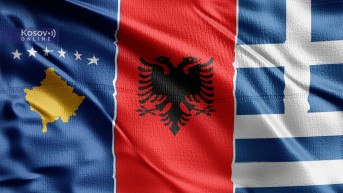
The eyes of Pristina have been focused on Greece for quite some time, often seeing it as the weakest link among the five European Union member states that do not recognize Kosovo. At the same time, tensions for months between Athens and Tirana have given rise to speculation that Greece, through the Kosovo issue, could negotiate a resolution to the problems it has with Albania.
The case of the arrested Greek mayor of the Albanian town of Himara led to Greece blocking the European Union negotiation process with Albania. However, sources speaking to Kosovo Online, knowledgeable about political processes in Greece, say that this issue will not affect the Kosovo issue.
Despite the assessment by Kosovo's Prime Minister Albin Kurti that "Greece is the first on the list of countries approaching the recognition of Kosovo's independence", analysts say there are currently no indications that Greece will recognize Kosovo. It is also unlikely that in the future, Greece will be the first among EU countries to take a step in that direction.
"There are some diplomatic circles in Greece that believe Greece is gaining Albania through Kosovo, both regarding the issue of the Greek minority and determining the exclusive economic zone at sea, which is an open issue with Albania. However, Greece has a clear stance of not recognizing Kosovo's independence, and there are currently no indications that this will change. In my opinion, Greece, regarding Kosovo, will primarily be guided by the results of the dialogue process between Belgrade and Pristina. If there is a serious shift towards normalization of relations, there may be a change in stance, and other countries that do not recognize Kosovo will follow the same principle", Nikos Pelpas, ERT Greek Television correspondent in Belgrade, says to Kosovo Online.
He dismisses the possibility that Greece may be more lenient towards the Kosovo issue to more efficiently resolve open issues with Albania.
"I don't believe there is any leniency. In recent years, Greece has taken many steps to approach Pristina because the prevailing view is that - if Serbia can have trade relations with Kosovo, why not Greece? Greece has never had political or economic relations with Kosovo. Kosovo has had its liaison office in Athens for only two years. Now, the prevailing view is that something needs to change, but I don't believe it will come to the point where Greece separates its opinion from the five EU countries and decides on its own to recognize Kosovo. I have the impression that this decision will depend on Serbia's stance. In other words, if there is complete normalization of relations between Belgrade and Pristina, and if Serbia does not recognize Kosovo, because no one is asking it to officially recognize it, I think then all five countries will recognize Kosovo, but not before the dialogue is concluded", Pelpas says.
The issue of Kosovo, he adds, creates a problem within the EU because if it is not resolved, Kosovo cannot become an EU member "as desired by 22 out of 27 EU member states".
"An entity claiming to be a state cannot be admitted if at least one country does not recognize it. And I do not believe that, if there is no solution between Belgrade and Pristina, Spain or Cyprus, who are firm in their stance not to recognize Kosovo, would accept Kosovo as an EU member. Therefore, I believe the EU is trying to win over Serbia, or 'force' it to directly recognize Kosovo, not de jure but de facto so that even those countries that do not recognize Kosovo would change their stance", Pelpas says.
Regarding Greece blocking the EU negotiation process with Albania, our interlocutor says that such a stance by Greece is based on the assessment that Albania has done nothing regarding the respect for minority rights.
"The Supreme Court in Albania did not allow the elected mayor of Himara, Fredi Beleri, who is in prison on charges of buying votes during local elections, to be temporarily released to take the oath as mayor. What angered Athens is that Edi Rama, two days before the court's decision, stated that Beleri's request would be rejected. And that is a sign to the Greek Government that the judicial authorities in Albania are not independent", Pelpas explains.
Vassilis Nedos, a foreign policy commentator from Athens, told Kosovo Online that, for Greece, the Beleri case was linked to the issue of the rule of law.
"Both sides stick to their positions. Greek Prime Minister Mitsotakis said after the European Council that the Beleri case was not a bilateral issue between Greece and Albania but was linked to the rule of law and the European acquis, while Edi Rama, on the other hand, said that, for his government, this was a bilateral issue that had nothing to do with EU accession negotiations. Greece has no interest in blocking accession talks for Albania, but the rule of law and the respect for the rights of Greeks in southern Albania are very important for the Greek Government", Nedos says.
As for Kosovo, Nedos also believes that Greece's position is very firm.
"There are certainly pressures from partners on Greece, especially Germany and the United States, to achieve recognition of Kosovo, but I would say that Greek recognition of Kosovo is a distant possibility. About a year and a half ago, the Kosovo Trade Office was opened, and the presence of Kosovo in Athens was diplomatically upgraded, but that is the extent of what we can do. As long as countries like Spain or Romania, not to mention smaller ones like Cyprus or Slovakia, do not recognize Kosovo, I am not sure that Greece will take a step towards recognition. I would say that Greek recognition of Kosovo is a distant possibility", Nedos says.
Although Kosovo officials often state that Greece will be the first of the five EU countries that do not recognize Kosovo to take that step, our interlocutor says that he has been hearing this for at least the last five years but that it has not happened yet.
"It is expected that Kosovo officials have such a stance. It is a long way for something like that to happen, and I don't think anything similar is currently imminent. At this moment, I would expect further cooperation between Kosovo and Greece, perhaps in the form of some military exercises within NATO, as Greece is a NATO member and NATO guarantees security in Kosovo. Something like that could happen. Also, there are Greek companies interested in energy projects or economic cooperation with Kosovo, but recognition of Kosovo's statehood is something distant", Nedos is convinced.
Analyst Ben Andoni from Tirana says he does not believe that the problems Greece currently has with Albania can affect the issue of Kosovo.
"The issues of Albania and Greece are something that affects only the relations between our two countries, from the time we established diplomatic relations, then during World War II, in the post-war period, and up to today. I do not believe that the problems Greece currently has with Albania can affect the issue of Kosovo. We are talking about two completely separate issues", Andoni says for Kosovo Online.
He believes that Greece actually wants to play a mediating role between Kosovo and Serbia but without recognizing Kosovo.
"Greece is doing this to gain as much significance in the eyes of Serbia as possible. I believe this applies in all aspects. First, in the economic aspect. Second, in building bridges of cooperation with Serbia since Greece wants to play a mediating role with European Union countries that have a pragmatic attitude toward Kosovo. Third, Greece wants to show its negotiating potential to major geostrategic powers in the East, primarily to Russia, but also to China and India", Andoni states.
Such engagement by Greece, as our interlocutor believes, Kosovo Prime Minister Albin Kurti has used for domestic purposes.
"Kurti used this smart action by Greek diplomacy for domestic use, which is why the Greek President, Greek Prime Minister, and the Greek Ministry of Foreign Affairs had to show their stance on Kosovo so many times and be categorical that Kosovo will not be recognized by Greece", Andoni says.



0 comments