
The elections in Austria – can the rise of the right-wing change the stance on the Kosovo issue?
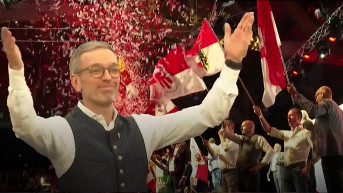
On Sunday, October 29, Austria will hold what many describe as decisive elections, determining whether the country aligns with left or right-wing ideologies. According to polls, the Freedom Party of Austria (FPÖ), a far-right political group led by Herbert Kickl, which opposes Kosovo's independence, has the most support leading up to the elections. While global media describe the elections as a "matter of life or death," analysts for Kosovo Online assess that it is difficult to expect significant changes in foreign policy, regardless of the election outcome.
Written by: Petar Rosic
"Austria is holding what many consider the most important elections of the year, but aside from the turbulent elections in France, there's a good chance you've never heard of them," Politico writes, while The Guardian expresses concern over the potential electoral success of Austria's far-right, headlined "This is the Normalization of Racism."
The main source of concern is the FPÖ, which already won in Austria's European Parliament elections this summer. However, the FPÖ has long-standing ties with Serbia, particularly on the issue of Kosovo.
In a February 20, 2008 article, three days after Kosovo's declaration of independence, the prominent Austrian newspaper Die Presse referred to the then-leader of FPÖ, Heinz-Christian Strache, as a "Serbophile" in its headline.
"Yes, I am a friend of the Serbs," Strache said, holding a prayer rope with an Orthodox cross, reported the Austrian paper.
Fifteen years later, the FPÖ's stance, now under the leadership of Herbert Kickl, remains unchanged.
Three months ago, the party submitted a resolution to the Vienna Assembly demanding that the parliament declare opposition to recognizing Kosovo.
"Kosovo was a part of Serbia and, contrary to international law, was separated from Serbia by NATO's bombing in 1999, and to this day, the majority of states have not recognized it as an independent country. The recognition of Kosovo by the U.S. and European states not only violated Serbia's sovereignty and territorial integrity but also UN Resolution 1244," the FPÖ stated.
In the June European elections, this party even had a Serbian-origin candidate, Konstantin Dobrilovic.
"Serbia must no longer be blackmailed with the Kosovo issue on its path to the European Union, which must be resolved through dialogue, as outlined in UN Security Council Resolution 1244, without imposing solutions," said Dobrilovic before the European elections in early June. He was 11th on the FPÖ's list, led by Harald Vilimsky, and added that Serbia's fight at the UN and its continued advocacy for the rights of Serbs in Kosovo serve as an example for everyone on how to defend citizens' interests.
Just two percentage points behind the FPÖ, with 25% of the vote, according to polls, is the Austrian People's Party (ÖVP).
Gudrun Kugler, chairwoman of the Austrian parliament's Friendship Group with Serbia and a member of the ÖVP, emphasizes that the upcoming parliamentary elections in Austria are of great importance, hoping that citizens will choose the "middle path" promoted by the People's Party.
"Austria has had a strong economic presence in the Western Balkans for many years, with many Austrian companies operating in the region, and we have also been a reliable partner in international missions for decades. In our election platform for the upcoming elections, we have clearly stated our strong support for the European perspective of the Western Balkans," she said in an interview with Kosovo Online.
She adds that Austria is one of the biggest advocates for Serbia's integration into the EU, not only due to geographic proximity but also because of close political, economic, cultural, and, above all, human ties. However, she notes that, like all Western Balkan countries, Kosovo also needs a credible EU perspective.
"Comprehensive normalization of relations between Serbia and Kosovo is essential and a prerequisite for a credible EU perspective. A critical unresolved issue, in my view, is the situation of the Serbian community in northern Kosovo, where the formation of the Community of Serbian Municipalities is necessary to ensure an appropriate level of self-governance for the Serbian community and comprehensive protection of Serbian cultural and religious heritage. In this regard, we have a clear expectation that Kosovo will fulfill its international obligations," Kugler stated.
Political analyst Predrag Rajic believes that regardless of who wins the Austrian elections on Sunday, the country's relations with Serbia will remain cordial.
Rajic told Kosovo Online that the FPÖ has already been part of the Austrian government twice, so it would not be surprising if it joined for a third time, although the chances of such a coalition are slim.
"I think there's now a certain distinction between, for example, the AfD in Germany and the FPÖ in Austria. It seems to me that established parties in Austria, such as the People's Party, view the FPÖ as part of the mainstream. I don't think they see them as an extreme option with which cooperation is impossible under any circumstances. They've collaborated before, and it's not impossible for that to happen again; the outcome of these elections could indeed be a coalition between the Freedom Party and the People's Party. I'm not saying it's certain, but there's a real chance. In contrast to Germany, where I see no theoretical chance of cooperation between the CDU and the AfD after next year's elections," said our interlocutor.
He believes that whoever is in power in Austria in the upcoming period will maintain correct relations with Serbia. He adds that even with the current government, made up of the People's Party and the Greens, Serbia has had good cooperation, despite the fact that within the Greens, as in Germany, there are individuals who are openly pro-Albanian and do not hide their role as Albanian lobbyists.
"This somewhat complicates our relations with Vienna, but I would say that the People's Party has recognized the strength of the Serbian state and all the positive developments Serbia has achieved in recent years, as well as President Aleksandar Vucic's vision. Ultimately, they are aware of his popularity and the success of the Serbian Progressive Party (SNS) in all recent elections. This pragmatism among the Austrians stems from their desire to cooperate with the ruling force in Serbia and maintain decent relations with the country that is the most influential in this part of Europe, given that Austria sees the entire former Yugoslav region as its natural zone of interest, where it is present both economically and politically," said Rajic.
When asked whether the rise of the Freedom Party could influence Austria's stance on the Kosovo issue, he says that such a scenario is unrealistic.
"For that to happen, you would need an absolute majority in the Austrianparliament. I don’t see any willingness among the People's Party to accept something like that, and the Freedom Party won’t win enough to have an absolute majority on its own — that's impossible. They may be the most popular individual party, but they will need to form a coalition with someone. So, while it would be great, and we have worked hard in recent years to make sure our voice is heard in Vienna — with significant contributions from the new ambassador in Vienna, Mr. Blagojevic — we shouldn't raise expectations too high in the public, only to be disappointed later," the political analyst concludes.
Dusan Dostanic from the Institute for Political Studies also does not expect major surprises.
“There shouldn’t be any big surprises; more or less the results from the European Parliament elections will be repeated. This means that the Freedom Party of Austria (FPÖ) will be the strongest with over 20 percent, probably around 27 percent. The second place will go to the People's Party of Prime Minister Nehammer. The Social Democrats will be in third place, followed by the Greens,” Dostanic explained to Kosovo Online, citing poll projections.
On the other hand, he says the question arises about the actual impact of the Freedom Party's victory.
“This is a situation similar to the local elections in Saxony or Thuringia in Germany, or similar to the victory of the National Rally in France. So, individually, the Freedom Party of Austria will be the strongest party, by far the strongest, but it will still be a party unable to form a government on its own. It is very likely that, despite the victory, the party may remain in the opposition at this time,” he stated.
He also notes that the rise of the Freedom Party, which has opposed Kosovo’s entry into international institutions, does not automatically translate into changes in foreign policy or relations with Serbia. He believes that expectations of drastic policy shifts are unrealistic.
"Even if the Freedom Party were to enter the government, it’s questionable whether the party would immediately prioritize the issue of Kosovo or Serbia, given that these are not central topics. The central issue in Austria at the moment is migration, and this is the primary focus of the Freedom Party’s policies. Of course, the Freedom Party has previously shown significant initiative regarding the Kosovo issue, questioning Austria's role and the recognition of Kosovo, just as they insist on Austria maintaining a neutral status in relation to the Ukraine conflict," Dostanic explains.



0 comments