
Elections in Germany: A new balance of power, but the same approach to the Belgrade-Pristina Dialogue?
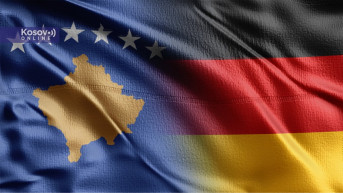
Germany will hold snap parliamentary elections tomorrow, with Friedrich Merz from the CDU being the frontrunner for the next chancellor. However, speculation remains about which parties might join the CDU in the new government. Regardless of the coalition that emerges, experts interviewed by Kosovo Online believe that Berlin will maintain its current approach to the dialogue between Belgrade and Pristina.
The Alternative for Germany (AfD), which opposes Kosovo's independence, is projected to finish in second place, according to polls. While this will allow their voice to be heard more strongly, it is not enough to bring about a radical shift in Berlin’s stance on Kosovo’s status.
Written by: Dusica Radeka Djordjevic
The Christian Democratic Union (CDU) has between 29% and 31% support, according to opinion polls, while the Alternative for Germany (AfD) has around 20%. The Social Democratic Party (SPD) of outgoing Chancellor Olaf Scholz is polling at 15%.
During Scholz’s tenure, the Franco-German plan for normalizing relations between Belgrade and Pristina was developed. This plan later evolved into a broader European initiative, and the next German government is expected to continue pushing for the implementation of agreements reached in the 2023 dialogue based on this framework.
As Belgrade and Pristina continue to clash over the interpretation of these agreements, AfD lawmakers submitted a proposal in the Bundestag last year calling for Germany to revoke its recognition of Kosovo.
However, despite potentially doubling its voter support compared to the 2021 elections, AfD is unlikely to be part of the future government. Friedrich Merz has assured his electorate that he will not form any alliances with the far-right party.
Former Yugoslav ambassador to Germany, Zoran Jeremic, believes that after the elections, AfD will become what Germany has been lacking—a strong and vocal opposition that will scrutinize every move the government makes.
This also means that any government action regarding Kosovo, if opposed by AfD, will face a strong and clear response, Jeremic predicts.
When it comes to the Belgrade-Pristina dialogue, the new German government, according to Jeremic, will strive to remain within the framework of the European Union while always seeking to ensure that Germany's voice is heard more prominently through its influence on the authorities in Pristina and the negotiation process.
"If necessary, they will also exert pressure on Pristina to implement what has been agreed upon, as the foundation of the dialogue has now become the Franco-German plan—whether we like it or not. And by its very nature, Germany will insist on its provisions. However, there will also be a strong insistence on the formation of the Community of Serb Municipalities, as they understand that a vacuum has emerged, leading to a stalemate in implementing or conducting the dialogue. All sides were waiting to see what the U.S. would do, but now the cards have been dealt," Jeremic told Kosovo Online.
Germany, even under its new government, will remain traditionally interested in Southeast Europe, including the relations between Belgrade and Pristina, according to Petar Curcic, a researcher at the Institute for European Studies. He expects the Christian Democratic Union (CDU) to win tomorrow’s federal elections and likely form a government either with the Social Democrats or the Greens.
"I believe we will see a continuation of the policies we had under Chancellor Merkel and Chancellor Scholz. Germany, which has supported Pristina’s interests for decades, will continue to play a role as one of the mediators in the Belgrade-Pristina dialogue," Curcic told Kosovo Online.
According to him, the methods for achieving certain political goals might change, as the situation has become increasingly complex. The U.S. is now pursuing a distinct foreign policy aimed at confronting China, while the conflict in Ukraine is entering a completely new phase—diplomatically, militarily, and economically.
"In this larger equation, all of these factors must be considered for Germany to align its interests in this region, where it also has strategic economic stakes. They certainly do not want this region to be unstable or problematic, given its proximity to the EU. Therefore, I believe Germany’s primary objective will continue to be maintaining the Western Balkans in as stable a position as possible, given the complexities of the global landscape," Curcic said.
He also noted that even if AfD were to participate in the future government—which some U.S. Republican-aligned politicians, such as Vice President J.D. Vance and Elon Musk, might support—it would not fundamentally alter Germany’s stance on Kosovo.
"AfD represents an alternative political current in Germany, but centrist parties—whether center-left or center-right, including the Christian Democrats, Social Democrats, Greens, and Liberals—are expected to secure between 70% and 75% of the vote. These parties are strongly pro-European and uphold Germany’s established policies, which include supporting Kosovo’s unilateral secession in 2008. Alternative political movements exist, but we have already seen an example in Austria. When the Freedom Party was in government under Chancellor Sebastian Kurz, Austria did not change its foreign policy towards Kosovo," Curcic explained.
He also pointed out that another political option in Germany—the Left Party—has consistently supported Serbia’s interests since 1999. This party is expected to make a modest surprise in these elections by performing better than in previous ones.
Similarly, university professor and former diplomat Blerim Canaj from Pristina believes that the new German government will not change its stance on the Belgrade-Pristina dialogue, as this is a "state strategy."
He stated that the AfD has a good chance of being part of the future German government, but the odds of Germany revoking its recognition of Kosovo are "minus 100,000," even if AfD comes to power. According to him, Germany is a serious country that does not make policy decisions "overnight."
"Whether the CDU will form a coalition with AfD remains to be seen. Germany will be in a stalemate, just as Kosovo is now," Canaj assessed.
Discussing the key issues for voters ahead of tomorrow’s elections, Jeremic emphasized economic development, despite political parties trying to use migration as a topic to score additional political points.
"While migration is important to voters, their primary concern is the economy. When the four chancellor candidates debated, 90% of the topics were economic. On migration, their views differ only slightly. However, economic development is a critical issue because Germany is entering a phase where its economy is struggling to meet the growing demands stemming from past policies," Jeremic concluded.


0 comments