
Elections in North Macedonia - how Serbia and Kosovo fit into the "balkanization" of the new president
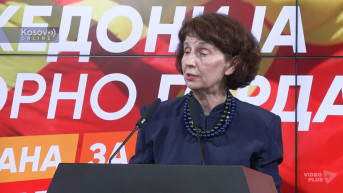
The elections in North Macedonia and the victory of the opposition party VMRO-DPMNE have brought about a new redistribution of power in the country, as well as a political shake-up in the entire region. The new president, Gordana Siljanovska Davkova, in her first address, stated that her paths before Europe "lead to the Balkans," and analysts from across the region have responded to how Serbia and Kosovo fit into this path for Kosovo Online.
Siljanovska Davkova has become the first female president of North Macedonia. Her party, VMRO-DPMNE, also emerged victorious in the parliamentary elections held on Wednesday alongside the presidential elections, securing 58 seats out of the 120 available in the Parliament of North Macedonia.
"I confirm that I will act as the president of all citizens. This means all ethnic groups, all party members, and those who are not in a party, because no president can aim for unity if they follow a party line,” emphasized Siljanovska Davkova in her address on Wednesday evening.
She called on neighbors to support, as she put it, "balkanization," and to assist each other and be true politicians.
"We must start to understand each other, to help each other, not to look for vetoes, but to seek support. My paths first lead to the Balkans, and, of course, Brussels is not out of the picture,” said Siljanovska Davkova.
The second largest party in parliament is the "European Front," led by Ali Ahmeti, which secured 19 seats. It is followed by the Macedonian party that previously held power, SDSM, with 18 seats, and then the "VLEN" coalition ranks fourth at the national level, with 13 parliamentary mandates. This party was supported by Kosovo's Prime Minister Albin Kurti, who has been harshly criticized for interfering in the elections in North Macedonia and accused of dividing Albanians into two blocks, thereby contributing to their electoral failure.
Kurti's Self-Determination movement had three candidates for MPs within the opposition VLEN block, of which only Bekim Coku, Kurti's advisor, managed to secure a seat in the Macedonian parliament, reported by Gazeta Express.
Although this could be considered some form of gain, university professor from Pristina, Nedzmedin Spahiu, says that his interference in the elections in North Macedonia actually contributed to Albanians now having much less influence. Spahiu assesses for Kosovo Online that Kurti’s campaign was in favor of Serbia’s policy.
“What Kurti did in Macedonia went in favor of Serbia’s policy. In the whole game around Macedonia, Serbia is still the biggest winner and beneficiary. Everything that Kurti and Edi Rama did in Macedonia went in favor of Serbia, so the influence of Albanians in Macedonia will be much smaller than it is now,” Spahiu stated.
He estimates that the foreign policy of North Macedonia towards Kosovo and Serbia will change and be more inclined towards Serbia.
"I hope that an agreement between Kosovo and Serbia will be reached; otherwise, it can be expected that Macedonian policy will now be more on the side of Serbia than on the side of Kosovo,” Spahiu said.
On the other hand, the former mayor of the Centar municipality in Skopje, Sasa Bogdanovic, believes that the convincing victory of VMRO-DPMNE represents, among other things, a "cry of the Serbian people" in Macedonia due to the injustice done to Serbs in Kosovo.
"This is at the same time a cry of the Serbian people who live in Macedonia because of the injustice being perpetrated against the Serbian people who live in Kosovo and Metohija. Everyone involved in politics should consider what kind of relations they will have with Serbia because the Serbian people are indivisible, whether they live in Serbia, Macedonia, Bosnia and Herzegovina, Croatia, and we are all emotionally tied to these events," Bogdanovic told Kosovo Online.
He believes that Serbia and Macedonia will continue to deepen what he describes as phenomenal, primarily fraternal relations. In this sense, he notes that this was evident last night when the President of Serbia, Aleksandar Vucic, was the first to congratulate Gordana Siljanovska Davkova on her victory.
"By doing so, he showed that he is ready to deepen cooperation without jeopardizing anyone, and on the other hand, I think that this connection will become even stronger precisely because of those who want to create problems between the two peoples," said Bogdanovic.
He adds that these attempts to create problems between Serbs and Macedonians have had the opposite effect and indicates that this can be seen based on the election results in constituencies where many people of Serbian nationality live.
"Anyone involved in politics in North Macedonia must understand that they need to respect the Serbs living in North Macedonia because they are the link between the two countries," he states.
Commenting on Albin Kurti's support for an Albanian faction during the election campaign in North Macedonia, Bogdanovic notes that his support was not fully established, neither in terms of its extent nor its existence. In that context, he mentions that Kurti called for a boycott of the presidential elections. However, he says, in areas predominantly inhabited by Albanians, based on turnout, it can be seen that Albanians participated to a certain extent, about 20 percent, which indicates that they did not heed his call.
"It was evident that the DUI boycotted yesterday's vote for president, they organized it publicly, but it is clear that they did not manage to organize a boycott everywhere. Albanians did not want such a crisis to occur, to fail to meet the quorum. People here are aware, regardless of their nationality, whether they are Albanians or not, and do not want to fall into undesirable scenarios because we all live and function together here. I think that Albin Kurti does not have any particular influence among Albanians in North Macedonia," Bogdanovic noted.
Historian Aleksandar Rakovic from Belgrade also believes that the victory of VMRO-DPMNE will contribute to warmer relations with Serbia, but, on the other hand, he does not believe that it will bring changes to North Macedonia's policy towards Kosovo.
"Serbia will have an easier time in some ways, but the stance towards Kosovo will not change," Rakovic told Kosovo Online.
He highlights that it is important that Ivan Stojilkovic is entering the government, noting that he has good relations with the President of Serbia, Aleksandar Vucic, as well as with the president of the winning party, VMRO-DPMNE, Hristijan Mickoski.
"I hope that the relations will be warmer and that there will be changes that will slightly favor Serbia, but very little. There won’t be any major changes; maybe in some minor things, they will make concessions where SDSM would not have. Maybe there is now room for such things, but in terms of relations towards Kosovo, there will be no change," he stated.
According to him, citizens were dissatisfied with the SDSM and DUI coalition, which is why it fared as it did. However, as he says, such a defeat was beyond any expectations even though it was certain that VMRO-DPMNE would win. However, he says, Mickoski will surely include this other option of the Albanian coalition - VLEN, in order to show that he actually has the coalition capacity to make a multiethnic government and to show that he does not intend to engage in the kind of revanchism that was made when the SDSM government was formed, and VMRO, although it won within the Macedonian structure at that time, was not part of the government.
"Mickoski will extend a hand to all those he thinks should be reached out to, and he has also announced that there will be actions against those from DUI, which is actually the KLA, who have been involved in criminal activities. Mickoski, as a Macedonian, will not initiate these actions himself, but I assume he will leave that to VLEN, the other Albanian coalition," he said. In response to how much Albin Kurti's support during the campaign influenced these election results, Rakovic says that Albin Kurti is not a factor.
"If he thinks he is, those are his illusions, and besides, here it was clear what the election results would be, not that they would be this drastic, but the results were clear even before the elections,” he said.
Professor of political science and program director at the Institute for Political Research in Skopje, Vladimir Bozinovski, also believes that relations with Serbia will be renewed and improved after the elections in North Macedonia, because, as he assesses for Kosovo Online, they went in an undesirable direction during the tenure of Minister Bujar Osmani.
He states that the goal of Macedonian politics is to nurture good relations with all neighbors, especially those who do not impose conditions and vetoes.
"Here are Serbia and Kosovo. I think the new government will try to establish or renew the relations between Skopje and Belgrade as they were. As for Kosovo, I hope they will continue to have relations in the direction of mutual respect and understanding. So, I do not expect relations to become strained with some and improve with others. What is needed is for relations with Kosovo to continue in a similar direction, and for relations with Serbia, which especially during the period of Bujar Osmani's ministry went somewhat in an undesirable direction, to improve," emphasizes Bozinovski.
He adds that the number of votes and parliamentary seats won are within the limits of what was expected before the elections.



0 comments