
Electoral "Swing" in America: Can Serbs and Albanians Decide the Presidential Election?
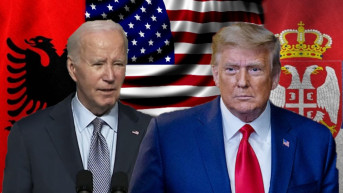
For years, the so-called "swing" states have played a significant role in American elections. In these states, neither party has a firm foothold, making the chance of victory for both candidates a "toss-up" from cycle to cycle. In these states, immigrant communities can play a crucial role, and experts speaking to Kosovo Online do not rule out the possibility that Serbs and Albanians could be the deciding factor. They note that Serbs predominantly support Donald Trump, while Albanians back Joseph Biden. The November presidential election will be a good opportunity to measure their influence.
By: Petar Rosic
The notion that Serbs in the USA have a unique position and the ability to influence the outcome of the American presidential elections was recently highlighted by former Illinois Governor Rod Blagojevich. He called on the Serbian community in "swing" states to support Donald Trump.
"We are in a unique situation where we can have a significant impact on deciding the outcome of the presidential election. By mobilizing as a Serbian community in Wisconsin, Michigan, Ohio, and Pennsylvania, we can make the difference between defeat and victory. The Serbian community is very aware of this and is already working at the local level. As far as I know, everyone supports Trump," Blagojevich said.
Marko Miskeljin from the Center for Social Stability views Blagojevich's assessment as realistic. He told Kosovo Online that the Serbian diaspora places much greater trust in Republicans, which he says is natural when considering the relationships different administrations have had with Serbia, especially the Democratic administration in the 1990s.
"Although it's a small number, when we look at the final tally, Serbs can make a difference, especially in Wisconsin and Michigan. Both are marked as 'swing' states and could perhaps be decisive in the final electoral count, so from that perspective, of course, every vote matters," he says.
Regarding the Albanian diaspora, Miskeljin notes that it is mostly spread in areas where Democrats win, so he believes it won't have a significant impact on the outcome.
"From our history, we know that the Albanian lobby primarily finances the Democratic establishment. When we talk about specific states, the safest ones for Democrats are those where Albanians have the highest number of votes," Miskeljin explains.
In contrast, political analyst Aleksandar Cipa from Tirana says that the Albanian community in the USA is the third largest in terms of immigrant numbers and, as such, will have a certain influence not only as participants in the electoral process but also as lobbies supporting one or the other main party candidates.
He told Kosovo Online that Democrats are closer to Albanian interests, but currently, there is a difference compared to the elections four years ago, as the interest of Albanians in Republicans is also tied to the internal American reality.
"It is understood that Democrats have supported more Albanian goals and interests in the Western Balkans. During the early years of Biden's presidency, there was a positive approach to unresolved issues regarding Kosovo in relation to Serbia. Additionally, the interest shown by the Biden administration in Albanians, considering them a strategic ally in the Balkans, was positive," the analyst from Tirana says.
However, Cipa emphasizes that in the second part of Biden's presidency, there has been a shift, with American policy becoming more interested in Serbia.
"They want to remove Serbia from Russian influence and bring it closer to the EU membership process. American diplomacy is more focused on bringing the U.S. and Serbia closer. The Serbian lobby in the USA is heavily invested in this direction, creating the impression that Republicans are closer to Serbia than to Albanians in general," he states.
He explains that Albanians are mainly concentrated in New York, Massachusetts, and Boston, where they have a tradition of representation and participation in American public life.
"There are also Albanians in other American states, especially in coastal areas. The number of Albanian voters increases every year as they obtain American citizenship. Compared to previous elections, there are now five percent more Albanian voters," our interlocutor says.
The president of the Matica Albanaca in Serbia, Demo Berisha, agrees, noting that there are more than a million voters of Serbian origin in the USA, compared to about 800,000 of Albanian origin, but that Albanians are more unified when it comes to national interests.
"Specifically regarding these elections, for the first time, the Serbian community has the outline of an organized community and has participated in all elections. Despite a certain level of assimilation, it exists, is organized, and this is evident since the formation of the Ministry for the Diaspora. This has shown that the Serbian diaspora can influence to a certain extent because it's not a small number of votes," Berisha told Kosovo Online.
He says that over time, the Serbian community in the USA has changed the candidates it supports, and they will now certainly vote for the Republican candidate Donald Trump if he remains a candidate until the end.
Berisha points out that, on the other hand, the Albanian diaspora is also very strong in America and recalls that they have been there since 1946, especially since the 1970s when the SFRY (Socialist Federal Republic of Yugoslavia) opened up. He notes that at that time, a large number of Albanians, not only from Kosovo but from all Balkan regions, went to America.
"When it comes to national interests among Albanians, unlike Serbs, regardless of where they are and which party they belong to, and despite what Kurti has managed to do—to divide them—they will, in this specific case, support Biden. We have a battle between the two communities in this case, and we'll see which one will have more influence," he said.
Berisha emphasizes that the messages the Serbian community receives from Serbia are extremely important.
"Serbia must maintain its presence within the American political elites through this segment. In any case, they can influence the results, and they should be supported because they are essential to us at this moment. It would be foolish to leave them to decide freely. We should demand their support, as supporting Trump at this moment is supporting Serbia. Serbia needs to have relations with America that, while not particularly bad at the moment, should be better," he says.
Commenting on the candidate debate in the U.S. elections, Berisha believes that replacements for both candidates are possible at this stage.
"Various legal proceedings are being conducted against one candidate to eliminate him and prove that democracy prevails in the U.S., allowing such individuals to run until certain verdicts are finalized. On the other hand, we have a candidate who, as we can see, is no longer physically capable. If he were sent for a medical examination, I'm sure he wouldn't pass. Both candidates can essentially be called into question," he says.
Miskeljin shares a similar view, stating that the Trump and Biden debate might be the first television event in history where Trump participated without being the main topic.
"The most significant change might be that there is now more pressure on Biden than on Trump. We have a situation where the focus is not on what the candidates said during the debate but on how they looked during the debate, putting Joe Biden in the spotlight. Almost every other potential Biden successor is the loudest in their support for Biden himself, indicating that a change of candidate at this last moment is unlikely," Miskeljin concludes.
Commenting on the TV duel between Trump and Biden, Assistant Professor Stevan Nedeljkovic from the Faculty of Political Sciences in Belgrade says that it was one of the most influential debates in the history of the United States, dating back to 1960 when televised debates began.
"Joseph Biden was definitely defeated, although Donald Trump did not have an exceptionally notable performance, given the amount of misinformation he presented, as well as some rather controversial positions and his avoidance of answering questions. However, Joseph Biden's performance was indeed the worst in memory. If you compare his debates from 2020 to today, you will see that we are truly not talking about the same person," Nedeljkovic told Kosovo Online.
He adds that the debate sparked a broader discussion about whether Biden should remain in the race, which took place within the triangle of Biden's family, the Democratic establishment, and campaign financiers.
"It seems to me at this moment that this triangle is somewhat closer to the decision for Biden to stay in the race for several very important reasons. One is tradition and inertia. It would be extremely undemocratic for the candidate who has won a significant number of delegates for the convention, which will be held in mid-August in Chicago, not to be the candidate. If you now decide to choose someone else, it would not come from a democratic process but from a party establishment decision, which would be viewed very negatively," our interlocutor explains.
Commenting on the Biden administration's approach to Serbia, he says, "We have fared much better than we expected."
"When Joseph Biden won, a drastic shift and significantly more pressure from the U.S. administration on Serbia were expected. We can honestly say that this has not been the case. The most significant pressures from 2021 to today have primarily come from European countries, specifically Germany and the United Kingdom. The U.S. has maintained a kind of mild approach toward Serbia," he notes.
As an illustration of instances where there have even been more positive shifts compared to the Trump administration, he men


0 comments