
Why is Kurti worried about the possible return of Trump to the White House?
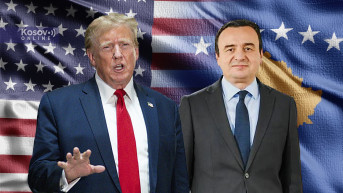
Although convicted in a criminal trial in New York, former U.S. President Donald Trump will be able to run in the November elections, and his possible return to the White House, according to Kosovo's Prime Minister Albin Kurti, creates "anxiety across the continent, including in Kosovo." Analysts interpret Kurti's concern in various ways - as a fear for his personal position, and less so about the impact that changes in the U.S. administration would have on the Pristina-Belgrade dialogue, although it is expected that Trump would be stricter in demanding the implementation of agreements.
In Kurti's rhetoric about Trump, there is also a message addressed to some European capitals: we are on the same side.
The dismissal of Kurti's first government in 2020 was initiated by the Democratic League of Kosovo, at that time a coalition partner of Self-Determination, and it is believed that the then U.S., Trump's administration, was pulling the strings, which is why a potential change in the White House would certainly not be to the liking of the Kosovo Prime Minister.
However, considering that as a prime minister in his second term he has not been distinguished by cooperation with the administration of President Joseph Biden, it can still be said that the statement by the Brussels portal "Politico" from last summer stands - that Kurti achieved the impossible in American politics: a consensus among Democrats and Republicans, where the point of agreement is that the Kosovo leader is stubborn and occasionally thoughtless, undermining the joint efforts of the U.S. and EU to achieve a lasting peace solution between Kosovo and Serbia.
Milan Igrutinovic, a research fellow at the Institute for European Studies, believes that Albin Kurti is "worrying his personal worry" and is primarily concerned about his personal position and the position of his party in maintaining power, and he fears specific American pressure on him, but also probably considers that he can always threaten new elections where, given the situation in Kosovo, his party would likely again be the main party in power.
"With these arrows towards Trump, he shows another thing - that he is part of the broader European mainstream in which Trump's coming to power is followed with possible apprehension, with negative expectations about what he will do, especially towards the war in Ukraine and more broadly towards relations within NATO. With these statements, he actually shows most European capitals: I am on the same wavelength with you," says Igrutinovic for Kosovo Online.
He also believes that Kurti is less interested in the consequences for the dialogue between Belgrade and Pristina if Trump returns to the White House because the dialogue, as he says, does not look like a dialogue, but is more of a dialogue between Brussels and Pristina, and Brussels and Belgrade.
"It is rarely a dialogue between two sides that, even when they meet, does not lead to concrete solutions, especially not those good for our community in Kosovo. The dialogue will probably not be the focus of the new U.S. administration. In the broader order of things, Europe will probably be subordinate in relation to China," assesses Igrutinovic.
What, as he says, could enhance the profile of Kosovo, or the Belgrade-Pristina relationship, is the perception that there may be some easy points that can be quickly harvested.
"To say: The European Union is doing this very slowly, it is inefficient, nothing is happening there, let us show that we are powerful enough and capable of striking a new deal after 2020, after the Washington Agreement which is not a formal legal agreement, but rather political points for discussion, and which in reality was not particularly achieved. But, if possible, that this be shown as a point of success in a relatively quick period after the arrival of a new administration, something that can at least be touted in front of the American public as a minor success of the new administration, it might be operationalized," says Igrutinovic.
Regarding American foreign policy in general, in the case of Trump's return to power, our interlocutor says that he would probably bring a policy of greater focus on China, less concern for Europe, and the war in Ukraine, but that this will partly depend on personal divisions within the new administration itself.
"Within the European context, of course, the Ukrainian issue will take up the vast majority of attention and political energy, while Kosovo, Serbia, and the Western Balkans will likely be third-tier interests and concerns of the future Republican administration, which is actually not much different from how it is today," emphasizes Igrutinovic.
Political analyst from Pristina, Afrim Hoti, says that the relationship between Kosovo and the U.S. is not as it used to be, that Prime Minister Albin Kurti is under pressure from the Biden administration and that this will not change even if Donald Trump becomes president after the American elections.
"Kurti does not have the full support of the current U.S. leadership, or at least it has not been shown. The fact is that he does not prove himself as cooperative or as a leader who will stand behind their political positions. Because of the obstacles Kurti has created, the relations between Kosovo and the U.S. are not as they were before, so I do not expect any changes," says Hoti for Kosovo Online.
Regarding the fears of Trump's return, which Kurti discussed, Hoti says that it's not only Kurti who is concerned, but all political leaders of NATO member states.
"This is due to the position that Donald Trump held during his first term, especially regarding commitments and support to NATO. Bearing this in mind, all European leaders have expressed their fear that Trump's next term could create some confusion among the major powers, and if the major powers were under such influence, there would certainly be consequences for smaller states, and then it's obvious that the Prime Minister of Kosovo would also be in a very difficult position along with other leaders of small states. Because if Trump comes to power, the situation will be somewhat unpredictable since no one will know exactly what his mandate or the structure of NATO will be in the future," Hoti explains.
Regarding whether Trump's administration would continue where it left off with the Washington Agreement when it comes to the relations between Belgrade and Pristina and how much Kosovo and the Western Balkans would be in the focus of Washington, Hoti says it would be in the interest of both Kosovo and Serbia.
"Definitely, previous agreements will come to the top of the agenda. Maybe not as they were before because circumstances are now different. Previously, there was no war in Ukraine or between Israel and Hamas, and the global political agenda has changed, so the political leadership will follow a new path, but always keeping in mind and maintaining a focus on the Western Balkans," Hoti states.
The economic normalization of relations between Pristina and Belgrade, which was insisted upon by Trump's first administration in which Richard Grenell was Trump's envoy for dialogue, would now be necessary according to Marko Savkovic, senior advisor at the ISAK fund, especially as, he points out, there is currently no exchange because Serbian goods are blocked, and the dinar has been abolished, affecting the Serbian community living in Kosovo.
"First, we would need normalization. Probably any administration, even a hypothetical one, would first insist on this. But I would certainly expect even more pressure on Pristina. We must not forget that Kosovo is under sanctions, restrictive measures by the European Union, and the criticism coming from America is quite strong. We had a recent visit by a high-ranking State Department official, which not only did not yield any results, but was immediately followed by a raid on the Postal Savings Bank, closure of branches, and so forth. So certainly, any subsequent administration will continue to insist on the implementation of agreements, and Trump's would, probably, be more forceful," Savkovic evaluates for Kosovo online.
If Kurti has some apprehensions about the potential coming to power of Donald Trump, they are, says Savkovic, probably justified because Kurti was not on good terms with his previous administration, which contributed to the fall of his first government. But, he adds, it should be noted that Kurti returned with a second government and had a stronger position.
"When it comes to staying in power, we also need to dispel the notion that America is all-powerful and that it can change the government in Kosovo at any moment. It's not that simple anymore. Kurti has great support. He presents himself to the citizens as someone who is, let's say, a sovereigntist, who strengthens the statehood of Kosovo. And this is a policy that has a large number of followers, not only among citizens in Kosovo but also in the diaspora, which is very strong," says Savkovic.
Savkovic emphasizes that U.S. foreign policy regarding our region and in the case of the Republicans and Trump coming to power will not change because it already changed to some extent in 2017.
"Then there was a kind of correction of their course in the sense that they began to seek a more intensive partnership with Serbia, primarily. If we look at how American foreign policy unfolded after Trump was replaced by Biden, we saw that there weren't many significant changes. For example, America will not suddenly withdraw support for Kosovo's independence and take another stance in this regard. But what America tries to do is understand the positions of both sides. It tries, as much as possible, to act as a mediator seeking a solution, sometimes it seems even more intensively than some European partners. It is open to new initiatives, some of which it proposes itself, some it supports, such as the Open Balkans initiative, and is actually always trying to give wind to the back of the process under European leadership which is not yielding results," says Savkovic.
Trump was, as a reminder, convicted last week on all 34 charges of falsifying business records to conceal secret payments to former porn star Stormy Daniels, thus becoming the first U.S. president to be criminally convicted. The sentence will be pronounced on July 11, and he could be sentenced to up to four years in prison, although those convicted of the same offenses are usually fined or given a suspended sentence.



0 comments