
Fires in the Region: Are inspections and legal regulations effective against human negligence?
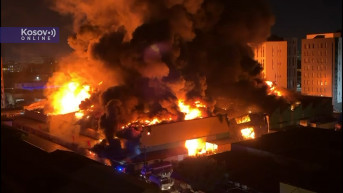
In the past year, a large number of fires were recorded across the region in residential buildings and other premises, while on New Year’s Eve a fire in Crans-Montana, Switzerland, claimed dozens of lives and injured more than 100 people, including several from the Balkans. When it comes to fires in buildings, human error and negligence are risk factors that lead to a high number of casualties, interlocutors for Kosovo Online say, adding that control measures have been stepped up across the region and that strict legal regulations are in force. They note that citizens fear misdemeanor penalties, but warn that, amid negligence, such cases can escalate into criminal charges.
Written by: Jelena Novakov
The Higher Court in Belgrade scheduled for today the start of the trial of suspects accused of negligence that led to the deaths of 11 people at the “Ivanovic” Home for the Elderly and Adults in Veliki Borak, Barajevo. The hearing was postponed at the defense’s request after the Prosecution precised the indictment following the receipt of autopsy findings for five of the victims.
The director of the home and two other individuals are charged with the criminal offense of endangering public safety in co-perpetration. The Prosecution states that they failed to install the prescribed fire-protection devices and did not act in accordance with legally prescribed regulations and technical rules on protective measures, which resulted in the deaths of residents. In addition, there is suspicion that the accused disregarded rules banning tobacco smoke in social-care institutions and the requirement regarding the minimum number of caregivers present.
At the opening of the trial, the defendants are expected to plead and present their defenses. The Prosecution has proposed that they plead guilty; if convicted, they face up to 12 years in prison. The Prosecution and the defense will deliver opening statements on February 24, and the defendants will have the opportunity to present their defenses on March 6.
A few days before the tragedy in Barajevo, a fire at the “Puls” nightclub in Kocani claimed 63 lives and injured more than 200 people. At the end of November, the trial began for a group of 37 defendants charged with serious criminal offenses against public safety.
North Macedonia’s Prime Minister Hristijan Mickoski said that all those connected to the case would be held accountable. Among the defendants are high-ranking officials, including the then mayor of Kocani, Ljupco Papazov, his predecessors Nikolca Iliev and Ratko Dimitrovski, former ministers of economy Kresnik Bektesi and Valon Saracini, as well as a state secretary and five officials of the Ministry of Economy responsible for issuing permits for nightclubs, and Minister without Portfolio Saban Saliju.
According to the indictment, the facility did not meet the minimum technical requirements for hospitality operations; it lacked a reconstruction permit, a basic design and reconstruction reports, a specific report on protection against fire, explosions and hazardous substances, as well as a protection and rescue plan and risk assessment. That night, capacity was exceeded, with more than 500 people inside.
In a similar incident, on New Year’s Eve a fire at a nightclub in Crans-Montana, Switzerland, killed 47 people, including Serbian national Stefan Ivanovic, who, according to media reports, rescued several guests before losing his life. The competent authorities had not conducted an inspection at that location for five years prior to the tragedy. Some eyewitnesses testified that exits were blocked, and Kosovo Online interlocutors note that this would not be the first time locked emergency exits have led to a large number of casualties.
Skopje Authorities Step Up Inspections
The acting chief inspector at the Directorate for Protection and Rescue of North Macedonia, Zivko Stavreski, said that since the tragedy at the Kocani nightclub, the government has made significant efforts to improve operations, cooperation and coordination among state institutions, including amendments to existing laws. Stavreski emphasized that the number of inspections and closures of facilities has increased, but that a comprehensive analysis to harmonize all fire-protection provisions will take time.
“A new legal solution will introduce stricter fire-protection rules. These rules will impose new obligations and greater responsibility on all stakeholders—institutions, companies and individuals—while also providing for harsher penalties for those who violate the rules or fail to comply with the law. In this way, we want to change the mindset in society—from reacting only after a fire occurs to increased prevention and preparedness. That means greater investment in prevention and readiness to avert, God forbid, major loss of life or significant material damage,” he told Kosovo Online.
Stavreski noted that authorities are conducting more inspections and that the number of fines and closures has increased.
“Although the Directorate operates with 14 inspectors across the entire country, in the period since the fire at the Puls nightclub to the present day, the number of inspection controls in hospitality venues and all premises where large numbers of people gather simultaneously has increased several times. At the same time, cooperation with other inspectorates and inspection services has been intensified and strengthened, particularly with the Ministry of Interior in carrying out joint enforcement actions in hospitality venues. During this period, around 1,300 inspections were carried out, resulting in more than 170 fines and over 30 decisions banning operations or the use of facilities,” he said.
Stavreski added that the current focus is on institutional prevention—not punitive policy per se—but on more decisive enforcement of the law to prevent large-scale accidents and improve public safety.
Human Negligence Is Decisive
Aleksandar Krstic, head of a department at the Fire and Rescue Units Administration within Serbia’s Sector for Emergency Situations, said that nearly 28,300 fires occurred in the country last year, resulting in 328 fatalities. He emphasized that this represents an increase of about 1,500 fires compared to 2024, and that when it comes to fires in facilities such as cafés and nightclubs, the most common cause is human error and negligence.
“After investigations, statistics show that humans are the main cause of fires. When we say humans, we do not mean arson. Most often—almost 100 percent—it is carelessness, even negligence. Simply put, we are not careful enough toward others; we leave things running unattended—heating appliances, stoves—and that leads to fires,” he assessed for Kosovo Online.
Due to strict legal regulation, Krstic believes Serbia does not face major problems caused by fires in buildings, but he cautioned that guarantees do not exist.
He said that following the fire at the nursing home in Barajevo, the Sector for Emergency Situations increased site visits and control inspections, though regulations were not changed because strong legal frameworks already exist. He added, however, that there is an insufficient number of inspectors conducting preventive inspections.
“There are not enough inspectors for preventive fire and explosion protection in the field. People work to the limits of their capacity, but there should always be more to improve the situation,” Krstic added.
Misdemeanor Charges Are Citizens’ Greatest Fear
Ivan Arandjelovic, a professor at the Faculty of Mechanical Engineering in Belgrade, assessed that Serbia’s legal framework for fire protection has advanced over the past 20 years, but that awareness of prevention remains insufficient and that citizens mostly fear misdemeanor penalties.
“On the one hand, over the past 20 years our legal framework has made significant progress. We introduced a new Fire Protection Law in 2009, and in the last decade many by-laws related to the storage of flammable liquids have been amended,” Arandjelovic told Kosovo Online, noting that Serbia has adopted new regulations on fire protection in hospitality venues and binding rules for business, residential and public buildings.
He added that citizens often implement fire-protection measures to avoid misdemeanor penalties, while there is insufficient awareness that anyone can become a victim of fire.
Speaking about the high number of casualties in fires in Barajevo, Kocani and Crans-Montana, the professor said the causes differed.
“A fire always has three components: the presence of air, which cannot be eliminated; an ignition source; and combustible material. All three fires were different. In major cases, there are no two identical fires. In Kocani, it was characteristic that wall and ceiling linings were made of materials that burn very quickly and emit toxic combustion products, causing partial poisoning of those present,” he said, adding that obstructed or inaccessible evacuation routes further worsened the consequences.
Arandjelovic noted that Serbia has clear regulations for venues where large numbers of people gather and that special fire-protection measures apply, but pointed out that the backup evacuation exit during the 2012 fire at the Kontrast nightclub in Novi Sad was locked—just as it was recently in Crans-Montana, Switzerland.
Regarding the fire at the nursing home in Barajevo, he cited the fact that it occurred at night, when everyone was asleep, as an aggravating circumstance, meaning it was not noticed in time despite not spreading rapidly, and added that winter months pose particular risks.
“During winter, energy consumption increases, and the risk depends on how we heat. Some buildings are not connected to district heating, leading to increased electricity consumption. Some are heated with solid fuel, which brings additional risks from improper furnaces, chimney fires due to inadequate maintenance, and the disposal of embers into containers not intended for that purpose,” Arandjelovic said.
Safe Materials Are Key to Fire Prevention
Skelcim Goxhaj, director of the Fire Service in Tirana, said that inspections of all enterprises in the city are conducted annually to ensure adequate fire protection, and that, under Albanian law, company certification is carried out every five years.
Discussing risk factors, Goxhaj stressed that the Fire Service insisted on the use of safe materials after a recent fire spread rapidly along the façade of a building in the Albanian capital because it was made of fire-propagating materials.
“We had a case where the façade of a building in Tirana, in the area of the former bus depot, caught fire. This happened because the façade acted as a fire spreader. The fire broke out due to an air-conditioning unit on a balcony and then spread extensively. It was so large that we deployed all fire-service forces. From that moment, in addition to other measures required of builders or property managers, we require the use of safe façade materials—unlike those used on the building where the fire occurred. We demanded that such materials no longer be used. According to the information we have, only a very small number of builders in the municipality of Tirana used these materials. After the fire, the façade material on that building was changed to a fire-resistant one. These types of façades have only begun to be used in our country in recent years, as traditionally building façades are made of brick, mortar and concrete, which do not propagate fire,” he told Kosovo Online.
He also assessed that fire-protection measures in nightclubs and discotheques in Albania are good, including passive protection through the use of safe construction materials and staff training.

0 comments