
Flirting of Limaj with Self-Determination: Does this alliance have a future?
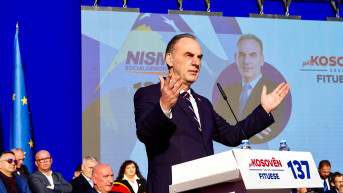
In the elections four years ago, they were left out of parliament, far below the threshold. After the vote on February 9, with currently three secure mandates, they could be the deciding factor for forming the "Kurti 3" government. Fatmir Limaj's willingness, the leader of Nisma, to cooperate with Self-Determination, even though he was once a sharp critic of them, is attributed by some to pragmatism, while others find it incomprehensible. In any case, analysts do not predict a long life for a government formed by Self-Determination, non-Serb minorities, and Nisma.
Written by: Dusica Radeka Djordjević
Fatmir Limaj's statement, the leader of the Social Democratic Initiative (Nisma), that he is willing to cooperate with any party to form a new government, including the Self-Determination Movement of Albin Kurti, because Kosovo's interests are above all political divisions, has not left Kosovo's political public indifferent.
Nisma entered the February 9 elections in a coalition with the Alliance for the Future of Kosovo (AAK) of Ramush Haradinaj, and according to preliminary election results, this coalition won 7.46% or 62,588 votes.
"We don't necessarily have to vote the same way on different issues," Limaj said, talking about the relationship within the coalition with AAK, emphasizing that Nisma and AAK are still two separate parties.
"We are two parties in the coalition, but it is still fair and right to consult with each other to have a common stance," responded AAK candidate for MP Ahmet Isufi, noting that it is incomprehensible to make a statement that creates confusion and shows interest in entering the government while final results have not been confirmed.
Before the elections, Limaj did not hold back criticism towards Kurti and his government. The problems in the dialogue, as he said, show how irresponsible the Kosovo government is, while he called Kurti a
"first-class fraudster." A month ago, he stated that Kosovo does not need a prime minister who rules through trauma, threats, and invented fears.
In response to the signal he sent publicly to Self-Determination, Mimoza Kusari-Lila, the head of the parliamentary group of this movement in the previous parliament, commented that it is too early to talk about any possibility of cooperation, as the results have not been confirmed.
Political analyst Artan Muhaxhiri told Kosovo Online that Limaj's message was surprising for Kosovo's public opinion, as the opposition has a chance to form a joint government, which would include the Democratic Party of Kosovo (DPK), the Democratic League of Kosovo (DSK), AAK, and Nisma. These parties, he adds, have much better relations with minorities and it would be much easier for them to form a government if they showed the will and political intelligence to cooperate and find common ground for collaboration.
"Mr. Limaj and Mr. Kurti have had very sharp and insulting arguments over the years. Kurti's ministers have used very harsh words about Limaj. So, this was a big surprise. However, in Kosovo politics, we shouldn't be surprised anymore because anyone can go with anyone, and this is some sort of Plan B," says Muhaxhiri.
However, as he believes, if a government were to form in which Limaj's initiative was with Self-Determination, it would not be long-term due to the disparity between the two parties. Self-Determination will likely have 48 MPs, while Nisma will have three or possibly four.
"Limaj is a very experienced politician, he has been a minister and an important figure, and he knows institutional life. If Limaj can serve as a bridge for Kurti to improve relations with foreigners, the Americans, and the EU, then we might have a different result from such a government. However, I believe it will be 99% short-term, especially because of the upcoming process of electing a new president of Kosovo, which will be a big problem with these kinds of relations. To elect a president, 80 votes are needed, and with this gap between Self-Determination and the other side, especially DPK and DSK, it will be very difficult, so we will enter yet another crisis," concludes Muhaxhiri.
Milos Pavković, a collaborator from the Center for European Policies in Belgrade, told Kosovo Online that Fatmir Limaj's willingness to cooperate with the Self-Determination Movement should be seen as his personal ambition to be part of the government and secure something more for himself than a position as an opposition MP.
"I would look at it through that lens. Limaj is a long-time politician, he has been in the government several times, and he was also the deputy prime minister for one mandate, so I believe this stems from his personal ambition," says Pavković.
Limaj's statement, he adds, is not surprising, given his understanding of political life in Kosovo and considering that experts from Pristina had pointed out the possibility of MPs "defecting" to support Kurti in forming the next government.
"Whether there will be a Self-Determination government supported by Limaj depends on the final results and an assessment of how many mandates Kurti is lacking. Right now, it's a battle for every seat. Kurti currently has 47 mandates, and if we factor in the ten mandates from minorities, he still needs four MPs to support him in becoming prime minister. After the overseas votes are counted, there may be a change of one or two mandates in Kurti's favor, which would make his situation easier," says Pavković.
In this calculation, as he points out, it is also important to consider how many MPs Limaj and his party will have based on the final results.
"The question is whether he will have enough mandates to support the government into which he would enter as a member, because that would mean one less mandate for his list and one more for the Alliance for the Future of Kosovo, Ramush Haradinaj's party. Different numbers are in play, but I view this mainly as some sort of groundwork being tested by Self-Determination, while on the other hand, we have the offering of some MPs for the government who are still formally in opposition but are clearly aiming to join the government and support Albin Kurti's government," says Pavković.
The potential "Kurti 3" government, he adds, would, in political theory, be called a minimal government, as it would have exactly 61 MPs out of the 61 required. This government would constantly be on the edge, very unstable, and could potentially be overthrown.
"It only takes one MP to change their mind, and we know that in Kosovo, MPs often change their positions under various pressures, particularly from the international community. Such a government would most likely be limited to a period of no more than a year, as there are two major challenges for any government in Kosovo over the next year—local elections scheduled for October this year, and then presidential elections in January 2026," says our source.
He reminds us that the president of Kosovo is elected from parliament with a two-thirds majority in the first two rounds of voting, and it is already clear that no party or coalition currently has a two-thirds majority. This, he believes, will also be taken into account when forming the government and could be a significant factor in calling for snap parliamentary elections, either in the fall or at the beginning of next year.
Limaj, otherwise, was the deputy prime minister in Ramush Haradinaj's government from 2017 to 2020. He was one of the commanders of the former KLA (Kosovo Liberation Army), who was indicted in 2003 by the Hague Tribunal for war crimes and acquitted of all charges two years later.
On the list they presented in the February 9 elections, the first position was held by AAK leader Ramush Haradinaj, who was also the coalition's candidate for prime minister, while Limaj's name was in second place.

0 comments