
"Happy Warriors" and "Apostles of Freedom": Why is Kamala Kurti's logical choice?
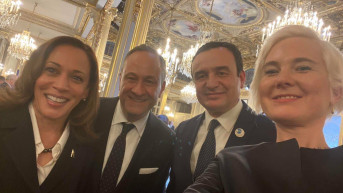
An American journalist, Harold Meyerson, wrote, while observing the Democratic National Convention, that the new Democrats sound like some "very old and very good Democrats from the past." He exaltedly called them "apostles of true freedoms," something with which people in Pristina would surely agree, grateful for the not-so-distant freedom to unilaterally declare independence. If this were not the case, Albin Kurti would not be posting selfies from Chicago, ignoring the cynical comments that he was seated in the last row.
Written by: Dragana Savic
The Kosovar Prime Minister also posted a picture with Kamala Harris, to which Richard Grenell responded, stating that the Democratic candidate "doesn't even know who Kurti is, nor that her government criticized Kurti for destabilizing the region."
The Kosovar Prime Minister doesn't care about tweets from Trump's former envoy to the Western Balkans, nor about the fact that the U.S. elections are yet to be decided. He seems unfazed by the fact that he faces elections in Kosovo next year, where a premature decision on "which empire to join" could cost him dearly.
Is it possible that Kurti, sitting "high up in the clouds," sees farther and better, predicting Kamala Harris's inevitable victory?
It seems that it's not a view of the future, but rather a look into the past that drives the Kosovar Prime Minister to gamble everything on "blue." Due to disagreements with the current U.S. administration, he received warnings. Due to his differences with Trump, his government was toppled.
Thus, the "happy warriors" – as Kamala Harris and Tim Walz call themselves – are his logical choice. Provided, of course, that he is theirs. As one of our interlocutors reminds us, without U.S. support, one can win power in Kosovo, but one cannot stay in power.
Stefan Vladisavljev, Program Coordinator of the BFPE Foundation for a Responsible Society, tells Kosovo Online that the support of current Pristina officials will be directed towards the Democratic Party in the U.S., as he recalls that the position of people from Donald Trump's administration responsible for this region was heavily criticized.
"Therefore, it is to be expected that this support from current Pristina officials will be directed towards the Democratic Party, much more than towards the Republican Party, given that Donald Trump is once again a candidate for president after losing the 2020 elections," Vladisavljev assesses.
In his opinion, the problem that Kosovo has faced is the inconsistency within the opposition and the lack of strength within the opposition to compete with Albin Kurti in the previous period, which, he adds, has allowed him to centralize power and increase his popularity.
"In the upcoming period, especially when we enter the campaign phase for the elections themselves, it remains to be seen whether the tacit or explicit support of the U.S. will stay on Albin Kurti's side, despite his lack of a constructive role in the dialogue process, or if it will shift to the parties currently in opposition," concludes Vladisavljev.
Kosovar politicians should be cautious in offering support to Kamala Harris before the elections, although this has not been the case so far, says Marko Miskeljin, a researcher at the Center for Social Stability, for Kosovo Online.
"We know that Albin Kurti began his first term by clashing with Donald Trump's administration, which ended poorly for him, as his government was toppled. They cannot influence the outcome at all, but on the other hand, they can cause significant harm to themselves. Most likely, we can expect them to follow the European stance and policy. We see that European politicians themselves have significantly toned down their rhetoric towards Donald Trump, especially after the assassination attempt, with many no longer using terms like he is a threat to democracy or the Western order, which remains the view of his opponents," our interlocutor believes.
When it comes to U.S. foreign policy, he recalls, no sudden changes can be expected, but Trump will likely apply the same approach as in his first term.
"It's quite certain that in such a scenario, when it comes to dialogue, the U.S. will have more understanding and pragmatism to listen to both sides, which has not always been the case with a Democratic administration," notes Miskeljin.
Regarding the elections in Kosovo, Miskeljin believes that Albin Kurti has indeed proven that it is possible to win elections without strong U.S. support.
"However, if we're talking about whether it is possible to lead that administration without support, or even in opposition to the U.S., as we currently see with Albin Kurti countering the entire U.S. foreign policy, it's hard to imagine that anything can be effectively governed or achieved," concludes Miskeljin.
Political analyst Shkëlzen Maliqi tells Kosovo Online that the U.S. will not forget Kurti's arrogance over the past two years and adds that the Kosovar Prime Minister must realize that "the problem of Kosovo cannot be resolved without the support of major powers."
"I don't know what this administration, led by Kurti, can expect, as it has been relatively boycotted by U.S. officials for a long time. This may be the last opportunity given to them to attend the Democratic Party Convention... I was surprised he was even invited, as they have been clearly boycotted over the past year, and he has also been arrogant towards the ambassador and diplomats involved in the dialogue," Maliqi says.
He believes the U.S. will not forget the last two years "when Kurti played a defiant and arrogant role, setting conditions for both the U.S. administration and the EU."
"Now we need to see what he can expect from Kamala—it's not about America changing its position, but about him realizing that the problem of Kosovo cannot be resolved without the support of major powers. We cannot rely on the Council of Europe either, as Kosovo has been under sanctions for a year because it hasn't fulfilled its obligations," Maliqi recalls.
Nikola Lunic from the Council for Strategic Policies believes that Kosovar Prime Minister Albin Kurti is investing in the Democratic candidate's election in the U.S., knowing that Serbian President Aleksandar Vucic has already established very good relations with the Republican candidate.
"We know that the U.S. is a key factor in Kosovo's sovereignty. Both Albin Kurti and previous governments have invested in such relations with the U.S. Similarly, Kurti is now investing in the election of the Democratic candidate, knowing that Vucic has already established very good relations with the Republican candidate," Lunic tells Kosovo Online.
However, he adds that it would be better for America and its interests to have a different administration in Pristina than Kurti's.



0 comments