
Has the Constitutional Court finally untangled or only further entangled the political crisis in Kosovo?
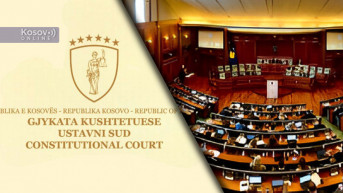
The goal is the same, but the distance is much, much shorter. Can the Constitutional Court’s decision, which provides only three attempts for the election of a new Speaker of the Assembly, “speed up” the process and end half a year of institutional crisis in Kosovo? For analysts, this remains a “million-dollar question.” They warn that it is still unclear what happens if “this train” also passes: will there be elections, or new, additional clarifications of the Kosovo Constitution?
Written by: Djordje Barovic
Today the 55th attempt to constitute the Kosovo Parliament has failed. This time, however, under new rules.
The Self-Determination Movement first once again proposed Albulena Haxhiu for Speaker of the Assembly, and when that proposal was rejected, they put forward a new candidate, acting Minister of Foreign Affairs Donika Gërvalla. That attempt also failed, so the session was adjourned until Friday.
“Disregarding the decisions of the Constitutional Court amounts to disregarding the Constitution. In this particular case, the Court assessed that, because the previous continuations of the constitutive session had not been held in line with its earlier ruling, the process should return to the point where it was stopped,” reads part of the explanation of the “new rules of the game,” which were detailed on Monday and formally adopted by the Constitutional Court on August 8.
In that explanation, it was stated that presiding officer Avni Dehari of the Self-Determination Movement had failed to comply with their earlier ruling, which is why all continuations of the constitutive session from June 27 to July 6 were declared invalid.
At the same time, this ruling obliges Dehari, as presiding officer, to call on the representative of the largest parliamentary group to propose a candidate for Speaker of Parliament, who will be elected by public vote, with “up to three attempts” for the same candidate.
While the office of Kosovo President Vjosa Osmani stresses that swift constitution of new institutions in line with the Court’s ruling is “of vital importance for stability, democratic representation, and the interests of citizens,” the caretaker government takes an entirely different view.
Deputy Justice Minister Vigan Qorolli argues that the Constitutional Court, with its ruling on the constitution of the Kosovo Parliament, has stepped into the Assembly’s domain, which, he says, sets a dangerous precedent because the Court becomes a legislator rather than a constitutional interpreter.
Former Deputy President of the Constitutional Court Kadri Kryeziu stated that, regardless of different comments or criticisms, the Court’s ruling is final.
“The ruling is final. All parties involved have every right in the world to comment on it, agree, disagree, praise, or criticize, but, in practical terms, this issue is closed,” said Kryeziu.
Yet, for Kosovo Online’s interlocutors, the issue is not “closed.”
Football, Labyrinths, and Decisions
University professor Nexhmedin Spahiu claims that the latest ruling of the Constitutional Court has actually further entangled Kosovo’s political crisis.
“The Constitutional Court’s decision has tangled the crisis even more because it offers no way out of the situation, and the reason lies in the 2014 constitutional decision, which absurdly and illogically stated that the post of Speaker belongs to the largest party (the one with the most parliamentary seats) and must be voted on. If it belongs to the majority party, why should there be a vote? And if a vote is necessary, then the rule is that the Speaker is the one who receives the most votes, regardless of which party he or she belongs to,” Spahiu told Kosovo Online.
He stressed that instead of overturning the decision from 11 years ago, the Constitutional Court is taking the country deeper into a labyrinth.
“Instead of annulling that 2014 decision, the Court continues, deeper and deeper, into a labyrinth with no exit. Imagine now they stipulate that only three votes are allowed for the same candidate. But what if none of the candidates proposed by Kurti—which is highly likely—receives a majority? Then what? And all within a 30-day deadline. The Court has given no solution to that scenario,” Spahiu explained.
He added that the biggest absurdity is that it remains unknown what happens if within 30 days, and after three attempts, no Speaker of Parliament is elected.
“They didn’t clarify that. It’s completely unprofessional and unpatriotic. It complicates an already complicated situation, created by that idiotic 2014 decision. Even if elections are held, if that 2014 decision is not annulled, what if Kurti once again gets the most votes, but not more than half? We would face the same situation again, wasting another year in illogical and harmful procedures to the detriment of Kosovo and its citizens,” said Spahiu.
To illustrate the absurdity of the situation, which he calls “idiocy,” Spahiu gives the example of a football match where the government and opposition are the teams, and the Constitution is the rulebook enforced by the “referee,” i.e., the Constitutional Court.
“Imagine a foolish referee who interprets the rules so that the winning team is the one that concedes more goals, not the one that scores them, and own goals don’t count. We’d have two teams not playing at all, because as soon as one team scores, they lose. The fans—government supporters—would ask the opposition why they aren’t playing, and they’d reply: you play. So it’s not their fault they aren’t playing—it’s the referee, the Constitutional Court, that gave a stupid interpretation of the Constitution of Kosovo,” Spahiu emphasized.
Procedures, Agonies, and Questions
Strategic Director of the Center for European Policy, Milos Pavkovic, believes that Kosovo is gradually sinking from “an institutional into a political crisis.”
He explained that the Constitutional Court ended one “agony”—the endless repetition of constitutive sessions of the Assembly—but opened a new one: the possibility of early elections, which are “highly questionable” due to the division of political forces.
“It is the end of one agony, since we now finally have a clear procedure for electing the Speaker, and it will no longer be possible for institutions to remain blocked for so long, as in the past six months. Now, after one month, or if after three attempts no Speaker is elected, early elections will be called, which at this moment is the most likely scenario. Thus, we are opening a new agony,” Pavkovic told Kosovo Online.
He added that early elections are “highly questionable” in resolving the institutional crisis given the divisions between political forces.
“That is a new political agony. From an institutional crisis, we are moving into a political one,” Pavkovic emphasized.
Commenting on the fact that the Constitutional Court did not directly propose elections as a solution, Pavkovic said this is an additional problem.
“Obviously, if after 30 days or three attempts no Speaker is elected, another opinion of the Constitutional Court will be sought, which prolongs uncertainty,” he said.
From today’s perspective, Pavkovic said, if a new deadlock occurs, the Constitutional Court will have to give definitive answers.
“That way, additional prolongation of the entire political crisis would be avoided. But of course, this remains a question for Kosovo’s political actors and the Court. It is also a question for the international community, whether there will be some sort of involvement, suggestions, or pressure on political actors to resolve the crisis. These are all open questions at this point,” Pavkovic noted.
“Weak Coalitions” and “Clear Water”
Political analyst from Pristina, Shkëlzen Maliqi, said that “like it or not, the referee has ruled.”
“There is no other arbiter. The referee has ruled. You may like it or not, but you asked for it, and there is no other mechanism. So Self-Determination must either calm down and accept it—because they clearly don’t have enough votes for a Speaker, which is a condition for moving forward, nor for forming a government,” Maliqi told Kosovo Online.
Commenting on the new series of constitutive sessions, which under the Court’s ruling cannot last more than 30 days and allow only three attempts for a public vote to elect the Speaker, Maliqi said this procedure must be respected, and it is up to Self-Determination to secure a majority.
“They have 48 deputies, but that is not enough to rule, as before,” Maliqi said.
In a situation where the Democratic League of Kosovo (LDK) is determined not to enter into coalition, and a majority with minority parties is hard to achieve, Maliqi said Self-Determination’s only option is a coalition with the Democratic Party of Kosovo (PDK).
“That would in some way destroy Kurti’s entire concept. He was against that government, against Hashim Thaçi, and now the question is what would happen if they entered into coalition,” he said.
Maliqi sees the solution either in a “weak government” or new elections.
He is also convinced that it is important for Self-Determination leader Albin Kurti to “clear up” the situation ahead of Kosovo’s local elections in October.
“In October there are local elections, and by then he will need to clarify support. Last time Kurti fared disastrously in the locals—he won three or four municipalities. It’s clear he is losing support, and this period of deadlock has opened the eyes of some people,” said Maliqi.
He added that Kurti boasts of winning over 50 percent of the votes at the last elections, but 100,000 of those came from Vjosa Osmani and former LDK voters.
“That is the contingent of votes that can ‘shift.’ At the last elections, the LDK did better. So things must be clarified. When water is stagnant, it clears once a wind blows,” Maliqi concluded.
Politics, Obligations, and Obstruction
Belgrade lawyer Dragan Pasic also believes the Constitutional Court’s ruling is binding, and that caretaker Prime Minister Albin Kurti is obstructing it out of political motives.
“Albin Kurti is clearly obstructing the ruling out of political motives, even though he knows it is binding, because the Court is an independent branch of government, independent of both the executive and legislative, but bound to constitutionality and legality,” Pasic told Kosovo Online.
He pointed out that the Constitutional Court’s ruling of August 8 entered into force when it was published with reasoning, and that the 30-day deadline for constituting the Assembly began at that point.
“In any case, it is binding for all, especially for those in the so-called caretaker government,” Pasic concluded.



0 comments