
Has Miroslav Lajcak justified the high expectations during his four years of mediation in the Belgrade-Pristina dialogue?
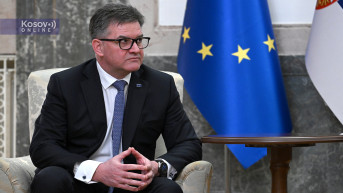
When the European Council appointed Miroslav Lajcak as the EU Special Representative for the Belgrade-Pristina dialogue four years ago, one of the tasks officially placed before him was to "achieve a comprehensive normalization of relations between Serbia and Kosovo." Lajcak's mandate expires at the end of August, and, as things stand, it is unlikely that the Slovak diplomat will be able to claim that he has successfully concluded this mission.
Although his appointment on April 3, 2020, was accompanied by comments that a diplomat of global caliber, persistent, with a good knowledge of the region, and fluent in the Serbian language, was taking over the role of mediator in the dialogue, interlocutors of Kosovo Online believe that he has not achieved any significant results during the past period. The problems that existed four years ago, they say, are still present today, and the mistrust between the two sides has intensified, although they also stress that the progress of the dialogue depended little on Lajcak.
It is worth noting that Lajcak was proposed as the EU Special Representative by the European Commissioner for Enlargement, the Spaniard Josep Borrell, and since neither Spain nor Slovakia have recognized Kosovo's independence, Pristina was openly unhappy in 2020 that diplomats from these countries would be in charge of the negotiations.
Dusan Prorokovic, a senior research associate at the Institute for International Politics and Economics, told Kosovo Online that the result of Lajcak's mediation is an increased conflict potential between Belgrade and Pristina and throughout the Balkans, and he does not see that the Slovak diplomat has achieved any significant results.
"I don't see that the long-term solution is what he has been doing. Simply put, solutions were imposed, invented, often realized under pressure, there was no compromise, everything was based on insincere attitudes, and this will leave long-term consequences. Of course, in the European Union, no one will admit that. They will say that Lajcak did a fantastic job, that the result of his work is Chapter 35, that the so-called Republic of Kosovo is opening doors in the Council of Europe, maybe even in some other international organizations. But these are all stories that they were saying back in 2008, and here we are in 2024 dealing with the same issues again," says Prorokovic for Kosovo Online.
He adds that in the long term, all the problems we have faced so far remain.
"Just now we have an incredibly increasing conflict potential based on mistrust. Here, no one trusts anyone anymore," Prorokovic notes.
Considering that Pristina had been objecting from the beginning to Lajcak's appointment as a mediator in the dialogue, and later due to his approach to the dialogue, our interlocutor says that he doesn't see many reasons for Albanians to be dissatisfied with Lajcak.
"But I see plenty of reasons for them to be dissatisfied, either with themselves or with the Americans. They expected everything to be resolved swiftly after 2008, for Serbia to recognize them, to establish bilateral relations... Why were they so confident? Because someone in Washington promised them that. That's why they hardly did anything and put their fate in the hands of Western intermediaries, and I don't know who in Washington could make such promises and how they could make such misjudgments. They achieved something, but they didn't finish the job as they thought they would 16 years ago, and probably because of that, they will now lay the blame on Lajcak. They will start shouting at him, Borell, and the EU, but the essence is somewhere else," assesses Prorokovic.
Foreign policy commentator Miroslav Stojanovic says that in the four years of Miroslav Lajcak's mandate as a mediator in the dialogue between Belgrade and Pristina, there have been no tangible results, and he failed not because he probably didn't want to but because his maneuvering options were limited.
"Although not directly involved in the negotiations in Brussels, the U.S. still 'sat in the other room' and in any case pulled the strings. The fact that he has strong support from the State Department is just a sign that America closely monitors what's happening there, even though the European Union has been entrusted with leading this kind of dialogue," says Stojanovic for Kosovo Online.
Stojanovic assesses that Lajcak, as an experienced diplomat who knows this terrain, tried, but despite his experience, he was 'clumsy' several times, as he bid for quick deadlines to finish the job.
"Then he kept postponing it for another six months, and those were extremely unrealistic deadlines. For these reasons, this mission can be considered extremely unsuccessful. But also for objective reasons, because the Kosovo knot cannot be cut so easily. It's a Gordian knot that big supporters of Kosovo's independence, very powerful countries, have tried to solve in haste, and that's an unsolvable issue. This will last for a long time, and this kind of uncertainty, of course, affects everyone living in our province, especially Serbs," says our interlocutor.
Stojanovic says that Lajcak was probably chosen as a mediator in the dialogue because he is familiar with the Balkans, having been involved in various missions in this region, but also because he comes from a country that has not recognized Kosovo.
"At that moment, it was expected that Belgrade would accept him more easily; however, it was a double game, he was Merkel's and Germany's favorite. Lajcak tried at all costs to leave the impression of an impartial mediator precisely because of Pristina, which is why it is very interesting that Pristina has accused him of bias in recent weeks, which I interpret as Pristina's battle for his successor, to profile the type of politician who will be more suitable for them. It is not at all surprising that in recent days they have talked about having great trust in the U.S., which is their great protector, but they have also mentioned the UK and Germany," Stojanovic points out.
University professor Nexhmedin Spahiu says for Kosovo Online that he does not know the real performance of the European Union representative for the dialogue between Belgrade and Pristina, Miroslav Lajcak, during his four years in this position because, he emphasizes, it depended little on him how things would go.
"It's not necessarily his merit that an agreement has been reached, but he cannot be blamed for the lack of better progress either. It depended little on him how things would go. I don't know what his performance is because the main actors of the European Union, such as Schulz and Macron, who exerted the necessary pressure on the parties to reach an agreement, contributed most to the mediation," says Spahiu.
However, he believes that Belgrade and Pristina are closer than they were before Lajcak became the mediator in the dialogue.
"Now we have an agreement on the CSM, we have the German-French agreement, and now the question is whether it will be implemented or not. But the fact that the agreement is on the table is a big step forward," says Spahiu.
Before becoming a mediator in the dialogue between Belgrade and Pristina, Lajcak had a long-standing career related to the Balkans. From 1999 to 2001, he was the Executive Assistant to the Special Envoy of the Secretary-General of the United Nations for the Balkans. From 2001 to 2005, he was the Ambassador of Slovakia to the Federal Republic of Yugoslavia. As the Personal Envoy of the EU High Representative on behalf of the EU, he negotiated, organized, and supervised the referendum on the independence of Montenegro in 2006. He served as the EU Special Representative for Bosnia and Herzegovina from 2007 to 2009 and as the High Representative of the international community in Bosnia and Herzegovina. He has also held positions as the Minister of Foreign Affairs of Slovakia and the President of the United Nations General Assembly (2017-2018).
Before Lajcak, the mediators in the dialogue between Belgrade and Pristina were Federica Mogherini and Catherine Ashton. His mandate expires on August 31, and from September 1, as reported by some media outlets, he will assume the position of EU Ambassador to Switzerland.
0 comments