
High offices, low penalties: Corruption scandals in Albania persist despite judicial reform
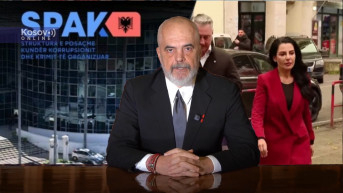
Albanian Deputy Prime Minister Belinda Balluku, a close associate of Edi Rama, has been charged by the Special Prosecution Office for the Fight against Corruption and Organized Crime with violating the equality of participants in tenders and public auctions. The indictment refers to the period when Balluku served as Minister of Infrastructure and Energy, and she is not the only high-ranking official under investigation. Analysts Gjergj Erebara and Leonard Karaj told Kosovo Online that the fight against corruption cannot be left exclusively in the hands of prosecutors and that stricter laws are necessary.
By: Bledar Kuka
In Albania, a fierce clash has begun between the prime minister and the special judiciary after the court decided to suspend Balluku from her functions. Rama, who did not dismiss her, referred the case to the Constitutional Court.
By a majority vote, this court decided to reinstate Balluku to her position. In a statement, the Constitutional Court said that the decision on Balluku would be published in the Official Gazette.
Meanwhile, concern is growing because, despite trials of many ministers, mayors, and so far two deputy prime ministers, corruption scandals at the highest levels continue.
Why is this happening?
Gjergj Erebara, editor of the regional media outlet BIRN and an economics specialist, told Kosovo Online that corruption cannot be stopped by prosecutors alone.
“The Balluku case, as well as other cases, shows that corruption in our country is at a systemic level, so we cannot trust that any tender is truly carried out properly in Albania. More or less, all public procurements are affected by corruption, and their very purpose is corruption. This problem is extremely serious because, in order to fix it, you would have to overthrow the corrupt political class and create a new political class. This is a very difficult, very complex process with an uncertain outcome,” he said.
Even if this political class were to be overthrown, he believes it would take many years to create a new political class in which corruption is not so widespread.
“Corruption exists everywhere in the world, so it cannot be completely eradicated, but it is one thing to have corruption, another to have corruption at high levels, and something entirely different to have systemic corruption. This is the case when the entire state is built on a model where tax money is stolen to buy votes, and votes are bought in order to steal tax money. This is a problem that requires the commitment of the whole society to fight it – prosecutors alone are not enough,” he said.
Lawyer Leonard Karaj, founder of the law firm LEAL and a former journalist, told Kosovo Online that the work of the prosecution is not at an adequate level, because people suspected of corruption are mostly charged with abuse of office, although the Balluku case is somewhat different.
“The case of Ms. Balluku is a special case in the full sense of the word, both legally and as a corruption case, of course if the court confirms it. I am waiting for the court because, for the prosecution, Ms. Balluku has been charged and this legal status means that, in the prosecution’s view, this person committed a criminal offense. Of course, I have a different view compared to many judicial experts or lawyers regarding the criminal offense attributed to Ms. Balluku. So, we are talking about a violation of equality in public tenders. I believe it is not normal for Ms. Balluku to be charged with such a minor criminal offense, because if you look at the things revealed in her investigative file, we are not dealing only with a violation of equality in tenders, but at least with theft under Article 135 of the Criminal Code, and in the most serious case we are dealing with corruption,” the lawyer said.
He believes that abuse of office is an invention in the Albanian Criminal Code designed to make the prosecution’s work easier.
“In this case, the prosecution does not even try to uncover what kind of corruption a certain official committed, but instead charges them with abuse of office – a criminal offense that is often not punished with even a single day in prison, as has happened in other cases. I would not call the Balluku case an ‘alarm bell’, because in our country those ‘bells’ have been completely destroyed, but I would appreciate the fact that the Special Prosecution Office, for the first time, investigated the tender procedure of such a powerful individual. This had never happened before, neither with Mr. Beqaj (the former health minister), nor with Mr. Veliaj, nor even in the incinerator cases, where several people were investigated and convicted, but never for the tender procedure itself, which was never investigated,” he said.
Karaj says that the public prosecution process in Albania has deteriorated and that the laws leave a lot of room for corruption to go inadequately punished.
“We have had two tender periods in Albania. The first until 2013, when the government of Mr. Berisha boasted that, thanks to responsible public procurement procedures, millions of euros were saved in the state budget. I remember that in 2018 this figure was 18 million euros, and that was due to competition in tenders. Then we moved to the period from 2013 to 2025, where tender acts no longer exist. The tender has now remained an administrative term, but the legal aspect of these procedures is not respected at all. Almost all tenders are awarded at the maximum limit fund, almost all tenders are won by companies that submitted the only bid or in cases where there is only one company participating in the competition. We have countless such cases,” he emphasized.
He adds that the biggest problem is that no one in Albania is afraid of the law.
“This is a very serious problem. Two or three months ago, Mr. Altin Dumani, head of the Special Structure for the Fight against Corruption and Organized Crime, stated in parliament that in 2024 cases of corruption in tenders increased. So, we have a special judiciary fighting corruption, but at the same time, paradoxically, the level of corruption is rising instead of falling. This shows that people here are no longer afraid of the law. What needs to be done? The Criminal Code must be changed and these criminal offenses must carry much stricter penalties. The law should not be as it is now, where an offense is punished, for example, from one to seven years. This difference creates opportunities for extraordinary abuse. Criminal offenses that cause great damage to the Albanian state should have penalties with a smaller range, for example from three to 10 years or from five to 10 years, so that the court is not given the opportunity to help the accused receive little or no punishment,” Karaj said.
What are these internal audit bodies for?
However, despite ongoing corruption scandals at high levels, Erebara believes that judicial reform has produced results and that there are areas in which Albania has made progress.
“We must take into account the fact that the new judicial system has not only cleaned part of the ‘mud’ that existed in our country, but has also brought another major change in the autonomy of prosecutors’ decision-making. This means that the change compared to the previous judicial system is quite significant. In the previous system, there was a chief prosecutor elected by parliament, and he had full power over the career of every other prosecutor and complete influence over them. He decided everything. The government or the political class at the time did not have to control 300 prosecutors and 300 judges, which is approximately how many there are in Albania, but it was enough to control the chief prosecutor, who then controlled everyone else. This pyramidal system, built during the communist era, served to turn the prosecution into a ‘whip’ of politics against the people,” he said.
According to him, judicial reform had many components, but the element of prosecutorial independence made it harder for politicians to control them.
“There are 20 prosecutors in SPAK and each of them has their own autonomy, but also their own character. There are prosecutors who are braver, those who are more fearful, some are more capable, others less so. The remaining problem is that high-level corruption and those we call ‘big fish’ are the subject of many cases, but are often investigated for only one. It is true that justice is moving in the right direction, but the prosecution cannot replace the political processes that citizens themselves must carry out,” Erebara said.
Lawyer Karaj also blames the government and its internal control bodies for doing nothing to fight corruption in public administration, even though they are paid with taxpayers’ money.
“In such cases, the executive power, that is, the government, should be held responsible. Why? Because we have adopted many laws and bylaws, which is characteristic of a bureaucratic state, and Albania is unfortunately such a state. On the other hand, the government has not intervened in a single case through its internal audit bodies. We should know that citizens pay for 70 to 80 internal audit institutions in ministries and local governments, and each of these institutions may have five or ten people receiving salaries. The fact is that during all these years, not a single internal audit has been conducted and not a single criminal case of corruption has been sent to court,” he emphasized.
Because of all this, the lawyer poses, as he says, a very simple question – what are these internal audit bodies for?
“Why are Albanian taxes spent on paying these bodies when they do not uncover a single case of corruption in public tenders? The same applies to public procurement commissions, first- and second-instance commissions. It happens that they conduct investigations for procedural purposes, but these procedures are never forwarded for criminal prosecution to the special prosecution office, nor to general prosecution offices,” Karaj concluded.
In recent years in Albania, trials have been held and convictions handed down against many high-ranking officials, such as former Deputy Prime Minister Arben Ahmetaj, Deputy Prime Minister Belinda Balluku, former Health Minister Ilir Beqaj, Tirana Mayor Erion Veliaj...


0 comments