
How are Belgrade and Pristina viewed from the land of the rising Sun?
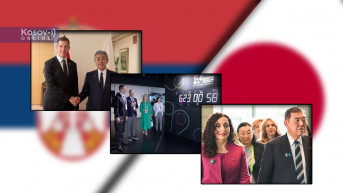
Within just a few months, senior officials from both Belgrade and Pristina have visited Japan. First, in mid-June, Kosovo’s President Vjosa Osmani declared that the two countries “share the same values,” while Serbia’s Foreign Minister Marko Djuric is currently on a two-day official visit. For analysts speaking to Kosovo Online, despite having recognized Kosovo, Japan seeks excellent cooperation with Serbia, demonstrated not only through increasing investments but also by the fact that on several occasions Tokyo refrained from voting for Pristina’s membership in UNESCO and Interpol.
Written by: Djordje Barovic
Minister Djuric, at the beginning of his official visit, underscored:
“This is an important visit to strengthen Serbia’s position in Japan and a prelude to further high-level visits we will have next month. Japan is an important partner for Serbia, and that is why today’s meetings with Foreign Minister Takeshi Iwaya, with representatives of the Japan External Trade Organization (JETRO), and with members of the parliamentary group, were held in a positive spirit.”
In his talks with Foreign Minister Iwaya, Djuric briefed him on the current situation in Kosovo, stressing that “the fundamental human rights of the Serbian population are seriously endangered by Pristina’s latest escalatory moves.”
According to a statement from Serbia’s MFA, Djuric emphasized the importance of respecting the principles of international law, as well as protecting the fundamental human rights of the Serbian population, which have been “seriously endangered by Pristina’s latest escalatory actions.”
By contrast, during her visit to Japan, President Osmani held a series of separate meetings with Japanese officials.
In talks with Prime Minister Shigeru Ishiba, Osmani expressed gratitude for “the commitment to deepening the partnership between Japan and Kosovo,” as well as discussions on the possibility of abolishing visa requirements for Kosovo citizens.
Perceptions of the Western Balkans
Speaking to Kosovo Online, Serbia’s former ambassador to Japan, Nenad Glisic, emphasized that Japan understands Belgrade’s position regarding Kosovo, and that bilateral cooperation has been on a steady upward trajectory over the last decade, with Tokyo perceiving Serbia as the most important country in the Western Balkans.
“Serbia–Japan relations have been consistently advancing for more than ten years, especially since former Prime Minister Shinzo Abe’s visit in 2018. This led to an increase in investments, stronger political dialogue and alignment, as well as cooperation on the multilateral level and in other fields. As long as this level of cooperation is maintained, relations will continue upward,” Glisic explained.
Commenting on the timing of Djuric’s visit, Glisic noted:
“The visit comes at the right moment, since (Vjosa) Osmani was recently here, and it is now important to once again seek support for our positions regarding Kosovo.”
He recalled that this was the first such visit since 2009, though in the meantime Serbia was visited by Prime Minister Abe and two Japanese foreign ministers.
On Japan’s relations with Pristina, Glisic underlined that Tokyo’s recognition of Kosovo was in line with the foreign policy of its main allies.
“Japan aligns its foreign policy positions with its G7 partners, especially the United States. Thus, recognition followed ‘automatically.’ Just as the main partners acted toward Kosovo’s independence, so Japan followed,” Glisic said.
Nevertheless, he noted, Japan has demonstrated it would not engage in “unilateral moves,” including its abstentions in votes on Kosovo’s membership in international organizations.
Glisic reminded that Japan abstained twice on Kosovo’s Interpol membership and once on UNESCO.
“Serbia has worked hard over the past decade in countering Kosovo’s attempts to join international organizations. Japan’s basic stance is to build relations with both Kosovo and Serbia. Since recognition already occurred, Serbia was in a more difficult position, but we managed through diplomacy to secure understanding for our positions, which led to Japan’s neutral stance in UNESCO and Interpol votes. This was a balancing act,” Glisic explained.
He stressed that Japan consistently highlights Serbia as the most important country in the Western Balkans.
“This is evident through various initiatives, cooperation, economic investments, and other engagements. Since 2000, Japan has provided substantial assistance, and Serbia stands out in this regard – not only compared to Kosovo but also relative to many other Western Balkan countries,” Glisic noted.
Cooperation and Neutrality
Legal scholar and political analyst Blerim Burjani argued that Japan maintains good relations with both Kosovo and Serbia while remaining neutral in the EU-mediated dialogue.
“Japan enjoys good cooperation with both Kosovo and Serbia, remains neutral regarding the dialogue, but supports the EU and the United States. With respect to Kosovo, cooperation is excellent. Japan recognized its independence, but it also seeks good relations with Serbia,” Burjani told Kosovo Online.
He emphasized that Japan supports Kosovo’s membership in international organizations and provides assistance in the fields of economy, culture, and education, while leaving the facilitation of dialogue to the United States and the European Union.
Unresolved Territorial Questions
Translator and long-time correspondent from Japan, Dragan Milenkovic, stressed that it is important for Serbia to present all relevant facts about Kosovo to official Tokyo, while also reminding Japan that it, too, faces unresolved territorial disputes.
He recalled Japan’s ongoing dispute with Russia dating back to the end of World War II over a group of islands between Japan’s Hokkaido and Russia’s Kamchatka, known as the “Northern Territories.”
“They should be reminded that they too have the Northern Islands – some call them the Kuril Islands, others the ‘Northern Territories.’ These were taken away and have not been returned. A peace treaty has still not been signed with the Soviet Union, later Russia, since World War II. So there are always parallels to be drawn,” Milenkovic said.
When Kosovo’s President Osmani, during her June visit, claimed that relations with Japan are “built on shared values,” Milenkovic argued such statements must be countered with facts.
“Pristina shouldn’t be countered with slogans but with facts. She (Vjosa Osmani) said that Kosovo and Japan share the same values. Do those values include protecting monuments under UNESCO’s safeguard? We know that the Church of the Holy Virgin of Ljevisa, one of the most beautiful churches in Kosovo and Metohija, was burned down by those very people they recognized,” Milenkovic remarked.
He stressed that Japan recognized Kosovo “under pressure from Western allies with whom it has close ties,” noting that Japan recently regained the right to maintain armed forces and has become a NATO observer.
According to Milenkovic, Belgrade can “counter” Pristina with practice, not slogans.
“We can counter with even stronger cooperation, with economic engagement, with far better conditions than they offer. We have practice, they only have rhetoric. With practice, we can prevail and further strengthen cooperation,” Milenkovic stated with confidence.
Commenting on Djuric’s visit, Milenkovic said relations between the two countries are “on an upward trajectory,” reflected also by the number of Japanese investments in Serbia.
He expressed confidence that deeper economic cooperation could not only strengthen ties but potentially lead to a shift in Japan’s position on Kosovo recognition.
“At the Osaka Expo, our pavilion is very well visited and well presented. Japan has already announced its participation in our Expo (2027). These are the paths of cooperation and new steps after which everything can fall into place – just as Japan followed others in recognition, it could also follow in de-recognition,” Milenkovic concluded for Kosovo Online.


0 comments