
Sorensen in Belgrade: Can the EU return the Dialogue with Pristina to fundamental principles?
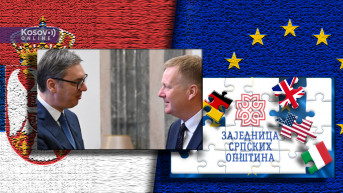
Return of the dialogue to fundamental principles. This was the key message of Serbian President Aleksandar Vucic to European mediator in negotiations Peter Sorensen during his “Belgrade tour.” Pressured by the war in Ukraine and internal crisis, the Kosovo issue is no longer in the focus of the EU’s attention, making it difficult to expect progress in the dialogue or the fulfillment of the “condition of all conditions” – the formation of the Community of Serb Municipalities, interlocutors of Kosovo Online believe.
Written by: Djordje Barovic
During his visit to Belgrade, Sorensen held several separate meetings, in all of which he was presented with the security and political challenges faced by the Serbian community in Kosovo.
In addition to talks with Vucic, Sorensen also met with Serbian Foreign Minister Marko Đuric.
“Stressing the necessity for the international community, and especially the EU, to exert stronger influence on the authorities in Pristina in order to avoid further unilateral and provocative moves against Serbs and representatives of their political organizations, Minister Đuric pointed out that in recent weeks there has been an increase in entry bans for certain Serbs whose families live in the territory of Kosovo and Metohija,” the ministry’s statement reads.
Serbian Minister for European Integration Nemanja Starovic said that his key message to Sorensen was that “dialogue has no alternative.”
“I informed him about a series of unilateral and escalatory moves undertaken by Kurti’s regime against the Serbian community in the province, carried out completely outside the framework of dialogue,” Starovic noted.
Analysts with Divergent Views.
Analysts interpret the visit of the European mediator to Belgrade in two ways. While political scientist Ognjen Gogic claims it represents “breaking the ice,” Strategic Director at the Center for European Policies Miloš Pavkovic argues that Sorensen’s visits to Belgrade and Pristina have “proven fruitless.”
Kosovo Out of the EU’s Focus
In a conversation with Kosovo Online, Aleksandar Sljuka, associate of the NGO “New Social Initiative” from North Mitrovica, assessed that Kosovo is currently outside the EU’s focus, and therefore Sorensen’s visit to Belgrade should not be interpreted in the light of current developments in Kosovo – from attempts to ban the Serb List to the obstruction of electing a representative of the majority Serbian party as deputy speaker from the ranks of minority communities.
“I wouldn’t say this visit is connected to current events, considering that such visits are usually planned well in advance. After his visit to Pristina, he himself said that he would realize a visit to Belgrade. The planning period passed, and this is a usual diplomatic occurrence. I think it is a coincidence that it coincided with these events. It could have overlapped with other events as well,” Sljuka emphasized.
Asked whether the ban on the Serb List, as well as a series of other developments in Kosovo, “hurried up” Sorensen’s visit to Belgrade, this analyst is convinced that these were indeed topics with Serbia’s top officials, but not the reason for his visit.
Sljuka claims that at this moment the influence of the EU’s chief mediator in the dialogue is not significant.
“We have seen visits to Belgrade and Pristina, but we have not seen anything concrete from the meetings, especially not meetings at the highest level. We have not seen that since September 2023. Simply put, the focus of the West and the EU at this moment is not Kosovo and the situation here. There are much more important issues in the world, such as Gaza and Ukraine. On the other hand, the relationship between the EU and the US administration is not particularly good or fully established on common grounds. In such a situation, if Sorensen does not have clear support and focus from the highest EU officials, and if there is no coordination between the EU and the US, it is difficult to expect any progress in the dialogue,” Sljuka explained.
He added that the possibility of new rounds of talks at the technical level should not be ruled out.
“To resolve concrete issues, coordination between transatlantic partners is needed, as well as support from the EU leadership and the most important European states. Ultimately, we have political crises both in Belgrade and in Pristina. Under such circumstances, it is unlikely that a breakthrough could occur. There are many factors that need to align. It is difficult to expect progress in the near future,” Sljuka concluded.
An Important Moment for Dialogue
Professor of International Relations at the University of Pristina Afrim Hoti thinks differently. He told Kosovo Online that Sorensen’s visit to Belgrade came at an important moment due to political crises in both Serbia and Kosovo, and that the EU representative conveyed a clear message that normalization of relations is inevitable.
“His visit is very important, especially in these moments of political crisis in both countries,” Hoti said confidently.
He added that Sorensen first sent this message to Pristina, and now to Belgrade as well.
“The visit to Serbia shows that with Mr. Vucic or with any eventual change, the normalization of relations between Kosovo and Serbia is inevitable. The same signal was given to Kosovo, which, as soon as it establishes new institutions, must begin taking concrete steps in that direction,” Hoti stressed.
“Dead Letter on Paper”
Security studies researcher Nikola Vujinovic stressed that although the visit of the EU’s chief mediator in the dialogue between Belgrade and Pristina was expected, it was at the same time a consequence of “political violence” against the Serbian community in Kosovo.
“This was an expected visit. From the moment he was selected as mediator by the new European Commission, it was to be expected that such a visit would follow. It is somewhat unusual that it happened in August, but one reason lies in the consequences of what is currently happening in Kosovo – political violence against the Serbian community and the Serb List,” Vujinovic told Kosovo Online.
He explained that these were also the key messages Serbian officials conveyed to Sorensen.
Vujinovic is convinced that with the formation of institutions in Kosovo, the dialogue will continue, along with the EU’s further insistence on the formation of the Community of Serb Municipalities. However, he warned that this could remain a “dead letter on paper.”
“The entire behavior of Self-Determination and Albin Kurti is not only politically based in preparing for a new election campaign but also a broader attempt to diplomatically prepare for these negotiations. EU pressure is indeed for the CSM to be formed. It is quite likely that it will be formed, but completely emptied of substance. It will be only a dead letter on paper,” Vujinovic argued.
He expressed concern that Pristina’s latest moves, culminating in the attempt to exclude the Serb List from the electoral process, will be used as an “argument” in the continuation of negotiations.
“This visit encourages me also because of the statements by our officials – the President, the Foreign Minister, and the Minister for European Integration – that dialogue has no alternative. Regardless of the many voices suggesting a different approach, given Serbia’s internal political situation, Serbia’s foreign policy position, and the overall geopolitical situation in the world – dialogue remains a priority,” Vujinovic emphasized.
Asked how ready European mediator Peter Sorensen is to hear the Serbian side’s arguments, Vujinovic replied with a folk proverb.
“As our people say, he is ‘ready to hear, but not to listen.’ I think he already has a prepared agenda, a prepared outcome. We see that the EU views Kosovo’s independence as the result of negotiations, which for us is unacceptable. That is the direction these negotiations will take. As our people say, ‘two wrongs make one right.’ I fear that, as much as I am an optimist and want negotiations to be the instrument for resolving this major problem, the EU and the Albanian community are working together so that the Serbian community accepts and agrees to all of it. But I remain optimistic, as I was with all previous mediators, because what is the alternative? The status quo,” Vujinovic concluded.


0 comments