
If she is not re-elected, what role will Vjosa Osmani have on the political scene?
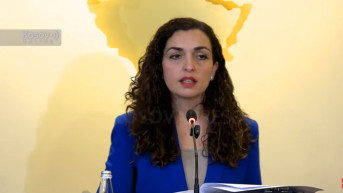
It is not yet known whether she will be among the candidates for the presidency of Kosovo in the next five years, but even if she is not nominated or fails to secure the required number of votes in the race, that would not mark the end of Vjosa Osmani’s political career. This is the assessment of interlocutors for Kosovo Online, who believe that Osmani could remain on Kosovo’s political scene either through her party Guxo or by forming a new one, and that Kosovo’s allies still count on her.
Written by: Dusica Radeka Djordjevic
Opposition parties have frequently criticized Vjosa Osmani for often siding with the Government of Kosovo during her five-year presidential term or remaining silent on key issues.
For that reason, the Democratic Party of Kosovo (PDK) has already announced that it will not support her for another presidential mandate.
On the other hand, the leader of the Democratic League of Kosovo (LDK), Lumir Abdixhiku, stated that his party does not hold a rejecting position toward anyone, including Osmani.
Before becoming President of Kosovo on April 4, 2021, Osmani served as Speaker of the Assembly and was a member of parliament for five consecutive terms. She graduated from the Faculty of Law at the University of Pristina and holds a doctorate in international law from the University of Pittsburgh.
Founding a New Party?
If she does not secure a second presidential mandate, political analyst Artan Muhaxhiri believes that this would by no means mean her withdrawal from politics.
“She will continue to be an important part of Kosovo’s political scene, regardless of the form,” Muhaxhiri told Kosovo Online.
In the event that she is not re-elected, Muhaxhiri believes that Osmani would likely take a short break before returning strongly to the political scene, either through her party Guxo or by establishing a new political party.
Osmani, he notes, is politically very young and energetic.
“I believe she will remain an important actor because voters like her. Within the Kosovo electorate she has a very positive image, dating back to the time when she was in the LDK and later when she founded her own party. I believe she will remain because, although young, she has extensive experience. She was very young when she began working as a political adviser to former President Sejdiu, and she has gone through all the major political developments of the past decades. Therefore, I do not think she would have any difficulty establishing a new party and even becoming the fourth political force in the upcoming elections, after Self-Determination, PDK and LDK,” Muhaxhiri said.
After being elected president five years ago and taking the oath of office, Osmani stepped down as leader of the Guxo list, which she had founded, while Guxo was officially registered as a political party a year later.
Before that, she had been a member of the LDK, from whose leading positions she was dismissed in June 2020. Her removal was requested by the then leader of LDK, Isa Mustafa, who argued that during the Assembly session that voted on a motion of no confidence in the government of Albin Kurti, Osmani—who at the time served as Speaker of Parliament—contrary to the position of the LDK Presidency, called for the motion not to be supported.
International Support
If she fails to secure a second presidential mandate, Aleksandar Mitic, a senior research fellow at the Institute of International Politics and Economics in Belgrade, also believes that she still has a clear political future in Pristina and that she is particularly counted on in Washington, and to some extent in Brussels.
“It is clear that Vjosa Osmani has become a political actor on the Pristina political scene who must remain in some position—whether an official one or simply political, in the sense of leading a political party. Regarding her future mission, there will likely be a very clear agreement. Everything that has been done so far has been carried out in full coordination and in accordance with Albanian interests and the interests of their sponsors. I do not believe they will miss the opportunity to continue a policy they probably consider to have brought significant progress for their interests in recent years. She is a very useful foreign policy asset for the political West, for Turkey, and for Saudi Arabia; she is also useful for Kurti, and I do not believe he will easily give her up,” Mitic told Kosovo Online.
Speaking about her term, which is approaching its end, he believes that Osmani played a significant role in advancing Albanian interests in Kosovo.
“She presented herself internationally as someone performing the role assigned to her by mentors in the political West, Turkey and Saudi Arabia—the sponsors of so-called Kosovo independence—in order to legalize and further legitimize Kosovo within the international community. She was relatively successful in that, particularly last year. With considerable assistance from Ankara, Riyadh and Washington, recognitions were reportedly secured from Syria, Kenya, Sudan and the Bahamas. It is a fact that she made a positive step in advancing Albanian interests in Kosovo and Metohija,” Mitic said.
At the same time, he adds, Osmani played an important role in attempting to balance between Berlin and Washington. It is well known, he notes, that Albin Kurti is considered closer to Germany and enjoys primarily German backing, while the United States has at times criticized him, at least formally.
According to Mitic, Osmani clearly aligned herself with the United States, especially during the past year and at the beginning of this year.
“The two of them, Kurti and Osmani, were playing a coordinated game. It is clear that this was a coordinated approach in which Kurti acted as the hard-line figure making unilateral and sharp moves on the ground and absorbing criticism, while Osmani softened that image within the international community, particularly in Brussels. That produced certain results, including progress regarding the lifting of so-called measures against Pristina, which were rather symbolic but gradually diluted in part through her diplomatic engagement,” Mitic assessed.
“Without Sensitivity for Serbian Interests”
At the same time, he notes, it remains questionable how much influence Osmani actually had domestically, given that Albin Kurti is widely seen as the central political decision-maker in Kosovo.
“All of this does not in any way absolve Vjosa Osmani of moral, and possibly even criminal, responsibility for the ethnic cleansing of Kosovo Serbs, for ethnic and institutional discrimination, and for everything that has occurred over the past five years, which have been extremely difficult for Serbs in Kosovo and Metohija. She took a very hard line, without any particular sensitivity to their interests.
Apart from a few rhetorical statements, she did nothing substantial to improve the status of Serbs in Kosovo and Metohija. She took a very firm stance against Belgrade and, of course, also against Russia and China, which was expected within the narrative that exists in Pristina,” Mitic said.
Possibility of a Second Mandate
For Vjosa Osmani, who was born in Mitrovica, to be nominated for a second term, at least 30 members of parliament must support her candidacy with their signatures.
If signatures were to be collected in South Mitrovica, there would likely be strong chances of obtaining them, judging by the views of some local residents.
“I am almost certain that Vjosa Osmani is suitable for another mandate as president. She is very capable, an excellent speaker and organizer. I believe she deserves it,” Sinan Shala from South Mitrovica told Kosovo Press.
Sabri Osmani also praised her abilities.
“There are very few people in Kosovo as intelligent and capable as Vjosa Osmani. Her grandfather was like that, her father was like that, her great-grandfather was capable. They are generally patriotic and intelligent,” Sabri Osmani said.
Osmani was elected President of Kosovo in 2021 as the candidate of the Self-Determination Movement. Her opponent was Nasuf Bejta, also from Self-Determination, but neither of them received the required 80 votes in the first two rounds of voting. She was elected president in the third round with 71 votes.

0 comments