
Isolated incident or terrorism: Different perspectives of the international community on Banjska and Kumanovo
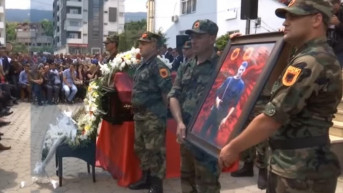
The events in Banjska on September 24 reminded the entire region of May 2015 when a group of Albanians from Kosovo opened fire on Macedonian police officers in Kumanovo, killing eight of them. Besides being, as noted by the sources of Kosovo Online, an "isolated incident" at the time, it is also a fact that Macedonian forces did not kill the wounded attackers – 37 of them were injured and arrested.
Furthermore, they point out that the international community's perspective on the events themselves and what followed differs. As Minister of Foreign Affairs of Serbia Ivica Dacic reminds us, there has been no condemnation of the glorification of the attackers from Kumanovo.
Recently, Serbian President Aleksandar Vucic recalled the events in Kumanovo, also highlighting the hypocrisy of the West when it spoke of "European values". He pointed out that in 2015, after the major conflict in Kumanovo involving Albanian terrorists attacking Macedonia, a United Nations member, there had been a "state" funeral in Pristina, complete with uniforms of the KLA, and no one from the region or Europe "gave lectures". One of the killed Albanians, Beg Rizaj, even received a monument.
What is particularly problematic in the case of the murder of the three Serbs in Banjska is the way they were killed. The silence of EULEX on questions regarding the autopsy is particularly suspicious. This was pointed out by the Director of the Office for Kosovo and Metohija, Petar Petkovic, who emphasized that the issue of the autopsy was crucial, especially regarding the two murdered Serbs, Bojan Mijailovic and Igor Milenkovic.
The Mayor of Kumanovo, Maksim Dimitrievski, remembers all the events from eight years ago. He believes that the international community acted very responsibly at that time, condemned the attack, and, according to his information, directly intervened in the events and in the negotiations that were taking place. He believes that without their involvement, the conflict would have lasted longer and the material and human losses would have been greater.
"And if you are trying to draw a parallel with what happened in Kosovo, I think there are quite a few similarities in both cases. The state should react in an organized manner, but on the other hand, in neither case in Macedonia were individuals who were injured or shot killed. They were captured, tried, and are currently serving a final prison sentence," Dimitrievski for Kosovo Online emphasized.
There is no doubt that at that time, a "classic terrorist act" occurred, preceded by the attack on the Goshintse border post, where they acquired vast amounts of weaponry.
"Two days of war. May 9th celebrated as 'Europe Day', May 10th in Moscow celebrated the victory over fascism, and in Kumanovo, a two-day mini-war took place, ending tragically with the killing of eight police officers and over thirty-seven injured," he stated.
According to him, Kumanovo remains traumatized by these events to this day, and he believes the entire country and the whole region are affected.
"We had no experience with such events, with terrorist attacks in the city, but before that, it was felt that something was brewing because there was a noticeable increase in police presence and their positioning at certain locations in the city, which means that our state services had some information. However, we as citizens never received an official answer as to who the scriptwriter was and who the director of what happened," Dimitrievski noted.
In the name of the OSCE that year, the current head of Serbian diplomacy, Ivica Dacic, had discussions with the Macedonian authorities, recalling that at that time, no international officials, including the EU, characterized it as terrorism in which eight police officers were killed.
"Albania and Kosovo paid all respects to the terrorists in Kumanovo. I even mentioned, since Donika Gervalla talks about violating territorial integrity, that in the Cultural Center in Decani, named after her father, Jusuf Gervalla, homage was paid to the terrorist who perished in Kumanovo. A monument was erected in his honor. Each family of the deceased or convicted was given 10,000 euros by the Kosovo authorities. Nobody talked about it," Dacic said.
Correspondent for Politika from Skopje, Zeljko Sain, said for Kosovo Online that the international community had characterized the Kumanovo incident as an isolated phenomenon even though a group of armed individuals in KLA uniforms had crossed into foreign territory, while the conflict in Banjska was characterized as a terrorist act, even though it involved people fighting for their freedom on their own territory.
"In Kumanovo, we had an army of people who were trained, wearing KLA uniforms, and they entered the territory of another state. Kosovo, or rather the leadership at the time, rewarded the participants, that is, the families of those who were a part of that operation".
He states that the US, EU, NATO, and OSCE issued a joint statement in which they indicated that the attack in Macedonia was an isolated phenomenon and hoped it would not affect social events within Macedonia. However, today's events in Banjska are described as a terrorist attack, which is announced by these same countries and organizations.
Ivan Stoilkovic, the President of the Democratic Party of the Serbs in North Macedonia, believes that the events in Kumanovo in 2015 and in Banjska on September 24 indicate double standards within the international community, as well as among some politicians in the region. He states that "the event in Macedonia was more than terrorism".
"In Kumanovo, we had something more than terrorism. It was an attempt, in a way, to say, to stage a revolution in the country. And you had a very organized group of Albanian terrorists with support from various structures, both here in Macedonia and from Kosovo and Metohija. I doubt that this was not done with the support of a part of the international community," Stoilkovic noted.

0 comments