
Joint Committee of North and South Mitrovica – A short-lived venture or a body with a future?
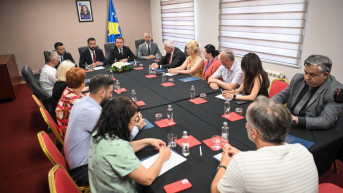
Symptomatically established just four months before local elections—despite being foreseen in a law adopted 17 years ago—the Joint Committee of North and South Mitrovica may have a future if it remains focused on local issues rather than high politics, according to interlocutors of Kosovo Online. Topics requiring cooperation between the two municipalities, such as water supply or local infrastructure, could be on its agenda, but without a final demarcation between North and South Mitrovica, joint projects will be difficult to implement.
Written by: Dusica Radeka Djordjevic
According to the explanation provided by the Kosovo government in a technical mandate, the Joint Committee of North and South Mitrovica will offer “a new model of institutional cooperation aimed at improving the everyday lives of citizens.”
The existence of a Joint Committee between the two municipalities was also envisaged by the Ahtisaari Plan, which official Belgrade never accepted, while its formation is mandated by the Law on Administrative Municipal Boundaries, adopted by the Kosovo Assembly on 20 February 2008.
As stipulated in the original version of the law, the Committee consists of eleven members—five representatives from each municipality and one international representative who chairs the Committee. Following a legal amendment in 2012, the chairmanship was assigned to a representative of the Kosovo Government, and since 12 June, by decision of the current Prime Minister in a technical mandate, Albin Kurti, the chair is Elbert Krasniqi, Minister of Local Government Administration in a technical mandate.
According to the Mayor of North Mitrovica, Erden Atiq, the Committee will address all projects and plans concerning both municipalities of the same city, considering that Mitrovica is the only city divided into two municipalities. Since there is no official cadastral demarcation between North and South Mitrovica, Atiq told Kosovo Online that he doubts this process can be completed before the upcoming local elections, given its complexity.
Signing a joint project on the construction of two new bridges over the Ibar River was, however, less complicated. Signatures were affixed yesterday by Atiq, the Deputy Mayor of South Mitrovica, Arijan Tahiri, and the Minister of Infrastructure in a technical mandate, Liburn Aliu, in the presence of Krasniqi as Committee Chairman.
Cooperation and Constraints
According to analyst Nexhmedin Spahiu, the municipalities of North and South Mitrovica share many commonalities, and cooperation could help resolve many issues since they are parts of the same city.
“For example, one municipality cannot build a factory near the border of the other because it could disrupt the other municipality’s development plans. So, all key developmental issues must be harmonized,” Spahiu told Kosovo Online.
Aleksandar Rapajic, Program Director of the NGO Center for Advocacy of Democratic Culture in North Mitrovica, believes the Committee should focus on local issues requiring cooperation, such as water supply, infrastructure, or regulation of the Ibar River, and avoid larger political matters beyond its scope.
Dragisa Mijacic, coordinator of the EU National Convention’s Chapter 35 Working Group, comments on the timing of the Committee’s formation, suggesting its purpose is primarily to politically align the two municipalities within the same party, especially ahead of elections.
“Mr. Atiq, the Mayor of North Mitrovica, does not currently represent the majority community—Serbs—in the north. Therefore, the scope of such an initiative is quite limited, especially since local elections are scheduled for October,” Mijacic told Kosovo Online.
Still, he adds that when it comes to functional cooperation between the two municipalities, efforts should be made to bring them closer through joint projects that also support inter-community rapprochement. He stresses that demarcating the North and South is a prerequisite for such infrastructure cooperation.
“This is something the Committee could work on to create conditions for eventually opening the main bridge. But implementing major capital projects amid the deep societal and political divisions between the Serb-majority North and the Albanian-majority South is more counterproductive than useful at this time,” Mijacic said.
What Happens After the Elections?
In North Mitrovica, where Serbs form the majority, an Albanian mayor is currently in office due to the Serb boycott of the 2023 elections. Whether cooperation through the Joint Committee will continue after the 12 October local elections—where Serb participation is expected—remains to be seen.
“Whether the Committee will function after new elections, with a likely Serb mayor in the North, will largely depend on who gets elected—not just their party affiliation, but their personalities and intentions. If they are reasonable people looking to develop their respective municipalities, they will cooperate. If they are only interested in corruption, they will likely work against cooperation,” Spahiu stated.
Mijacic emphasized that post-election cooperation between North and South Mitrovica would be beneficial for all citizens.
“There are numerous infrastructure problems that should be resolved jointly, rather than through majoritarian rule as is now the case. Solutions that accommodate all communities must be based on mutual respect and agreement,” he said.
As for the Committee’s future after 12 October, Rapajic says it will depend on the election results.
“Its continuation will depend on who wins in the North—but even more so on who wins in the South. We hope Serbian parties return to power in North Mitrovica. In general, the two municipalities must cooperate on certain matters. If they stick to local issues, they can function. If they manage to keep politics out of it,” Rapajic told Kosovo Online.
The Question of the Main Bridge
A pressing issue is whether the sensitive topic of reopening the main Ibar Bridge, especially from the Serb perspective, could become part of the Committee's agenda—even before the local elections.
According to Rapajic, there is pressure around the issue, but it must be resolved through high-level negotiations, not decisions by the two municipalities.
“Since the local government changed in North Mitrovica, one of the Assembly’s first initiatives was to open the bridge. It’s a difficult political matter used as a political tool. Its reopening is being framed as a final victory of Pristina over the northern Serbs. If such an initiative is adopted, I believe the international community will block it again—as they have before—since this must be part of broader negotiations,” Rapajic stated.
Spahiu, however, believes the bridge opening poses no threat and actually benefits the North more than the South.
“Going from North to South leads directly to the main road, while going from South to North leads through backstreets. Opening the bridge would ease traffic on both sides and has no other real significance. The bridge no longer holds political weight as it did during the times of ethnic tension. Now its only purpose is to facilitate mobility. It’s expected that more bridges will be built, as they’re much needed in a city, regardless of municipal division,” Spahiu noted.
Mijacic agrees the main bridge will not be opened before the 12 October elections and points out that KFOR has been clear on the matter.
“There’s a Brussels agreement about the bridge, which includes demarcating North and South Mitrovica. Until that happens, the bridge will remain closed. KFOR, as the security guarantor at the site, announced last year that the bridge would not reopen until all points from the Brussels Dialogue are implemented. I expect KFOR to maintain that position through this summer,” he said.
He also emphasized that demarcation is crucial in the context of holding local elections.
“It’s currently unclear who votes in which municipality—who votes for the mayor and councilors in the North, and who in the South. This situation has been abnormal for years, ever since the agreement on forming North Mitrovica municipality was reached,” Mijacic concluded.


0 comments