
Young people and seasonal jobs: Spending the summer working on the Adriatic – combining business with pleasure
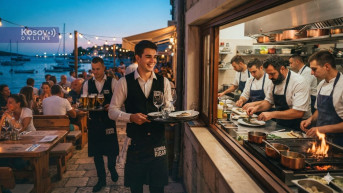
This year's tourist season on the Adriatic has been marked by an unprecedented race to secure seasonal workers, primarily from the region. Young people overwhelmingly choose the Croatian and Montenegrin coasts as the most attractive destinations for summer jobs, mainly in hospitality and the service sector, according to Kosovo Online's interlocutors from Belgrade, Gracanica, Skopje and Tirana. On the other hand, physically demanding agricultural work in the fields remains largely unpopular among younger workers.
Written by: Katarina Saicic
According to estimates by the Croatian Chamber of Economy, Croatia needed around 75,000 seasonal workers ahead of the summer season. Montenegro required approximately 25,000 seasonal workers, including 5,000 in Budva alone, according to data from the country's Chamber of Economy. Demand is highest in tourism and hospitality, with chefs, waiters, hotel housekeepers and support staff among the most sought-after workers.
As for wages, waiters can expect monthly salaries ranging from €1,200 to €1,600, while bartenders earn between €1,400 and €1,600. Receptionists typically receive between €1,300 and €1,500 per month, while maintenance workers and tradespeople usually earn between €1,100 and €1,300.
Highest salaries for head chefs
The greatest demand in the hospitality sector remains for chefs, whose monthly salaries range from €1,800 to €2,500, while head chefs can earn up to €3,000 a month. Grill chefs can expect salaries between €1,400 and €1,900, while pizza chefs are also in high demand, earning between €1,900 and €2,500. Assistant chefs typically earn between €1,400 and €1,800, while kitchen assistants receive between €900 and €1,400.
Miloš Turinski, spokesperson for the employment portal Infostud, told Kosovo Online that young people across the region remain highly interested in seasonal work, with hospitality jobs on the Adriatic coast—particularly in Croatia and Montenegro—being the most attractive. At the same time, interest in seasonal agricultural work in Serbia has been steadily declining for years.
"Young people are certainly interested in seasonal jobs, but we need to distinguish which types of work appeal to them and why. The most attractive positions are those in hospitality on the Adriatic coast, especially in Croatia and Montenegro," Turinski said.
Agricultural work remains unpopular
He added that, year after year, fewer young people are willing to take on seasonal agricultural jobs in Serbia, particularly those involving outdoor work, creating a serious labour shortage.
"These are physically demanding jobs that often require working 12 hours or more a day. Although daily wages can reach around €50, young people still prefer jobs on the Adriatic because they believe they are combining business with pleasure—working while spending the summer by the sea and doing what they perceive as easier work. However, many fail to realise that hospitality jobs are far from easy. While monthly earnings are good, employees often work more than 10 hours a day, six days a week, leaving them with only one day off for leisure and personal activities," Turinski explained.
He noted that young people throughout the region are willing to travel abroad for seasonal employment.
"They most often choose Croatia and Montenegro because they get to combine work with spending time at the seaside, and they also find the jobs themselves more attractive. However, that is not the only reason. Familiarity with the language and easier communication also play a significant role, especially for people coming from Serbia. Salaries are another major factor. Hospitality is not the only attractive sector. Along the Adriatic coast there are many different job opportunities, including kitchen support positions, hotel entertainers, photographers, receptionists and various tourism-related jobs. The wide range of available positions naturally generates much greater interest among young people from across the region, particularly in Croatia, which has a larger tourism industry and consequently a greater demand for workers," Turinski concluded.
The Adriatic is also the top choice for young people from Kosovo
The situation is similar in Kosovo. Dušan Borisavljevic from the Youth Council of the Municipality of Gracanica said that young people from Kosovo most often choose seasonal jobs on the Adriatic coast, motivated not only by the opportunity to earn money but also by the chance to spend three months by the sea.
"Once the school or academic year ends, many young people head to Montenegro or Croatia, where they work for two or three months to earn money. For young people, it's not always just about the income. Spending the summer on the coast is a unique experience. Many also go for the social life and entertainment. They have the opportunity to live by the sea for three months while earning enough money to support themselves for as long as six months back in Kosovo," Borisavljevic told Kosovo Online.
Speaking about Gracanica, he said the pattern is similar, although older residents are more likely to take seasonal agricultural jobs, which do not provide significant earnings.
"The Municipality of Gracanica remains predominantly rural. There are many seasonal jobs related to farming and agricultural land. People who take on seasonal work generally do so on their own farms or on relatives' properties. However, these jobs do not generate substantial income, especially for young people. Younger workers generally leave for Montenegro or Croatia to take seasonal jobs on the coast," he said.
Summer migration for work
Zoran Kocoski, director of the Skopje-based overseas employment agency Kouzon, said that seasonal workers from North Macedonia have been seeking summer jobs abroad for the past 30 years, with Croatia replacing Germany and Greece as the dominant destination.
"Traditionally, for around three decades, North Macedonia has experienced seasonal labour migration from early April until the end of October. Croatia has become particularly attractive over the past seven or eight years due to the opportunities it offers, especially in tourism," Kocoski told Kosovo Online.
He recalled that in the mid-2000s Germany and Greece were the most popular destinations.
"Migration later shifted partly to Montenegro and partly to Italy. However, over the past seven or eight years, Croatia has become by far the leading destination. This trend is likely to continue for several more years until wages in countries such as North Macedonia, Serbia, Kosovo and Albania become comparable to those offered in Croatia. We are already seeing salaries in the region gradually catching up. Frankly, we also expect Croatia to introduce certain restrictions because workers from the Balkans are becoming increasingly expensive for its labour market," Kocoski explained.
According to him, tourism and hospitality remain the highest-paying sectors during the summer.
"Professional chefs can earn between €3,000 and €3,500 per month. Experienced waiters working in prestigious restaurants earn around €2,500, while average earnings for young seasonal workers range from €1,200 to €1,800. These are the salaries most commonly offered in Croatia, whereas other destinations, such as Montenegro and, to some extent, Greece, Bulgaria and Albania, generally offer lower wages," Kocoski said.
Higher seasonal wages in Albania
Enriko Ceko, Head of Business Administration and Information Technologies at the Canadian Institute of Technology in Tirana, said that the most attractive sectors during the summer season in Albania, as well as across the Balkans, are hospitality, tourism, bars and restaurants, agriculture and retail.
Speaking about earnings, Ceko said salaries vary by season, with significantly higher income opportunities during the summer.
"If we look at hospitality and tourism, between 110,000 and 120,000 people are employed in this sector in Albania during the summer, compared to only 25,000 to 30,000 during the winter. The difference is therefore fourfold. There are two categories of salaries in hospitality and tourism—very high salaries for managers and chefs, and much lower wages for waiters and hotel housekeeping staff," Ceko told Kosovo Online.
He added that summer wages are considerably higher, with monthly earnings ranging from €800 to €1,000, while managers and chefs can earn €3,000 or even more.
Seasonal trend also visible in information technology
Ceko also highlighted Albania's information technology sector as another attractive area of employment.
"The information technology sector in Albania has remained stable, with gradual growth in both employment and salaries. Today, it is virtually unimaginable to work in IT, data protection or cybersecurity and earn less than €1,200 per month. This applies to both the public and private sectors. In fact, certain departments in the public sector offer salaries of €3,000 or even €4,000 because of the high level of security required. I would also say that even in IT, artificial intelligence and digitalisation, there is a seasonal trend, since many talented students are available during the summer and often take on two jobs. Overall, there is strong demand for IT professionals across the Balkan labour market," Ceko said.
He pointed out that over the past six to seven years Albania has seen a steady trend of between 30,000 and 40,000 young people leaving the country every summer.
"One of the reasons is the EU legislation on seasonal residence permits, which allows Albanian citizens to live and work in EU countries for up to three months. It would be highly beneficial if the Balkan countries also made better use of the agreements they have already signed on the mutual recognition of diplomas and labour mobility, as this would be particularly valuable in certain sectors. North Macedonia and Serbia have only one to two percent of their workforce employed in hospitality and tourism, while this sector contributes just two percent of total gross output. At the same time, we need employees with foreign language skills during the summer. A significant proportion of tourists visiting Albania come from Slavic countries, so knowledge of Slavic languages or English is a considerable advantage," Ceko said.
0 comments