
KLA as a campaign asset: A strategy to win voters
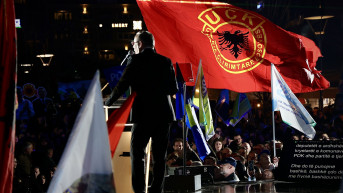
The themes dominating the pre-election campaign of Albanian parties in Kosovo range from the economy, investment in defense, infrastructure and other sectors, to higher wages and pensions and improved relations with the international community. However, during this campaign, the KLA and its leaders on trial in The Hague have emerged as an asset for political parties seeking to win as many voters as possible ahead of the December 28 elections. According to sources interviewed by Kosovo Online, political parties use every available means during the campaign period—including the KLA.
Written by: Milena Miladinovic
While some believe that former KLA leaders on trial in The Hague—Hashim Taci, Kadri Veseli, Rexhep Selimi, and Jakup Krasniqi—are not sufficiently respected, others glorify their actions and attend rallies in their support.
Leaders of political parties meet with KLA veterans, while Kosovo’s caretaker prime minister and Self Determination’s candidate for prime minister, Albin Kurti, has during the campaign repeatedly referred to a letter he sent to the President of the Kosovo Specialist Chambers, Ekaterina Trendafilova, requesting that former KLA leaders be transferred to Kosovo.
According to the interviewees, such actions by party leaders are politically motivated, noting that they are well aware there remains a large number of KLA supporters in Kosovo. As they add, during the pre-election campaign parties use every possible means to achieve their goals.
Kurti as a Political Opponent of KLA Leaders
Lawyer and former military prosecutor Dragan Pasic said that caretaker prime minister Albin Kurti is a political opponent of the former KLA leaders on trial in The Hague, yet uses their names in the campaign because he is aware he lacks sufficient support to regain power.
Pasic told Kosovo Online that Kurti’s statements about the KLA are political in nature, given the large number of people sympathetic to the organization.
“Albin Kurti does not mention any of the accused individually—namely Hashim Taci, Jakup Krasniqi, Rexhep Selimi, or Kadri Veselji. He refers to the so-called Kosovo Liberation Army, which he says waged a clean and just struggle. Thus, his true fight is not to free these four accused individuals and others from potential criminal liability; rather, this is a political statement aimed at winning voters, because a considerable number of people in Kosovo and Metohija are inclined toward the so-called KLA,” Pasic said.
He added that Kurti has not called for the abolition of the Specialist Court in The Hague, but rather for the release of the four former KLA leaders.
“I would remind you that Albin Kurti has not officially sought the abolition of the Kosovo Specialist Chambers or the Specialist Prosecutor’s Office. He says that Hashim Taci and the other accused should be released because, in his view, their detention has lasted unreasonably long. However, he does not deny the existence of these judicial institutions; instead, in this way he seeks to collect political points among a broader electorate,” Pasic said.
In his assessment, Kurti is politically opposed to the KLA leaders, but uses them in the campaign to attract undecided voters.
“I would remind you that Albin Kurti supported accountability for those accused of war crimes and crimes against humanity, but realized he does not have enough public support—given that he has been unable to form a government so far. In this way, he seeks to attract undecided voters or those who show political affinity toward Hashim Taci and others who represented the so-called KLA. Kurti aims to win over the electorate in this manner, even though it is undisputed that he is a political opponent of the four accused in The Hague,” Pasic concluded.
Campaign Strategy
Lawyer Amer Alija of the Humanitarian Law Fund said that during election campaigns political parties use every possible strategy to reach voters, including invoking former KLA leaders on trial in The Hague.
According to him, politicians who participated in the conflicts of the 1990s continue to use that record in their campaigns today.
“When a campaign starts, political parties use every possible strategy. Those who were active in the war and contributed to Kosovo’s independence use the political credit they earned at the time. Certainly, in every campaign we hear such statements: I had more credits, you had fewer; I was in the war, you were not, and so on,” Alija told Kosovo Online.
As he emphasized, Kosovo’s citizens have grown accustomed to such rhetoric.
“I think Kosovo’s citizens have become accustomed to such statements. Over time, we have seen that almost all parties have been in power, and that power in Kosovo can change easily because it depends on coalitions of at least two of the larger parties,” Alija added.
He stressed that messages about the KLA and its leaders during the campaign may have some impact on certain voters, but that most already know whom they will vote for.
“Given that all major parties—from Self Determination to PDK, LDK, and AAK—have been in power, this may have some effect on certain voters, but each voter will ultimately vote for the party they believe can bring positive change to the Republic of Kosovo,” the Humanitarian Law Fund lawyer concluded.

0 comments