
Kosovo between EU expectations and political reality: Will the new government form the Community of Serb Municipalities?
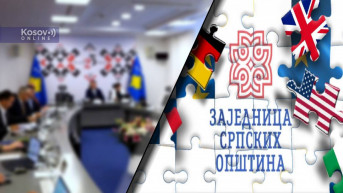
The condition of all conditions, and yet nothing. And so it has been since 2013. For EU officials, the "red light" keeps flashing. They insist that the formation of the Community of Serb Municipalities (CSM) should be one of the first tasks of the new Kosovo government—regardless of who forms it. While not impossible, it is highly difficult to achieve, sources tell Kosovo Online.
Written by: Arsenije Vuckovic
"Kosovo is expected to fulfill its obligations arising from the Agreement on the Path to Normalization, as well as all previous agreements from the dialogue, without further delays or preconditions," stated EU High Representative for Foreign Affairs and Security Policy, Kaja Kallas, and European Commissioner for Enlargement, Marta Kos, in a joint statement.
Former U.S. Ambassador to Kosovo, Jeffrey Hovenier, shares the same view.
He says he would advise the new EU envoy for the Belgrade–Pristina dialogue, Peter Sørensen, not to negotiate new obligations with Belgrade and Pristina until the old ones are fulfilled, reminding that the formation of the CSM was agreed upon back in 2013, and reaffirmed by both the Brussels Agreement and the Ohrid Annex in 2023.
Political Speculations
While political analysts mostly speculate on who might form the new Kosovo government, political analyst Blerim Burjani is convinced that a coalition between the Self-Determination Movement, the Democratic Party of Kosovo, and the Democratic League of Kosovo would bring stability and resolve Kosovo’s CSM issue.
Former Ambassador to Italy, Albert Prenkaj, warns that Kosovo risks being excluded from further processes if it does not meet the demands of its "partners."
"As we have seen so far, our partners are interested in having a consolidated parliament and a new government as soon as possible. For them, the most important thing is the swift implementation of parts of the 2023 agreement reached with Prime Minister Kurti and President Vucic. That is why they demand the immediate implementation of the agreement's provisions," said Prenkaj.
Tacit Consensus
However, political scientist Ognjen Gogic argues that one must be realistic when balancing European expectations and post-election political maneuvering. In his view, it is unrealistic to expect the new Kosovo government to form the CSM, regardless of who comes to power.
He describes a tacit consensus as the key reason why no major developments should be expected.
"It is unrealistic for the new government to form the CSM, regardless of who forms it. There is a kind of tacit consensus among Albanian parties that they will not rush with the formation of the Community of Serb Municipalities and that it could potentially serve as a bargaining chip Kosovo could offer Serbia in exchange for recognition," Gogic told Kosovo Online.
He asserts that all Albanian parties exclusively link the formation of the Community of Serb Municipalities (CSM) to Serbia's recognition of Kosovo.
"And they all think that way—only Kurti said it out loud. Everyone else has actually taken this position silently because all these parties have been in power and had the opportunity to take concrete steps toward forming the CSM, but they did not do so. Only Kurti made noise about it," this political scientist clarifies.
At best, he expects that if the new Kosovo government is formed by opposition parties, they might take some symbolic steps to appease the West.
"These parties are generally more receptive to Western suggestions, and they might submit the draft Statute of the CSM to the Constitutional Court, as requested. And that would be about it—they wouldn't do anything beyond that," he is convinced.
He also sees justification for this argument in the "strong excuse" that representatives of the future Pristina government would have.
"The municipalities in northern Kosovo are in such a state that forming the CSM is impossible. As long as new local assemblies, with proper Serbian representation, are not elected, discussing the formation of the CSM is pointless. That is the excuse for delaying it. But it should also be noted that if the opposition were to take power now, they would have a powerful Kurti as their opposition, who would block the process. No one would dare to establish the CSM with such a strong Self-Determination Movement in opposition, knowing what the consequences would be," Gogic emphasizes.
Commenting on the expectations of EU officials that the new Pristina government will fulfill its Brussels commitments, including the formation of the CSM, Gogic says that the leading opposition parties—PDK, LDK, and AAK—are "very cautious about signals from the West."
"None of them follow Kurti's policy of risking relations with the West over the Serbian community. In other words, they don’t consider it worthwhile to confront the Serbs to the extent that they would risk isolation, as Kurti has," Gogic believes.
The political leader closest to Western demands during the election campaign was AAK leader Ramush Haradinaj, who stated that he would immediately send the draft Statute of the Community of Serb Municipalities (CSM) to the Constitutional Court upon taking power.
Gogic explains that other opposition parties would also grant Serbs "at least minimal concessions."
"Haradinaj is the most inclined to attract attention with his statements, but generally, all three parties would take the same position—that some minimal concessions should be made to both Serbs and the West to avoid ending up in Kurti's situation. So, they would be willing to work on this, but the real question is what will happen once mandates are confirmed and Self-Determination enters parliament. Who would dare to provoke a reaction from them?" Gogic emphasizes.
CSM on Credit
The ball is in Serbia’s court, and the new Kosovo government could only form the CSM "on credit," says university professor Nexhmedin Spahiu in an interview with Kosovo Online.
He claims that the formation of the Community of Serb Municipalities does not depend on the new government in Pristina but solely on Belgrade.
"This does not depend on the new government; it depends more on Belgrade. Prime Minister Kurti promised the international community, in his letter regarding Kosovo's Council of Europe membership, that he would implement the CSM of Serb-Majority Municipalities, but only when Belgrade starts fulfilling its obligations. This means that the flag of the CSM of Serb-Majority Municipalities can fly in Kosovo only when the Kosovo flag flies in Belgrade at a permanent diplomatic mission—or when the Serbian flag flies at a permanent diplomatic mission in Pristina. That is the deciding factor," Spahiu asserts.
Therefore, Spahiu emphasizes that any government and any Kosovo prime minister will eventually form the CSM.
"When Serbia decides to go ahead with it, regardless of who is in the government or who the prime minister is, it will happen because it is in Kosovo’s national interest," Spahiu stressed.
He is convinced that if Belgrade fulfills its part of the agreement, Albin Kurti will definitely do the same.
The question for him is what happens if the opposition forms the new government.
"They might do it 'on credit,' demanding that the Americans and Europeans pressure Belgrade into fulfilling its part of the agreement later. And that is the difference. That’s why it is in Belgrade’s interest for the opposition to come to power rather than Albin Kurti, who is adamant that there will be no CSM flag until the Kosovo flag flies in Belgrade. That is the fundamental difference between them. If Belgrade is ready, the CSM can be formed at any moment," Spahiu asserts.
Guarantees and Serb List
For security studies researcher Nikola Vujinovic, the key issue is what kind of guarantees Kosovo Serbs will receive to ensure the CSM actually materializes.
He believes this would only be possible if Serb List participates in the new government.
"The new government is certainly expected to form the Community of Serb Municipalities in order to fulfill agreements with Serbia. The European Union expects this as well. The only question is when and which coalition will form that government. Once it is formed—which I am skeptical about—we can expect this issue to be on the agenda," Vujinovic told Kosovo Online.
For the EU, forming the CSM would be a "diplomatic success" given the situation in Ukraine, which is why he fears that European officials might accept a version of the CSM that merely satisfies the Albanian majority.
"The EU is eager to see the CSM established as soon as possible because it would allow them to claim a diplomatic success in Europe, something that is slipping away in Ukraine. Secondly, I fear they might take the easier path—to satisfy the Albanian majority—by creating an CSM that is an empty shell, something the Serbian community does not want and something Serbia did not agree to," this analyst warns.
The only way to ensure the formation of the CSM, he argues, is for Serb List to be part of the new Kosovo government.
"The only coalition partner that can guarantee the formation of the Community of Serb Municipalities is Serb List. If Serb List is part of the new Kosovo government, we can expect the CSM to be formed, at least in a formal sense, if nothing else," Vujinovic explains.
He also believes that, despite Western expectations, most Albanian parties are not focused on the CSM because everyone is already anticipating new elections.
"And in those new elections, there will be yet another campaign where 'Serbs will once again be the main target,'" Vujinovic concludes.



0 comments