
Kosovo between sanctions and candidate status: Why is Kurti angry with the EU?
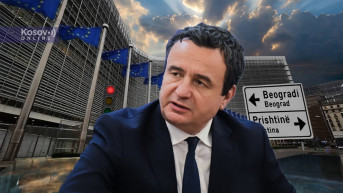
Application for full membership shelved, punitive measures on the EU's table. At the beginning of this month, during his visit to Brussels, Albin Kurti criticized the EU's approach towards Kosovo and called for the lifting of sanctions and the issuance of the questionnaire for candidate status. Analysts speaking to Kosovo Online explain that despite Kurti's irritation and frustration, there will be no change: not only because of the position of the five EU member states that oppose recognizing Kosovo, but also due to the increasingly evident dissatisfaction of EU officials with the current policies of Pristina.
Written by: Djordje Barovic
"My friend Josep Borrell, the former EU High Representative, wrote a letter to the 27 member states and said that the sanctions on Kosovo should be lifted. But the measures remain in place. We must receive the questionnaire and candidate status, not only because people want it, but because I believe our country deserves it," Kurti stated at the launch of the EU Enlargement Program "Willy Brandt" in Brussels.
Kosovo submitted its application for EU membership on December 15, 2022. At the time, Kurti handed the document to the Czech Minister for European Affairs, Mikuláš Bek, stating it was a "historic day for Kosovo and democracy."
Only six months later, in June 2023, the European Union announced punitive measures against Kosovo. These were the result of a report prepared by one of Kosovo's so-called "friends," then-EU High Representative Josep Borrell, requesting that Pristina take necessary steps to de-escalate the situation in northern Kosovo.
Gap in Expectations
Political scientist Ognjen Gogic told Kosovo Online that the greatest irony lies in the fact that many of Pristina's unilateral actions have since rendered the initial reasons for the sanctions meaningless.
"This reflects a gap between Brussels’ expectations and the situation on the ground. Many in Brussels now generally object to Kurti's policies—not just the northern crisis, but his unilateral measures more broadly. This is the price being paid now—by the government and Kosovo. There is no willingness to lift the sanctions, even if they may no longer serve a purpose. It’s the lack of consensus among EU states that’s keeping them in place. This inertia defines current Brussels-Pristina relations," Gogic explained.
He reminded that the EU had asked Pristina to hold new elections in four northern municipalities and to withdraw special police units.
"Two years later, none of that has been done, and those demands have arguably lost relevance. The situation in Kosovo has changed—not necessarily for the better—but those requests may no longer reflect today’s reality," said Gogic.
Several surveys conducted in Kosovo during 2023 indicated that up to 92% of citizens supported EU membership, with more than 80% believing it would happen before 2030. Although no new studies have been done since, Gogic stressed that the people of Kosovo remain decidedly pro-European.
"The general impression is that Kosovo is deeply pro-European. The people—especially Albanians—strongly support integration into Euro-Atlantic structures, EU and NATO membership. Many live or work there, and have family ties. Despite the prevailing narrative from the Self-Determination movement that the EU is unfair to Kosovo, public commitment to EU membership remains strong," he said.
Still, Gogic added, Kosovo’s desire to join the EU is not enough, because the main obstacle remains: there is no consensus within the EU on recognizing Kosovo’s independence.
"Kosovo signed the Stabilization and Association Agreement, the final step in the integration process that doesn't require a status resolution. For candidate status, consensus among all EU member states is needed, and only a recognized state can become a candidate. As long as five EU states don’t recognize Kosovo, they will not vote for candidacy. Moreover, some countries that do recognize Kosovo may still oppose the bid due to objections to its policies," said Gogic.
This is precisely why the issue is not being placed on the EU agenda.
"We already know the result—those five countries would veto the application, and likely others would join them, believing Kosovo doesn't meet the necessary standards," Gogic concluded.
Shifting the Blame
According to Pristina-based analyst Shkelzen Maliqi, the situation Kosovo finds itself in is entirely Kurti's fault.
"He had a chance around this time last year to conclude the process for Council of Europe membership. He didn’t take it. The only condition was to submit the draft statute for the Community of Serb-majority Municipalities (CSM) to the Constitutional Court. He refused, and naturally, trust in him was lost—by Germany and others involved. Now the sanctions remain, and Kosovo is still not in the Council of Europe. That’s entirely his fault, due to his uncooperative stance with Kosovo’s strategic partners. He cannot blame anyone else. But that’s his style—self-promotion through attacking others, without taking responsibility," Maliqi said.
He warned that implementation of agreements is an obligation for both Belgrade and Pristina—something the new European administration will insist upon.
"Brussels has appointed new facilitators who haven’t spoken much yet, but they’ve made it clear that the agreements reached—though not formally signed—are considered legally binding under international law," said Maliqi.
He is convinced the EU will not abandon the dialogue process that’s been underway for the past twelve years.
"There have been at least 30–40 agreements over the past decade. Some are fully implemented, others partially, and some not at all—but significant effort has gone into them. This will not be discarded just to start from scratch," he added.
Asked why the dialogue process has stalled, Maliqi emphasized that both Belgrade and Pristina currently benefit from the stalemate.
"It seems both parties are waiting to see how new geopolitical alignments unfold. Maybe they’re playing that card. But there’s no indication that former President Trump would focus on Kosovo or the Balkans at all. For now, the situation remains unclear, but there is no alternative to resolving the Kosovo issue through dialogue—except perhaps a military option, which would benefit no one," Maliqi warned.
Pressure Levers
Slobodan Zecevic, Director of the Institute for European Studies in Belgrade, believes that Brussels’ refusal to send Pristina the membership questionnaire is a kind of "pressure lever" to push for the formation of the CSM, which could then serve as a justification for the five non-recognizing states to support the application.
"They expect Albanians to make a move. This may be a way to pressure them—not sending the questionnaire until something is done regarding the Association. The Albanians are clearly anxious and demanding the questionnaire, but it seems it’s not something decisive enough to make them implement the Brussels Agreement," Zecevic told Kosovo Online.
He added that Kurti’s demand can also be seen as part of a political game with the EU.
"Kurti pretends the Brussels Agreement and CSM don’t exist, yet asks for the questionnaire. That’s the essence of his approach," said Zecevic.
Asked how sending the questionnaire to Kosovo might affect the five countries that do not recognize it, Zecevic explained that the justification would be that Pristina is trying to align with EU standards.
"They could argue that granting the questionnaire doesn’t mean formal accession, but that it’s a step toward aligning Kosovo’s legislation with that of the EU. That would be a strong argument for the recognizing states to try and convince the non-recognizers that Kosovo is constructive and has made a positive step deserving of encouragement," Zecevic concluded.


0 comments