
Kosovo faces EU sanctions: Fewer investments, growing imports
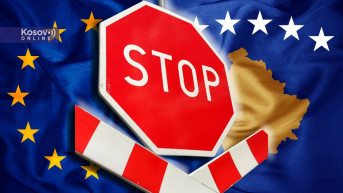
While officials continue to speak of economic growth, experts warn that Kosovo is facing serious financial and political difficulties. Representatives of the GAP Institute point out that these are the direct consequences of the EU’s restrictive economic measures, while analysts add that increasing imports and inflation are compounding the problem.
Written by Djordje Barovic
According to Kosovo’s caretaker government, everything is under control. GDP in the second quarter grew by 4.58 percent.
“Compared to the second quarter of 2024, when growth stood at 4.32 percent, it’s clear that we’re seeing an acceleration. Once again, the facts and figures contradict the opposition’s claims about the direction of Kosovo’s economy,” stated caretaker Minister of Finance Hekuran Murati.
Murati cited data from the Kosovo Agency of Statistics: growth in construction at 4.15 percent, in financial and insurance activities at 8.79 percent, and in manufacturing at 3.34 percent, among others.
However, many Kosovo economists disagree. Among them is Safet Grxhaliu, who argues that the caretaker government has overstated the economic growth rate, adding that real inflation is double-digit, not the officially reported 4.5 percent.
According to an analysis by the GAP Institute, Kosovo is facing serious financial and political consequences from the EU measures introduced in June 2023.
They specify that over €613 million in assistance has been suspended so far, mainly through the IPA programs and the Western Balkans Investment Framework (WBIF).
GAP coordinator Rona Zhuri stated that €7.1 million was lost after the deadlines expired for several IPA 2020 projects, and that the most affected sectors include environmental protection, energy, digitalization, and culture.
At the same time, statistical data show that between January and September of this year, Kosovo imported goods worth over €5 billion — half a billion more than in the same period last year.
Dialogue and Consequences
Dimitrije Milic, program director of the New Third Way organization, told Kosovo Online that the EU’s economic measures have led directly to rising imports, which last year stood at a ratio of 7:1 compared to exports.
Milic believes that Kosovo cannot expect major EU investments without normalization of relations with the West and a return to dialogue.
“Kosovo’s economy, in terms of exports and trade, is primarily linked with the EU and regional countries. The sectors that traditionally dominate Kosovo’s exports are metals, ores, and minerals. These have accounted for most exports so far, even though the economy largely depends on imports. In 2024, that ratio was about 7:1 in favor of imports,” Milic explained.
He added that the main barrier to greater international assistance is Kosovo’s lack of EU candidate status.
“If Kosovo obtained candidate status, financial assistance would increase significantly. Of course, that would also require an easing of Kosovo’s current political isolation, primarily in relation to Western countries. Once relations normalize, the framework for assistance would become solid — but real growth in aid would come only with candidate status,” he noted, referring mainly to IPARD and other pre-accession funds.
According to Milic, lifting the EU’s restrictive measures requires the formation of a new government that will reestablish dialogue with Brussels, and later with Belgrade as part of the normalization process.
“This would also mean avoiding escalatory actions by Pristina, which generated this kind of international isolation and Western mistrust in the first place, along with the EU’s restrictive measures. Ultimately, normalization of relations with the West and resumption of the dialogue between Belgrade and Pristina are the main conditions for returning to predictable, cooperative dynamics,” Milic said.
The Price of Stubbornness
Agim Shahini, president of the Kosovo Business Alliance, stressed that Kosovo is the only economy in the Western Balkans that depends on imports for 87 percent of its goods.
At the same time, he warned that due to the government’s stubbornness and missteps, Kosovo is now facing sanctions from both the EU and the U.S., and that all citizens are paying the price.
“Kosovo is the only country in the Balkans that depends on imports for nearly 87 percent of its goods. This year alone, we will import nearly €7 billion worth of goods from various countries. That’s how much money will effectively leave Kosovo. There is no strategy for increasing domestic production, so we depend on foreign products,” Shahini told Kosovo Online.
He reminded that Kosovo is currently under EU restrictive measures as well as U.S. sanctions.
“We’re talking about losses of nearly €1 billion. Everyone in Kosovo — citizens, the economy, public administration, and the private sector — is feeling the impact. Now we also face U.S. sanctions. Kosovo is effectively in the same category as Russia, Belarus, and China. It’s the fourth country under U.S. measures, especially after the suspension of the strategic dialogue. This will severely affect business and investments. The Kosovo government keeps making missteps, and we as citizens are paying the price,” Shahini said.
He noted that the EU introduced these measures because of the behavior of Prime Minister Albin Kurti, but that all citizens suffer the consequences.
“It’s very difficult to lift measures once they are imposed. They were tough from the beginning. I’m not saying they weren’t justified, but the EU didn’t impose them against the people of Kosovo — they were imposed against the Prime Minister for his defiant stance toward the international community, both European and American. But it’s the people who feel the measures the most,” Shahini concluded.
Foreign Investments and Remittances
Security studies researcher Nikola Vujinovic also pointed out that the core of Kosovo’s economy has become imports and diaspora remittances, while one of the consequences of EU measures is the lack of foreign direct investment.
“No developing economy can progress without foreign direct investment. The absence of such investment, combined with the loss of European assistance as a form of sanctions imposed by the EU, directly affects economic development. Infrastructure is not being built, markets are not expanding, and small and medium-sized enterprises are stagnating. Imports and remittances from Kosovo citizens abroad have become the backbone of the economy — and that is unsustainable in the long term,” Vujinovic said for Kosovo Online.
EU officials have announced the gradual lifting of the restrictive measures, but Vujinovic emphasized that this will happen only after Pristina fulfills Brussels’ explicit demands set out in June 2023: free elections, reduction of tensions in northern Kosovo, a change in policy toward the Serbian community, and the formation of the Community of Serb-Majority Municipalities (CSM).
He noted that only some of the EU measures — mainly financial ones — are being implemented.
“Essentially, the only measure being fully applied is the financial one — the prevention of EU funds from financing projects in Kosovo. The political measures vary in implementation, depending on individual European leaders. For example, Osmani attended the meeting in Copenhagen, although she was not supposed to under these restrictions, as it included European officials with whom she is technically barred from communicating,” he observed.
Vujinovic concluded that the true leverage of the EU measures lies not in their political dimension, but in the unfreezing of financial resources — which will only happen once Kosovo meets Brussels’ clear conditions.
“The essence is to restore financial support, which is essential for the survival of Kosovo’s economy. For that to happen, there must be free elections in northern Kosovo, a reduction of political violence against the Serbian community, and the formation of the Community of Serb-Majority Municipalities,” he concluded.

0 comments