
Memories of the March 2004 Pogrom: Serbian homes burned while members of international forces ate their rations
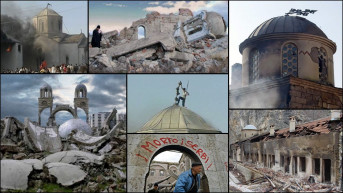
When what is most sacred to a people—its religious sites—is destroyed, interlocutors for Kosovo Online point out that there is a clear intention to erase every trace of that people. This, they say, is precisely what was attempted during the March 2004 pogrom, when more than 4,000 Serbs were expelled from their homes across Kosovo, dozens of monasteries were destroyed, over 10,000 valuable frescoes and icons were damaged, and church registers of baptisms, marriages, and deaths—bearing witness to the centuries-long presence of Serbs in Kosovo—were reduced to ashes. The three-day violence unfolded in the presence of 3,000 UNMIK personnel and 20,000 KFOR troops, and eyewitnesses still vividly recall how some members of international forces were eating their field rations while Serbian homes were burning.
Written by: Dusica Radeka Djordjevic
In the tragic events that began on March 17, 2004, Pristina was ethnically cleansed, and Serbs were expelled from Prizren, Djakovica, Pec, Urosevac, Stimlje, Podujevo, Gnjilane, and other towns.
According to data from Serbia’s Security Information Agency, plans by Albanian extremists to completely ethnically cleanse Kosovo of Serbs had been devised at secret meetings as early as the autumn of 2003. According to these sources, key individuals were already aware of the operational plan, waiting only for a suitable incident to initiate its implementation.
Ambulance Sirens Everywhere
Journalist Zarko Joksimovic recalls that the violence itself was not entirely unexpected for those who had already endured the traumas of the 1999 conflict, but he emphasizes that the events of March 2004 were far more widespread.
“We were somewhat caught off guard. Such things could always be expected here, but not with that level of intensity and on such a scale,” Joksimovic told Kosovo Online. At the time, he was an RTS correspondent in Pristina, where he first received information about casualties across Kosovo while sitting in a restaurant opposite UNMIK headquarters—a place where Serbs typically gathered during coffee breaks.
Unaware of the unfolding events, they soon heard that fighting had already begun in Caglavica, accompanied by ambulance sirens echoing throughout the city. Shortly afterward, a relative from Mitrovica informed him that there were already fatalities on the Serbian side.
The scene they later encountered in Caglavica, he says, was horrifying.
“Several tens of thousands of people from Pristina moved toward Caglavica. On our way through Kosovo Polje, part of it was already burning. Everything that remained Serbian was in flames, up to the health center. In a commercial zone, we encountered around twenty American ‘frogs,’ as they are called. They were present but not engaged in preventing the organized terror aimed at driving out the last Serbs. They seemed to be waiting for something—I still don’t understand what. While the police were expelling the remaining Serbs in Kosovo Polje, they sat calmly. By the time we reached Caglavica, part of it was already on fire,” he recalls.
Indifference of International Forces
He adds that a Swedish battalion had positioned its armored vehicles, while its members were lying on top of them in the March sun, again seemingly waiting.
“In the meantime, they were distributing rations and even eating while people were being killed and houses were burning. We documented and filmed all of this, somewhat astonished, hoping it was just an isolated incident. However, reports spread that the violence had reached massive proportions and that almost no town was unaffected. From the direction of Lipljan, a crowd moved toward Laplje Selo. We saw a large group stopped near what is now the roundabout toward Marigona. In Caglavica, the locals defended themselves,” Joksimovic states.
He says that the indifference of international actors was striking, as was the fact that no command authority intervened decisively to stop the violence.
“And this went on for days. There were isolated cases where individuals acted independently—such as a French officer in a northern village who decided to stay in Gojbulja and saved it. Similarly, in a residential building in Lipljan, where a Serbian population was trapped as the building was being set on fire, no one intervened—except for a Finnish officer who drove in and rescued several families,” he adds.
Nevertheless, he concludes that even such behavior was not entirely surprising.
“They came here to build a state. The fewer of us there are, the better for them—less work, and the process of state-building can continue without resistance,” says Joksimovic.
Over the following two days, March 18 and 19, the RTS crew documented the destruction in Prizren, including the Monastery of the Holy Archangels and the Church of Our Lady of Ljevis.
“They did everything to erase all traces of our existence, and that continues to this day—first through violence and killings, and now through administrative measures and laws. It is something we continue to endure,” he concludes.
An Investigation That Promised Little
Among the first victims was Borivoje Spasojevic from Mitrovica.
His son, Dragan Spasojevic, recalls that even at the time, the international investigation did not inspire confidence that justice would be served.
“When the international investigative team was formed after March 17, their main question to me regarding my father’s case was what he was doing on the street. They were not interested in the direction from which the bullet came or other relevant details—they focused on why he was outside. Meanwhile, their colleague from the FBI, Beryl Winch, had participated on the Serbian side in repelling attacks by armed Albanian groups who crossed into the northern part, vandalizing shops and firing weapons. They could have asked him instead what people were doing on the streets when shots were being fired,” he said.
Mitrovica, he adds, continues to honor the memory of his father and Jana Tucev, who was also killed that day.
“He was an electrical engineer who contributed to many projects in Mitrovica and Trepca. He was a respected man, a good friend, and people remember him as a valued member of the community, especially under the tragic circumstances in which he died,” he said.
He also notes that the violence that began in 2004 has not ceased, but has merely changed form.
“For me, March 17 is a date that reminds us to remain steadfast in our determination to stay here and continue living despite all challenges, including hatred from segments of the other community that attempt to erase traces of Serbian existence in Kosovo and Metohija,” he said, emphasizing that the primary targets were Serbian enclaves where life had been restored.
Destroyed Holy Sites
In Prizren, the Church of Our Lady of Ljevis, the Church of St. Spas, the Church of St. Nedelja, the Church of St. Panteleimon, the Church of St. Cosmas and Damian, the Monastery of the Holy Archangels (all dating from the 14th century), the Seminary of St. Cyril and Methodius, and the Bishop’s Residence were destroyed.
In Djakovica, the Church of the Dormition of the Most Holy Theotokos (16th century) with its parish house and the Cathedral Church of the Holy Trinity were destroyed.
In Srbica, the Devic Monastery (15th century) was burned.
In Pec, the Metropolitanate with the parish house of the Church of St. John the Baptist, the Church of the Presentation of the Virgin in Belo Polje, and the Church of St. John the Baptist in Pecka Banja were destroyed.
In Pristina, the Church of St. Nicholas (19th century) was burned, while in Kosovska Mitrovica the Church of St. Sava was destroyed.
Art historian and head of the Fresco Gallery of the National Museum of Serbia, Bojan Popovic, states that religious sites damaged during the March 2004 events—and even before and after—have not been fully restored, particularly smaller churches, indicating a clear intent to erase Serbian heritage.
“Even for major sites protected by UNESCO, such as the Church of Our Lady of Ljevis, we cannot say they have been fully restored. Not all frescoes have been cleaned from the 2004 fire damage. The intention to erase every Serbian trace is evident. This is done most profoundly by destroying what is most sacred to a people—their religious sites and cemeteries,” Popovic said.
He argues that responsibility does not lie solely with local authorities but also with those who, in his view, hold ultimate control.
Trigger and UNMIK Denial
The pogrom was preceded by reports on March 16, 2004, in Kosovo media that three Albanian boys—aged 8, 11, and 12—had drowned in the Ibar River near the village of Cabra, allegedly while fleeing Serbian attackers. However, UNMIK spokesperson Derek Chappell later denied that the boys were fleeing Serbs and assessed that the violence had been pre-planned.
UN police estimates indicated that more than 51,000 Albanians participated in violence at 33 locations, while OSCE and Human Rights Watch estimates placed the number at up to 60,000 participants.
0 comments