
Military power in the Western Balkans: Who shapes security strategies in the region?
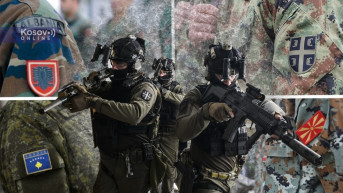
The publication of a new ranking by the Global Firepower portal has reopened the question of the balance of power in the Western Balkans and the direction in which the region is heading in terms of military strength. While some states are trying to adapt their strategies to new geopolitical circumstances, others perceive this as a threat, which, according to military analysts, creates a classic “security dilemma” and further deepens mistrust among neighbors. Although their views differ, the interlocutors of Kosovo Online agree on one point – Kosovo has the weakest-ranked military, yet it remains central to Balkan politics and security.
Written by: Petar Rosic
The Global Firepower portal has published its latest ranking, which provides a comparative analysis of the military power of all countries in the world. According to this ranking, Serbia has the strongest military in the region, placing 63rd globally, ahead of Croatia, Albania, Slovenia, North Macedonia, Montenegro, and Bosnia and Herzegovina.
The website states that the Serbian Armed Forces have a budget of USD 2.7 billion, 22,500 active personnel, 7,190 combat vehicles, including 242 tanks and 115 military aircraft.
After recently attending a briefing on the results of an analysis of the state, operational, and functional capabilities of the Serbian Armed Forces for 2025, President Aleksandar Vucic emphasized that Serbia has record expenditures for the defense and security system amounting to 2.65 percent of GDP, and reported that the meeting also discussed the introduction of a 75-day military service. He also expressed concern over the formation of a military alliance between Croatia, Albania, and Kosovo.
“In line with this, we behave seriously and responsibly, without provoking anyone, seeking to deter any potential aggressor,” Vucic said.
In contrast to Serbia, Kosovo ranks at the bottom of the list in terms of military power. According to Global Firepower, Kosovo has a defense budget of USD 1.17 billion, nine thousand active personnel, and 1,357 combat vehicles, with no tanks and no military aircraft. With these capacities, it occupies 139th place out of 145 military forces.
Transition of the Kosovo Army by 2028
Retired General Naim Haziri told RFE/RL that the Kosovo Security Force (KSF) is expected to complete its transition into an army by 2028, assessing that it already operates according to modern war doctrines and has functional capacities for current threats.
“I am very optimistic, although this is the most important phase of force establishment. Air capabilities are currently being developed and combat regiments strengthened, with elements that support operations. I am convinced that the KSF will reach full operational capability within the expected timeframe and that it will be a credible force, interoperable with all NATO armies,” Haziri said.
According to him, “Serbia remains the main threat to Kosovo,” but he emphasizes that even now the KSF has sufficient capacity to respond to any threat.
Security expert Burim Ramadani also pointed out that the ten-year plan to strengthen the KSF has not yet been completed, assessing that Kosovo is in an early phase of developing its army. Commenting on the ranking, he told Kosovo Online that such lists often provide an incomplete picture.
“Rankings by various organizations, such as Global Firepower and others, mainly focus on statistics on soldiers, armored vehicles, tanks, and other material assets, but they do not take into account training, methodology, intelligence capacities, and other important aspects of an army. As in many cases, this ranking did not accurately reflect the real situation and is still not fully adequate,” Ramadani said.
He adds that an army is not just the number of soldiers and tanks, but also cyber aspects, cyber capabilities, defense capacities, intelligence work, training, methodology, and other factors.
“I think Kosovo is at the beginning of this process, while other countries in the region have different models, since some are not NATO members and therefore are not fully compatible with NATO standards and procedures. I believe Kosovo will progress slowly, also due to the budgetary crisis,” Ramadani emphasized.
Military analyst Vlade Radulovic also told Kosovo Online that rankings provide a general picture but are not an absolute indicator.
“They give certain outlines, they can roughly show us certain directions, support certain claims – in some cases budget allocations for defense, in others population size, or the number of members of armed forces and paramilitary formations and their share in the total population, depending on the list. But the essence is that they roughly, at least in some contours, indicate where a certain country stands, or what its military power is. The results of these lists are not ‘written in red letters,’ they are not absolute, and you do not have to believe them one hundred percent. They are more of a guideline, an approximate outline of a country’s military power,” he explains.
He notes that key parameters of military power depend on the type of armed forces and the resources a state possesses. Asked why Western Balkan countries invest in armaments, he points to two key aspects.
“First, NATO member states follow the line of increasing defense spending, for example from two percent to a nominal five percent of the budget, including cyber security and critical infrastructure. The other side of the coin is that much of the equipment was inherited from the time of the Yugoslav People’s Army or the Warsaw Pact and has become obsolete. The modern battlefield dictates new trends, which requires additional investments and new financial allocations. There is also a theoretical aspect – the well-known ‘security dilemma.’ When one actor arms itself, another perceives it as a threat and raises its own capacities, creating a spiral that is also present in theory. When we talk about the Balkans, it is key that in the last seven to ten years, the procurement of equipment has been motivated by the fact that it was inherited from the 1990s and has become outdated,” he notes.
The Security Situation Is Not Good
Asked whether there is currently a real military threat in the region, he says it depends on whom you ask.
“In Europe today, apart from Ukraine, there is only one other neuralgic point – the Balkans. We have the unresolved issue of Kosovo and Metohija, the presence of international forces, and on the other hand tensions in Bosnia and Herzegovina. Sporadic incidents against the Serbian population in Kosovo and Metohija – from arrests and raids on facilities, to beatings, and even shootings at civilians and children – show that the security situation in the region is not good,” he notes.
However, he emphasizes that NATO is present and that major actors are monitoring the situation, so they do not allow anything to happen “outside their plans.”
Albania ranks 77th on the Global Firepower list, with a defense budget of USD 720 million, 2,335 active personnel, and 1,492 combat vehicles. It has no tanks but does have 20 military aircraft.
Political analyst from Tirana Ben Andoni says that in recent years Tirana has significantly redefined its defense policy, among other reasons due to Kosovo.
“Albania has had to reassess its entire defense strategy, especially in recent years. Today, the emphasis is on weapons production. In the new conjuncture, now that it has reached an agreement with Kosovo and Croatia, Albania must at least keep pace with Croatia. Of course, Croatia’s economic level is much higher than Albania’s, but Albania has increased its military budget from below two percent of GDP and is now exceeding that level. Albania is making maximum efforts to meet the standards that Mr. Trump demanded for the defense of NATO member states,” Andoni assessed for Kosovo Online.
Imaginary Enemies
In this context, he also highlights changes in U.S. engagement regarding Kosovo.
“The importance Albania attaches to the defense sector appears to be linked to Kosovo as well. This is because new developments show that the United States is increasingly reducing its interest in Europe, and that the burden of Kosovo’s defense will largely remain with Albania and some NATO countries,” Andoni says.
He compares the current situation to the COVID-19 pandemic, when countries around the world began to defend themselves without yet knowing how to protect themselves from the virus.
“We are intensively preparing to defend ourselves from an almost imaginary enemy. The first danger can be called Russia. Meanwhile, Serbia is attracting increasing attention, at least according to the press in Kosovo. There is a large concentration of its army near the border with Kosovo, and this may mean that it will never accept Kosovo’s independence. In that sense, while it is believed that Serbia is preparing to penetrate Kosovo, using all geostrategic opportunities and considering the geopolitical implications that could arise, Albania and other countries seem to be considering this imagined attack if Serbia actually undertakes such an action and if Bosnia destabilizes,” the analyst from Tirana says.
North Macedonia ranks 114th, with a defense budget of USD 421.5 million, 10,010 active personnel, and 1,878 military vehicles. Like Albania, it has no tanks and has 20 military aircraft.
Analyst Blagojce Atanasovski assessed for Kosovo Online that military power rankings can serve as a reference point for assessing state capacities, especially in the Western Balkans and the former Yugoslav area.
“Absolutely, rankings show us what military capacities each state has, especially when we talk about Western Balkan countries and the broader former Yugoslav area. Factors taken into account include the size of the state, population, security environment, and military history. Serbia in particular, as a militarily neutral state that is not a NATO member, has experience from wars in the recent past. Croatia as well, although it is a member of NATO and the European Union. Each state assesses how militarily prepared it needs to be at a given political and geopolitical moment, and these rankings mainly show what type of armament and what level of military power they possess,” Atanasovski says.
Speaking about the strengths and weaknesses of military systems in the region, Atanasovski emphasizes that manpower is the key pillar.
“Definitely the greatest strength is active and reserve personnel. These are Balkan states that do not have the super-sophisticated weapons possessed by major powers such as the United States, Russia, Israel, France, the United Kingdom, or China. Those are states that in the 21st century can wage war exclusively with the help of highly developed and hypersonic weapons. From that point of view, Balkan states are not that technologically advanced. Therefore, I believe that their greatest advantage is precisely manpower, while room for improvement exists in the modernization of military capacities,” he says.
The Wounds of the 1990s Are Still Fresh
Asked why Western Balkan countries have been investing more in armaments in recent years, Atanasovski believes the reasons are both external and internal.
“The world is at a geopolitical crossroads – we have the war in Ukraine, the situation in the Middle East, and potential new hotspots. This shows political elites in the Balkans, Europe, and the world that they need to organize militarily on their own. There is also the question of whether alliances such as NATO will be able to function in the future as a system of collective security for all members. On the other hand, there are internal circumstances – we know that Western Balkan countries fought wars with each other in the recent past. Distrust among neighbors still exists, and the wounds of the 1990s are still fresh among the generations living today. Each political elite still looks at its neighbor with a certain degree of mistrust,” Atanasovski explains.
Asked whether there is currently a real military threat in the region, Atanasovski firmly rejects this.
“I absolutely believe there is no real military threat. The period 30 to 35 years ago, when we had a bloody breakup and wars in the former Yugoslavia fought by both paramilitary groups and regular armies, belongs to the past. Most Western Balkan countries today are NATO members, which guarantees both internal and external stability and prevents wars with neighbors. Individual incidents that could disrupt the political or security situation in a given state are possible, but a war on a broader scale between two neighboring countries, involving a third party – I absolutely rule out such a possibility,” Atanasovski concludes.


0 comments