
Igrutinovic: If an EU army initiative were serious, the Americans might see it as competition
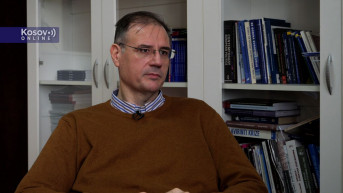
Research Fellow at the Institute of European Studies in Belgrade Milan Igrutinovic assesses that, following the proposal by EU Commissioner for Defence Andrius Kubilius that the European Union should have a military force of 100,000 troops, the Union is still only at the intellectual and philosophical starting point of the debate. For now, he says, there has been no substantive discussion beyond a negative comment by EU High Representative for Foreign Affairs Kaja Kallas.
“These are, in a way, like bubbles in boiling water that actually show the level of nervousness within the European Union over the war in Ukraine, which shows no sign of ending, while at the same time the United States is withdrawing as a supporter of Ukraine and pursuing a policy that is not only independent but already antagonistic toward the EU,” Igrutinovic told Kosovo Online.
As he notes, this is an attempt to float various ideas in circumstances that are far from rosy in terms of security. Apart from the negative reaction by Kallas, who rejected the idea, he has not seen positive comments regarding Kubilius’s proposal.
Igrutinovic explains that the formation of a European army could not be implemented without a thorough revision of the Lisbon Treaty—the constitutional framework of the EU—which does not envisage the existence of a European army, nor the allocation of EU budget funds for common defence.
In the accompanying protocols to that treaty, he adds, there is a clearly defined hierarchy of military relations, explicitly stating that NATO is the primary collective guarantor of security on European soil.
“That legal framework would have to be changed, which raises the question of a possible revision of the Lisbon Treaty. This would require unanimous consent of all 27 member states, and it is very difficult to imagine that happening for this reason alone. Under the current institutional and legal circumstances, this is practically impossible. There are various flexible arrangements one could imagine, where interested states engage in such cooperation, but that then raises questions of practicality and what resources would be allocated,” he said.
Although France has traditionally been a promoter of the idea of common European defence, Igrutinovic notes that Paris is now conspicuously quiet on the issue—partly because President Emmanuel Macron is politically weakened, lacking a parliamentary majority, and therefore does not have the political bandwidth to push bold initiatives internationally.
“Spain is most often mentioned as interested, along with several Northern European countries. Sweden, however, after joining NATO, has reoriented its priorities and I think it is not ready to do anything that Washington might react to negatively. This creates a double trap for Europeans. On the one hand, the United States constantly says, ‘Increase your defence spending, do more.’ But if a serious European initiative emerged—say, ‘we want to build our own army and common budgets’—the Americans might interpret that as competition and try to undermine it, which is in fact what they have done over recent decades,” Igrutinovic warned.
He recalls that after the Cold War victory, during the early 1990s, a European defence initiative—the European pillar of NATO—was being developed, but that the Americans effectively closed that debate, insisting there should be no duplication of capabilities and that NATO’s collective defence of Europe should prevail, ensuring U.S. leadership and primacy in Europe.
“As a result, there is a narrow corridor in which Europeans can act while satisfying American interests: invest more, but with America in the lead—which is what the U.S. wants. On the other hand, there are increasingly strong voices who, observing what Donald Trump is doing internationally and domestically, say: we must operate independently of the Americans—not against them, but we must have something that is truly our own. That means procuring our own equipment and developing technologies that replace what the U.S. currently provides: on the one hand the nuclear umbrella, and on the other hand numerous air-force capabilities such as aerial refuelling, surveillance, and reconnaissance,” he said.
If the idea of a European army were to be implemented, Igrutinovic says political control would rest with the European Council, comprising heads of state and government. There would also be a commissioner for common defence overseeing a classic military headquarters that would issue orders to the forces making up a potential future army.
For rapid-response situations requiring swift decision-making, he estimates that authority would likely be delegated to the Commissionerate, without convening the European Council—a process that can take days.
“Certain decisions regarding responses by such a force would certainly be reduced to qualified majority voting, to prevent any single country, driven by specific interests, from blocking decisions. There would have to be a relaxation of decision-making mechanisms, allowing some decisions to be taken by the European Commission without convening the European Council. Practical implementation would be left to an EU military headquarters—which exists today only in a rudimentary form, not as a classic command structure with a full spectrum of forces, including ground troops, a navy, and an air force,” Igrutinovic concluded.



0 comments