
Money, lobbying, defense: Is Pristina following the “Zagreb model” for the convicted KLA leaders?
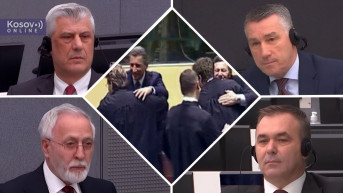
Croatia made the defense of its citizens accused of war crimes before the Hague Tribunal a matter of state policy and allocated substantial funds toward securing their acquittal. Some Albanian political parties are calling on Kosovo to apply the same model in the appeals proceedings involving former KLA leaders, while Kosovo Online’s interlocutors believe that Pristina is already following the approach once adopted by official Zagreb.
Written by: Ivana Sanjevic
Kosovo Prime Minister Albin Kurti informed the public that on Sunday he had held separate meetings with Democratic Party of Kosovo (PDK) leader Bedri Hamza and Democratic League of Kosovo (LDK) leader Lumir Abdixhiku, during which they discussed joint activities concerning the judgment against the former KLA leaders.
Kurti considers the judgment handed down by the Specialist Chambers in The Hague against the four former KLA leaders to be “legally and morally unjust, as well as historically and factually inaccurate,” and said that he would do everything in his power to have it corrected on appeal.
Following the first-instance judgment sentencing former KLA leaders Hashim Thaci, Jakup Krasniqi, Rexhep Selimi and Kadri Veseli to a combined 81 years in prison for war crimes, opposition Alliance MP Time Kadrijaj proposed that Pristina follow Zagreb’s example.
“The Croatian Government did not sit idly by, but used every method available, whether financial or through lobbying, to prove their innocence and defend the just war that Croatia fought against Serbia. Kosovo should do the same,” Kadrijaj said.
Savo Strbac, President of the Veritas Documentation and Information Center, believes that Kosovo is already applying the Croatian lobbying model, noting that one of the convicted former KLA leaders, Hashim Thaci, has the same lawyer who represented Croatian General Ante Gotovina.
Speaking to Kosovo Online, he recalled that official Zagreb had engaged a US-Canadian-British group of internationally renowned lawyers, legal experts and senior military officers, among them attorney Luka Misetic.
“Misetic is a US citizen of Croatian origin, and he is now taking credit for the achievements of that lobbying group. The Croats, however, listened to him. They raised enormous amounts of money and lobbied. It seems that only we Serbs still fail to understand that lobbying is entirely legal in the West,” Strbac said, reiterating that Misetic now represents Thaci.
In addition to the money allocated, Strbac said that, in Croatia’s case, lobbyists had pursued witnesses, primarily Serbs, paying large sums of money and offering them amnesty in exchange for withdrawing previous statements or asking them to testify differently.
Comparing the situation in Kosovo following the first-instance judgment against the KLA leaders, he said that statements could now be heard that were virtually identical to those once made in Croatia.
“What is this unanimous adoption of a Declaration declaring the judgment unjust? Unanimous, but without the Serbs. They quarrel among themselves, they practically tear each other apart, as the saying goes, but when it comes to their attitude toward the Homeland War, they are all unanimous and always united. All of that has simply been replicated in Kosovo,” Strbac said.
He added that Croatia had developed a model for prosecuting its wartime enemies and was now “exporting” that model to Kosovo, Bosnia and Herzegovina and Ukraine.
“Prosecute as many enemies from those wars as possible, in large numbers. The description of the wrongdoing, the offense or the facts does not matter; what matters is simply that it is classified as a war crime, because war crimes are not subject to a statute of limitations. The objective is to have the territory where Serbs once lived, but without the Serbs. That is more effective than tanks and rifles,” Strbac concluded.
Milovan Drecun, Chairman of the Serbian National Assembly’s Committee on Defense and Internal Affairs, also believes that Pristina is copying Zagreb. He noted that Kosovo had already allocated almost EUR 40 million from its budget and was planning to allocate even more for the appeals proceedings.
“They are conducting a horrific extremist campaign filled with Greater Albanian nationalism, the spread of hatred and denial of crimes committed by the KLA. They do not accept the judgment of the Specialist Chambers, which were established by a decision of the parliament in Pristina. They are demonstrating a complete unwillingness to confront the crimes committed by the terrorist KLA—not in their name, but together with them,” Drecun told Kosovo Online.
He recalled that Croatia had enjoyed extensive Western support, just as Kosovo did, adding that Kosovo was now being confronted with what he described as irrefutable facts showing that “the entire Kosovo story arose from a joint criminal enterprise.”
Preparing for the appeals proceedings
Drecun views the daily protests by KLA supporters as an attempt to exert pressure on the international community, as well as on those who will decide the appeals involving the former KLA leaders.
“They always use the method of exerting pressure on the international community through mass gatherings filled with brutal extremist energy, signaling that they are prepared to provoke serious incidents and endanger the Serbian people in Kosovo and Metohija if the judgment on appeal is not an acquittal,” Drecun warned.
What does Croatia’s example show?
Croatia’s legal framework provided for the possibility of enforcing judgments of the Hague Tribunal in the country, with sentences being served in accordance with domestic regulations governing the enforcement of criminal sanctions, while remaining subject to the Tribunal’s supervision.
At the same time, Croatia made the defense of its citizens accused of war crimes a matter of state policy and spent substantial sums in efforts to secure their acquittal.
Between 2006 and 2012, EUR 27.2 million was paid from the state budget for the defense investigation teams of three Croatian generals—Ante Gotovina, Mladen Markac and Ivan Cermak. In addition to state funding, various funds were established to raise money through public appeals in support of individuals accused of war crimes in Bosnia and Herzegovina and Croatia.
Official Zagreb did not respond to media requests submitted under legislation governing the right of access to information of public importance, including questions about whether it had financed the defense of Bosnian Croats accused of crimes committed during the war in Bosnia. Nor is there any official confirmation of the amount the Croatian state spent to engage the US firm Patton Boggs for lobbying in cases involving the generals.


0 comments