
UN between negotiations and strengthening the military coalition
Written for Kosovo Online by Zeljko Sajn, special correspondent in New York
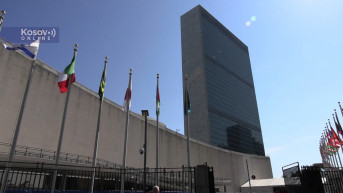
This year's session of the United Nations General Assembly is taking place at a time when two processes are intersecting around the Ukraine crisis – attempts to reopen space for direct political dialogue and, at the same time, the accelerated strengthening of European military capabilities.
From the General Assembly podium, French President Emmanuel Macron warned of the return of the “law of the jungle” in international relations and called for the preservation of international law and the multilateral order. Speaking about Ukraine, he called for the launch of a negotiating process and concrete measures that could help ease the conflict.
At the same time, European countries continue to strengthen military support for Kyiv.
The documents of the “coalition of the willing” call for an immediate and complete ceasefire and the continuation of direct negotiations between Russia and Ukraine, with the active participation of the United States and Europe. At the same time, they reaffirm the continuation of military, financial and civilian assistance to Ukraine, increased deliveries of air defense systems and the development of its military capabilities.
As part of the same initiative, a Multinational Force for Ukraine is also being prepared. According to the plans under consideration, the European-led formation would be deployed after the establishment of a credible cessation of hostilities, with the possibility of operating on land, in the air and at sea.
Thus, European policy toward Ukraine simultaneously includes calls for negotiations and preparations for a military structure for the period after the fighting ends.
For its part, NATO continues to increase military support for Kyiv, while also changing its own defense structure. Secretary General Mark Rutte has particularly highlighted the new role of European members in what he calls “NATO 3.0” – a model in which Europe and Canada assume a greater share of responsibility for their own security.
Within this framework, NATO's eastern flank has a particularly important place.
In Berlin, Rutte said that Germany had formed a new armored brigade permanently stationed in Lithuania, while the 1st German-Dutch Corps had received a new command role on the Alliance's eastern flank. German aircraft and ships, according to him, already form part of NATO's deterrence and defense system.
At the same time, there is talk in Berlin of a major increase in defense spending and the rebuilding of the military industrial base. Germany plans to reach 3.5 percent of GDP for core defense by 2029, while Berlin is also increasing investment in military production.
This is not only a question of new budgets, but also of production. NATO insists on increasing the capacity of Europe's defense industry, from ammunition and missiles to air defense systems, drones and other equipment needed for long-term defense.
Germany is among the main drivers of this process. Around 109 billion euros is planned for defense in 2027, while total security spending is expected to reach around 130 billion euros. At the same time, major investments in infrastructure and industrial capacities are planned.
Germany's defense industry is already recording an increase in orders. Rheinmetall said during the summer that its order backlog had exceeded 80 billion euros, while the company expects continued growth in demand for armored vehicles, ammunition, artillery and air defense systems.
Thus, alongside military aid to Ukraine and the strengthening of NATO's eastern flank, a third process is developing – the rebuilding of Europe's military industrial base.
But at the same time, the diplomatic channel is not completely closed.
Events in New York will also demonstrate this.
In June, the ambassadors of France, Germany and the United Kingdom held talks in Moscow with Russian officials. The European governments then reaffirmed their support for direct dialogue between Russia and Ukraine aimed at achieving a ceasefire and continuing negotiations.
Several months later, the same diplomatic channel received renewed confirmation precisely at the headquarters of the United Nations.
On the sidelines of the General Assembly, on September 26, Russian Foreign Minister Sergey Lavrov and German Foreign Minister Johann Wadephul met. It was the first meeting between the foreign ministers of Russia and Germany since the beginning of the war in 2022.
After the meeting, Wadephul said that the talks had been motivated, among other things, by security issues and the need to stop the further deterioration of the situation. Germany reiterated its call for a ceasefire and negotiations that would lead to lasting peace. Lavrov assessed that he had heard nothing new in the talks compared with Berlin's previously stated positions.
The following day, Lavrov presented Russia's view of European policy before the General Assembly.
The Russian minister assessed that European countries were making a political resolution of the conflict more difficult by continuing military support for Ukraine and seeking to prevent negotiations that could lead to an agreement. He presented Europe's strengthening of its military capabilities as part of a broader change in the European security architecture.
He spoke in particular about the changing balance of power in Europe and Germany's ambitions to assume a greater military role. Moscow views the increase in European military capabilities differently from Berlin and NATO: what European governments present as strengthening deterrence and protecting their own security, the Russian side sees as a continuation of military pressure on Russia.
At the same time, Lavrov spoke of Moscow's readiness to continue political contacts and negotiations on Ukraine, but as part of a broader agreement on European security.
In New York, the Russian minister also raised the issue of Kosovo and Metohija. Responding to journalists' questions about the implementation of UN Security Council decisions, he cited Resolution 1244 as an example of a document whose provisions, according to the Russian interpretation, are not being fully implemented. Lavrov recalled the provision of the resolution confirming the sovereignty and territorial integrity of the Federal Republic of Yugoslavia and assessed that the question of its implementation remains open.
In this way, the Russian minister placed the Ukraine crisis within the broader framework of the debate over the implementation of the UN Charter and Security Council decisions.
While Moscow views Europe's military buildup as part of the confrontation, NATO presents the same process as a response to security challenges.
At the beginning of September, Mark Rutte said that the Alliance must continue supporting Ukraine and that European members must produce more military equipment. In Berlin, he particularly highlighted the German defense industry and increased production.
On NATO's eastern flank, this process is taking on a practical dimension. From Lithuania to the Black Sea, the military presence is being strengthened, air and missile defense systems are being developed, and rapid response capabilities are being increased.
Germany has permanently deployed an armored brigade in Lithuania, while NATO is further developing airspace defense and protection against drones. Following the incident on September 15, when a drone violated Lithuanian airspace, the Alliance announced further adjustments to its forces and systems.
At the same time, European countries are attempting to link military strengthening with a possible future peace arrangement. The “coalition of the willing” is preparing a multinational formation that, according to current plans, would be deployed after the cessation of hostilities, while military assistance to Ukraine continues.
Thus, within the same European policy, there are calls for negotiations and preparations for a military presence after a possible agreement; diplomatic contacts with Moscow and continued military assistance to Kyiv; discussions about a ceasefire and, at the same time, the strengthening of NATO's eastern flank.
Meanwhile, Washington is seeking to restore a more direct negotiating channel between Moscow and Kyiv. During the General Assembly, Donald Trump spoke with Ukrainian President Volodymyr Zelensky, while there was also discussion of a possible US-Russia-Ukraine trilateral format.
In addition, the meeting between Trump and Chinese President Xi Jinping in Washington opened a broader discussion between the world's two largest powers on international relations and the crises burdening the global order.
At the General Assembly itself, the picture remains one in which military strengthening and diplomatic efforts to end the war can be seen simultaneously.
Europe is increasing military spending and production, NATO is strengthening its eastern flank, Ukraine is receiving continued military assistance, and the “coalition of the willing” is preparing multinational forces. At the same time, European ambassadors are holding talks in Moscow, the German and Russian foreign ministers are meeting in New York, while Washington is trying to open a new negotiating channel.
The UN General Assembly thus remains a place where both military strengthening and diplomatic efforts to stop the war can be seen at the same time.
0 comments