
More work for the Constitutional and Supreme Court: Legal or political machinations in Kosovo?
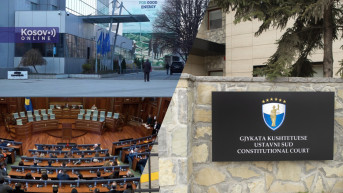
The temporary measure imposed yesterday by the Constitutional Court, ordering the Assembly not to proceed with government formation, is only the latest in a months-long string of rulings by Kosovo’s highest legal institutions involving the work of the legislative or executive branch. For experts interviewed by Kosovo Online, the key problem lies in the “legal gaps” of Kosovo’s laws—above all its Constitution—which often allow ambiguities to be weaponized in political games.
Written by: Djordje Barovic
The Court’s decision to temporarily halt the Assembly’s work followed an appeal filed by the Serbian List on 30 August, contesting the course and manner of voting (or non-voting) on the election of the deputy speaker from the Serbian community.
For Self-Determination, the measure amounted to “taking sides”:
“Everyone would rightly ask why such a measure was considered necessary and why the Constitutional Court requires a 25-day suspension of the Assembly’s work following the Serbian List’s request. By adopting this decision, the Constitutional Court has taken sides,” the movement said in a statement.
But this decision is only the tip of the iceberg. Numerous other rulings and appeals have piled up before Kosovo’s top courts.
One recent Constitutional Court ruling allowed progress in the constitution of parliament. At the same time, Pristina’s mayor Përparim Rama filed a complaint against the Ministry of Finance, accusing acting minister Hekuran Murati of politically blocking the city’s budget. Just at the end of last month, the PDK appealed to the Constitutional Court to annul a decision of the Energy Regulatory Office (ERO) allowing companies to enter the open electricity market, while the Supreme Court rejected Self-Determination’s appeal seeking to bar the Serbian List from
LDK MP Krenar Xhaferi argued that the growing number of appeals to the Constitutional Court is part of caretaker Prime Minister Albin Kurti’s maneuvers:
“I believe Kurti creates political situations that deepen the crisis—by not forming institutions, forcing recourse to the Constitutional Court, which delays institutional formation and produces political crisis,” said Xhaferi.
International representatives in Kosovo also signaled concern. EU diplomat Aivo Orav noted months ago, after Self-Determination attacked a Supreme Court ruling that declared it unlawful for acting ministers to adopt secondary legislation, that:
“Heads of EU missions discussed the situation after the Supreme Court’s decision. Attacks on individual judges and political interference in the judiciary are unacceptable.”
In response, the EU decided its representatives in Kosovo would no longer meet with Kurti and his acting ministers inside the government building. Similar concerns were echoed recently by German Ambassador Jörn Rohde after his meeting with President Vjosa Osmani:
“At the meeting I expressed concern about the ongoing political and institutional deadlock, as well as the recent public discourse questioning court rulings, as such developments risk undermining public confidence in the independence and integrity of the judiciary,” Rohde said.
“Buying Time”
Diplomat and university professor Bljerim Canaj told Kosovo Online that Self-Determination and other parties alike are using the Constitutional Court to buy time.
“They are exploiting the Constitutional Court. As soon as an issue is referred to it, the Court must respond, regardless of who submitted it. They want to use it to gain more time,” said Canaj.
He added that many cases are brought forward even though the likely outcome was clear from the beginning. The problem, he stressed, also reflects a lack of political understanding among parties:
“Where political understanding is needed, everything cannot be left to the Constitutional Court. But the Court is open to everyone, and they take advantage of that opportunity to ‘steal time’,” he explained.
Still, Canaj is confident the Court will not allow any ruling that contradicts the Constitution:
“It depends on who and what, but when something goes against the Constitution, they will certainly not allow it. Until now, the Court has always upheld the Constitution. All parties are just buying time,” he concluded.
Legal Chaos
Dusko Celic, Associate Professor at the Faculty of Law in North Mitrovica, sees the large number of appeals and rulings as proof that Kosovo is governed by “complete legal chaos.”
“Unfortunately, this demonstrates that there is utter disorder in Pristina when it comes to the rule of law. To put it mildly—disorder, since they cannot even respect decisions of their own institutions,” Celic told Kosovo Online.
As an example, he cited a Supreme Court ruling barring MPs from simultaneously serving as ministers—yet in practice, this still occurs:
“At one moment they are MPs, two hours later they are ministers. That is complete chaos, total disorder. To me it indicates—and I hope also to the political West—that what was done with Kosovo is a completely failed project. It bears no resemblance to what they called a state. There is no separation of powers, no rule of law in this legal makeshift entity,” Celic stated.
He stressed that the Assembly, as the legislative branch, also ignores Constitutional Court rulings—something unprecedented in comparative law, where court decisions, especially from the highest instance, are binding and irrevocable.
Celic attributes this to political interference:
“Through the lens of law this cannot be explained. It can only be explained through politics. This doesn’t exist anywhere else in the world,” he said.
He suspects the intent is to prolong the deadlines for constituting the Assembly and government, perhaps even until autumn when local elections are scheduled—potentially followed by new parliamentary elections.
He also pointed to the balance of political forces within the Constitutional Court, and the extent of influence that the legislative and executive branches exert over its judges. Moreover, he noted that the judges themselves face “legal gaps” in Kosovo’s laws and Constitution, often forcing them to “create constitutional provisions”—a role alien to the European continental legal system, where courts should adjudicate based on norms, not create them.
“I can partly understand the Constitutional Court’s caution—because new decisions would in fact amount to creating constitutional provisions, which is never popular, especially in continental Europe. But here, in this ‘squaring of the circle,’ the Court is left to fill gaps because the political majority in Pristina is clearly trying to buy time by violating what they themselves wrote and called a constitution,” Celic concluded.


0 comments