
New appeals to the Constitutional Court: Tit-for-tat or a way out of Kosovo’s political crisis?
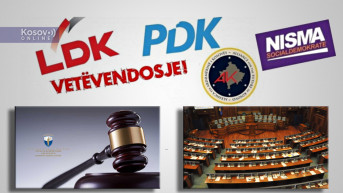
Instead of resolving the situation, the Constitutional Court’s recent decision has further entangled the political crisis that has gripped Kosovo since the February elections—at least according to the opposition. They are now offering a path forward. The Democratic Party of Kosovo (DPK) and the Democratic League of Kosovo (DSK) have submitted new appeals to the Constitutional Court, and, according to reports, President Vjosa Osmani may follow suit. Is this simply political tit-for-tat or a possible way out of the months-long stalemate? Analysts warn that the Constitutional Court must serve as a body that resolves crises—not one that brings about a full institutional paralysis.
Written by: Djordje Barovic
The institutional crisis in Kosovo began on April 19, when Members of Parliament confirmed their mandates on the second attempt.
The Self-Determination Movement (LVV) nominated Albulena Haxhiu, the outgoing Minister of Justice, as Speaker of Parliament, but after more than 40 attempts, they have still failed to secure the necessary 61 votes.
Prime Minister Kurti’s party sought to resolve the impasse on May 1 by calling for a secret ballot—but again failed to secure a majority.
To break the deadlock, the Alliance for the Future of Kosovo (AAK) was the first to request clarification from the Constitutional Court on May 16. The Court responded on June 26, stating that MPs are obligated to complete the constitution of the Assembly within 30 days. Still, no progress has been made.
In response, on July 3, the DPK filed a request for the Court to review the constitutionality of decisions made during the last three sessions of the Assembly.
The next day, the DSK also filed a request, seeking a ruling on the constitutionality of all sessions held since the Court’s June decision.
Meanwhile, the verbal sparring between the ruling LVV and the three main Albanian opposition parties—DSK, DPK, and AAK—has continued.
Eugen Cakolli of the Kosovo Democratic Institute warns that the continued political bickering and failure to constitute the Assembly is leading Kosovo into an "unknown constitutional-political zone," as any action taken after the 30-day deadline would be unconstitutional.
"Each side blames the other, but none—especially not the one bearing the greatest responsibility—is taking steps to reach an agreement and overcome the impasse," said Cakolli, referring to Self-Determination.
DPK MP Salja Jashari claims that Kurti’s party is interpreting the Constitutional Court’s decision to suit its interests, while Kosovo’s Ombudsperson Naim Çelaj blames all parties for putting personal interests above those of the citizens.
"I'm not a politician, but what the political class is doing right now is not what the people of Kosovo deserve," Çelaj stated.
A "Creative Approach" by the Court
Stefan Surlic, Assistant Professor at the Faculty of Political Science in Belgrade, told Kosovo Online that the Constitutional Court has so far shown a “rather creative approach” in handling the institutional crisis. A new decision, he warned, could further paralyze the Assembly’s formation.
“The idea of a secret ballot is aimed at securing a majority for Self-Determination’s candidate via backroom deals. If the entire process is reset, it essentially creates an endless loop and could be interpreted as the start of a new 30-day countdown. We're entering legal grey zones, and the Court itself has already taken liberties in interpreting the Constitution and drawing conclusions not grounded in its letter,” Surlic said.
According to him, the new initiatives represent a plunge into an undefined zone where outcomes depend largely on political pressure.
He believes this could be a tactic by the opposition to buy time.
“Resetting the process and nullifying the current committee would also serve to buy time for the opposition to obstruct Self-Determination,” Surlic emphasized.
“Drastic Decisions” Unlikely
Political analyst from Pristina, Gezim Kasapolli, does not expect the Court to issue any drastic rulings in response to the DPK and DSK’s appeals. However, he believes the crisis could be resolved if the Court clarified how many times a party may nominate a candidate for Speaker, and whether other parties may do so afterward.
In an interview with Kosovo Online, Kasapolli said that the same legal provisions applied in forming a new government should apply in constituting the Assembly.
“I don’t think the Court will take drastic action—it’s not within its authority. Experts agree that it’s Parliament that appoints Constitutional Court judges, not the other way around. That’s the problem—the Court has no authority over MPs,” Kasapolli stated.
He added that the Court could only answer two essential questions:
“First, how many times can one party propose a candidate for Speaker? And second, whether other parties or a different majority may then nominate their own candidate. These are the only two issues the Court could address,” said Kasapolli.
He pointed out that the June 26 ruling imposed a 30-day deadline on MPs to constitute the Assembly, but failed to outline what should happen if that does not occur.
“The lack of such measures has left it up to MPs to find a political solution—but that solution hasn’t come, because there is no political will,” Kasapolli noted.
He explained that in practice, Self-Determination refuses to withdraw its candidate Albulena Haxhiu, while the opposition parties “don’t see themselves in that arrangement.”
“So we’re back to square one, because the Constitutional Court didn’t impose any consequences for failing to constitute the Assembly within 30 days,” he added.
He also warned that the 30-day deadline is problematic in itself because it is not grounded in the Constitution.
“That’s the issue—the deadline isn’t constitutional. But if the Court continues setting deadlines, the most logical solution would be to apply the same logic as with the formation of a government: 15 days for the first attempt, 10 for the second,” Kasapolli suggested.
He dismissed the possibility of sanctions against MPs for not voting.
“I don’t believe the Court will go as far as imposing measures against MPs,” Kasapolli said.
“Institutional Order”
On the other hand, DSK MP Shkemb Manaj claims his party is merely asking the Constitutional Court to “restore institutional order” in Kosovo.
“We appealed to the Court regarding the continuation of the constitutive session on June 29. In our view, the manner in which the session was conducted by the presiding MP was in complete contradiction with the Constitution and the Court’s prior rulings. That’s why we are seeking clarification of all constitutional norms and Assembly Rules of Procedure related to the continuation of the session,” Manaj told Kosovo Press.
According to DSK, presiding MP Avni Dehari from Self-Determination must conduct the session in accordance with the agenda set during the first constitutive session.
“No political will can change the Assembly’s agenda. We are asking the Court to review this matter as soon as possible so that institutional order can be restored,” Manaj stated.
Commenting on President Osmani’s interpretation that secret voting is permitted, Manaj said that is precisely why they turned to the Court.
“This is a matter for the Constitutional Court. One of the key points is the issue of public voting. The Court has ruled that the Assembly’s Rules of Procedure and past parliamentary practices must be respected. In all previous cases, the Speaker and Deputy Speakers were elected by open vote. This is not a matter of agreement or political will, but of the Constitution and the Rules of Procedure,” Manaj stressed.
He added that the DSK did not request interim measures regarding the session, but noted that this is within the Court’s discretion.




0 comments