
New era in Serbia-Egypt relations
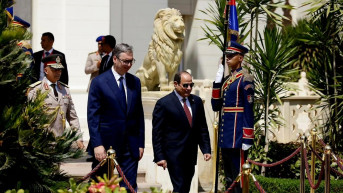
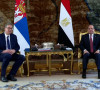
Today, Serbian President Aleksandar Vucic announced the opening of a new era in relations between Serbia and Egypt. He is the first Serbian president to make an official visit to Cairo in over a decade and a half. The visit culminated in the signing of 11 bilateral agreements, the most significant being a Free Trade Agreement that allows Serbian businesses to penetrate a market of 100 million people. Analysts note that this visit was exceptionally significant due to agreements on political, military, and economic cooperation.
During the talks in Cairo, both sides emphasized their mutual desire to deepen the strategic partnership established two years ago during the visit of Egyptian President Abdel Fattah Al Sisi to Belgrade. The cooperation between the two countries, which established diplomatic relations in 1908, reached its peak during the Non-Aligned Movement and continues today in all areas.
From July 1956, when the leaders of Yugoslavia, India, and Egypt signed the Declaration of Cooperation and Joint Policy in Brioni, to July 2024, when 11 important documents were signed, geopolitical circumstances have changed, but the need for dialogue on global challenges remains the same.
The Free Trade Agreement stipulates that 87.5% of agricultural and 30.5% of industrial products will be fully liberalized.
President Vucic stated that he discussed all geopolitical issues and various forms of cooperation with Al Sisi, from agriculture to military-technical cooperation, and announced joint exercises between the Serbian and Egyptian armies and special units.
Vucic noted that Serbia and Egypt have almost identical views on the conflict in Ukraine.
"We want peace and a ceasefire. At the same time, both of us are among the few countries still pressured to impose sanctions on the Russian Federation, but neither of us has done so. We also discussed the resolution issue in Srebrenica, initiated by President Sisi, who was very fair. It is important for us to address and improve past issues while building a future, as we see Egypt as a sincere friend. We also talked about Kosovo and Metohija. You know that during the rule of the Muslim Brotherhood and Mohamed Morsi, Egypt recognized Kosovo, but there are no serious activities or content in that regard," Vucic stated.
The President of the Supreme Council of the Islamic Community of Serbia (IZS), Muhamed Jusufspahic, indicated that the visit to Cairo was highly significant for Serbia.
He emphasized that the countries of the region, primarily Muslim and Arab countries, have been very interested in Serbia since the Non-Aligned Movement, and likely even before.
"The position of Serbia and its economic development make it very interesting to countries like Egypt and Saudi Arabia," Jusufspahic told Kosovo Online.
He added that the close relations between the two countries, enhanced by Vucic's visit to Egypt and Al Sisi's visit to Serbia two years ago, will contribute to Serbia's improvement in every sense—economically, geostrategically, and in terms of security.
"This visit will pave the right path for that. Everything President Vucic does for the benefit of Serbia in the Arab and Islamic regions is already bearing fruit," Jusufspahic is convinced.
He added that Serbia is recognized as a country with a balanced foreign policy, significantly influenced by President Vucic.
He is also confident that Egypt's firm stance on Kosovo will not change.
Egypt, as a populous and multi-religious country, serves as a "central hub" for that part of the world, primarily the Muslim world.
"It is a podium, a pulpit in cultural and religious terms. Additionally, Egypt's economic needs for fertile land, which Serbia possesses, are immense. Although Egypt is much larger than Serbia, Serbia has significantly more fertile land compared to what Egypt has, and this highlights the demand for our products, primarily agricultural ones. This need extends to the countries in the region as well," Jusufspahic concluded.
Foreign policy commentator Borivoj Erdeljan pointed out that Egypt is a much more important country than it appears at first glance and should not be underestimated. He stressed that it is good that this visit took place.
"In recent days, during the delicate negotiation process for the release of Israeli hostages and a potential ceasefire in Gaza, Egypt has been frequently mentioned. It is a mistake, not only ours but in general, to overlook and neglect Egypt, not only because of its 100 million inhabitants, geostrategic position, and the Suez Canal," Erdeljan emphasized.
He added that good relations should be developed with every country to maximize benefits and not be swayed by immediate gains.
"Getting a good hand in cards does not mean you've won the game and the prize. These relationships are built more enduringly and maintained more carefully. One should always speak with great respect for the Egyptian people, who are noble. A common mistake is to assume all Arabs are the same, but they are certainly not," Erdeljan said.
International relations expert Mirko Dautovic highlighted the cooperation in the defense industry, stating that one of the main products of Serbian manufacturing that interests Egypt is weaponry.
"It may not be the best in the world, but you get 'the most bang for your buck.' It is quite affordable, and Egypt imports it in significant quantities," Dautovic noted for Kosovo Online.
He pointed out that Egypt is an important country in the Arab world and Africa, emphasizing the significance of the visit in Serbia's ongoing effort to prevent the recognition of Kosovo and to achieve "de-recognition."
"Egypt stands in an unclear zone regarding Kosovo—it recognized Kosovo under President Mohamed Morsi, who was overthrown in a coup by the current President Abdel Fattah Al Sisi. It is actually unclear what Egypt's position on Kosovo is. Egypt plays an ambiguous role in this matter; it is clear that they do not support Kosovo's independence, but whether they are actively working on de-recognizing Kosovo, I am not sure," said Dautovic.

comments