
Vucic with Sisi on Kosovo: Egypt's recognition of independence without any substance
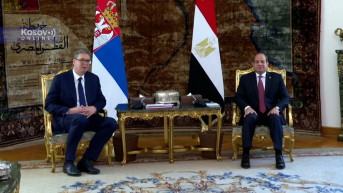
President of Serbia, Aleksandar Vucic, who is on an official visit to Egypt, stated to RTS that he discussed Kosovo with the Egyptian President Abdel Fatah al-Sisi. He mentioned that despite Egypt's recognition of Kosovo's independence during Mohamed Morsi's presidency, there have been no subsequent activities, and this will continue in the future.
"We talked about Kosovo and Metohija. You know that during the rule of the Muslim Brotherhood and Mohamed Morsi, Egypt recognized Kosovo, but there have been no activities, no serious substance," Vucic stated.
He assessed that he is almost certain that this position of Egypt will remain in the future and that Egypt can count on Serbia's support.
"We have brought our relations so close that I would be surprised if anything else happens. Just as Egypt can count on our support, I am confident that on these important issues, in world forums, we will have the support of the most populous Arab country," Vucic said.
Speaking about political cooperation, the president said to RTS that Serbia and Egypt have a similar, almost identical stance on the conflict in Ukraine.
"We want peace, we want a ceasefire, we want peace. At the same time, we are both among the few countries still under pressure to impose sanctions on the Russian Federation, but neither of us has imposed them. Today we also discussed the issue of the resolution on Srebrenica at the initiative of President Sisi, who was very fair. It is important for us now to work, to correct things from the past, and to build the future, because we see Egypt as a sincere friend," Vucic said.
Speaking about military cooperation between Serbia and Egypt, the president said that many meetings have been held on this topic since 2022.
"The discussions range from military-technical, military-economic, military-medical to military-military cooperation, and what we have agreed upon is that before the end of the year, we will have a demonstration exercise of our special units. We will also showcase some of our drones that will have been produced by then, as well as other drones we have managed to acquire in the meantime. I don't think we need to illustrate this to everyone every day," he emphasized.
He added that he would not rule out future joint work with Egypt on these issues and assessed that this shows the high level of trust between the two countries.
In Cairo, Vucic and President al-Sisi attended the signing of a free trade agreement between the two countries, which envisages the abolition of tariffs for almost 16,000 products immediately upon ratification or gradually - from agricultural and food products to pharmaceuticals and construction materials.
Vucic said that once both sides ratify the agreement, 87.5% of agricultural and 30.5% of industrial products will be fully liberalized.
"In total, over 10,400, exactly 10,412 tariff lines, and we have liberalized 6,075 tariff lines for them. Whether we will use this now or in the future, it is all the same. I am sure it will mean a lot to our economy, especially agriculture if we manage to strengthen livestock farming. There are now different tariffs for different types of poultry meat, as well as beef, and lamb, all of which we can market at any moment when we have enough for our own needs. So, a lot of work is required, 365 days a year," the president said.
He added that he fears we have all become somewhat accustomed to a better life and that few of us want to do hard work.
"Therefore, we will have to subsidize and support the most diligent among us much more than we have done so far," Vucic emphasized.
Egypt already has a free trade agreement with the European Union member states. The president assessed that until today's signing, "we had no chance" to export products to Egypt compared to the EU member states.
"If we continue to grow in this way, we will indeed have a chance, especially for agricultural products where their quality is not better than ours, regardless of whether it is fresh or frozen fruit, vegetables, or field crops. So, I believe this is an opportunity for us at this moment, but also in the future for industrial products. In any case, I think we have free space there. At least we can compete. You can't compete if they have no tariff, and we have 40 or 50 or 60 percent, then we had no chance," he noted.
He expressed his happiness about the signing of the agreement because, as he said, it is the job of the state to enable its farmers to have equal conditions.
"We will look to improve business opportunities between Serbia and Egypt as a government-to-government, state-to-state effort," the president of Serbia emphasized.
As negotiations are underway for an agreement with the United Arab Emirates, when asked if this means a reorientation to other markets since the EU is the most significant foreign trade partner, President Vucic said that the EU is and will be, but Serbia must look after its interests.
"Well, the EU didn't ask us when it was going to make a free trade agreement with Egypt; they calculated that it was in their interest. This is in the interest of Serbia, and we want to work in the interest of our citizens. Is having a free trade agreement with China of exceptional importance to us? For some others, it might be problematic. But let me ask you, today when some good vineyards, even 'Premier Cru' vineyards from Bordeaux, are being cut down because they don't have enough market in the world, it would be much easier to sell that wine if they didn't have tariffs with China," Vucic said.
He asked where Serbia would sell its wine and brandy and noted that in five years, zero tariffs on those and many other products are expected.
"We will have a market where we will be able to place tens, not to say hundreds, of millions of bottles. Some others will not have that opportunity, just as we have not had the opportunity so far in Egypt; some others have. These are things the state fights for, to achieve an advantage or at least create equal conditions in the market for its citizens and companies. That's it. So, we are looking to do everything we can for our country. We will look to fight for Africa, to fight for Asia, to fight primarily for growing markets, but also for growing economies. And where the economy and markets are growing the fastest is Africa and Asia," President Vucic emphasized.
Behind closed doors at the "Al Itihad" palace, the presidents of the two countries analyzed the relations between the two countries and geopolitical developments for almost an hour. They agreed on new paths of cooperation and concretized existing ones.

comments