
Is the new ministry proof that only the glorification of the KLA is permitted in Kosovo, while criticism and victims are silenced?
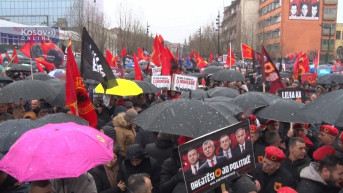
During the trial of four former leaders of the KLA before the Kosovo Specialist Chambers in The Hague, the central argument of the defense has been the alleged absence of command responsibility — namely, that Thaçi and the other accused were unable to control local commanders who allegedly acted independently, that the kidnappings and killings in question were acts of retaliation, that the KLA was not a structured military formation, and that its General Staff existed largely on paper. No one denied that crimes had occurred. However, over the past nearly six years, the victims have been scarcely mentioned in public discourse in Kosovo. Instead, the narrative has focused exclusively on the “KLA and the pure war for freedom,” culminating recently in the establishment of a dedicated Ministry for Work, Family and KLA Values.
Written by: Veljko Nestorovic
In the meantime, two declarations have been adopted in the parliaments of Albania and Kosovo. Glauk Konjufca traveled to The Hague as a representative of the Kosovo government, and a march in support of former KLA leaders was organized in Pristina.
Attorney and former military prosecutor Dragan Pasic believes that the appointment of Andin Hoti as head of the newly established Ministry for Work, Family and KLA Values sends a message both to the wider region and to the public in Kosovo that Pristina will not accept a conviction of the former KLA leaders currently on trial in The Hague.
Andin Hoti has headed the Commission on Missing Persons since 2021, and Pasic notes that Prime Minister Kurti’s decision to appoint him as minister is, above all, a political one.
“I believe the newly established ministry is primarily a message to the population of the so-called Republic of Kosovo, but also to the broader region. It is a political decision demonstrating that the current government represents continuity in supporting the so-called KLA. At the same time, it signals that any eventual conviction in this criminal case — that is, a finding of guilt — should not be perceived by the people of Kosovo or by war veterans as an attack on their role, but rather as a matter of individual responsibility. The second message is an attempt to influence the Specialist Chambers by showing that Kosovo stands behind the role and significance of the so-called KLA and that it will not accept a condemning judgment,” Pasic told Kosovo Online.
Regarding the recent resolutions adopted in the parliaments of Albania and Kosovo, attorney Amer Alija from the Humanitarian Law Center considers them a form of full political support for the accused in The Hague.
“In a way, this is support for KLA members, along with a demand that human rights be respected in the proceedings before the Kosovo Specialist Chambers in The Hague,” Alija said.
He views the resolutions primarily as a call for the decision in The Hague to be based on credible evidence.
“It is, above all, a declaration calling for respect for human rights, although when we hear statements by politicians and others, they clearly express full support for the accused on trial in The Hague,” Alija added.
Before the Kosovo Specialist Chambers in The Hague, the accused — Hashim Thaçi, Kadri Veseli, Jakup Krasniqi, and Rexhep Selimi — delivered their closing statements on Wednesday. The former KLA leaders once again rejected all allegations in the indictment and requested acquittal.
Historian Petar Ristanovic told Kosovo Online that the selection of Andin Hoti as Minister for Work, Family and KLA Values is significant, both due to his political profile and his family background, and that it indicates a lack of willingness within Albanian society to reexamine the role of the KLA.
He added that Prime Minister Albin Kurti’s continued emphasis on the KLA reflects accumulated problems within Kosovo’s society.
“As a rule, this is a consequence of deep internal and social problems. In such circumstances, authorities attempt to redirect public attention to other issues, internal tensions are fueled, and an image of an enemy is constructed — in Kosovo, this is typically the Serbs. I am certain that Hoti will play a role in that broader process,” Ristanovic stated.
The prosecution has requested 45-year prison sentences for each of the accused. A judgment by the Kosovo Specialist Chambers in The Hague is expected within the next three months, with the possibility that the delivery of the first-instance verdict may be postponed for an additional two months.


0 comments