
New Serbian Government and the Kosovo question - should we expect a tougher position from Belgrade in the dialogue?
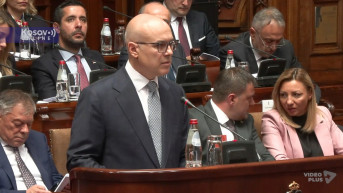
"This government, together with the President of the Republic and all other state institutions, will continue the uncompromising struggle to preserve our sovereignty and territorial integrity in Kosovo and Metohija," said the new Prime Minister of Serbia, Milos Vucevic, in his exposé. Not only based on this statement, but also based on previously known attitudes regarding Kosovo from Vucevic and other members of the cabinet, analysts from Belgrade and Pristina believe that we should expect a somewhat firmer position from the new Serbian government regarding the dialogue with Pristina.
Vucevic became a "thorn in the side" of Pristina during his tenure as Minister of Defense in the previous government, from which position he stated that Serbia would never recognize the independence of Kosovo, even if there were no Serbs left there. He also emphasized that the Kosovo Prime Minister, Albin Kurti, is an extremist who is "very creative in the terror he perpetrates against Serbs."
In Vucevic's government, which took the oath on May 2nd, there are two former directors of the Office for Kosovo and Metohija - Marko Djuric, until recently Serbia's ambassador to the United States, now Minister of Foreign Affairs, and Aleksandar Vulin, who is the Vice President of the Government. Also, in Vucevic's team, responsible for family and demographic issues in Serbia, is Milica Djurdjevic Stamenkovski, the president of the Zavetnici movement, which focuses its policy on defending national identity and territorial integrity. Each of these three individuals has been banned from entering Kosovo by Pristina, and Djuric was even arrested by Kosovar authorities six years ago when he was the director of the Office, and was taken from North Mitrovica to Pristina by heavily armed special units of the Kosovo Police, and then deported from Kosovo.
Djuric returns to the Serbian government almost directly from Washington, where he served as ambassador from 2020 to 2024. Milos Pavkovic from the Center for European Policy told Kosovo Online that Djuric has established extremely good contacts and relationships in America over the past four years and could now have a positive influence on strengthening Belgrade's position in the dialogue.
"Djuric may be able to use his connections and experience to help Serbia in the dialogue and in building positions towards progress in normalization. He can have a positive influence in lobbying with Western partners, especially the United States, especially when doing so from the position of Minister of Foreign Affairs. However, there is certainly no room for a reversal of the positions of Western countries regarding the status of Kosovo. They have simply recognized Kosovo as an independent state, and there should be no illusions that this stance can change," Pavkovic notes.
However, he does not expect major changes in Belgrade's stance towards the dialogue with Pristina because, he emphasizes, it is the President of the Republic who leads the dialogue at a high political level.
"It's interesting that in the new composition of the Government, we have former directors of the Office for Kosovo and Metohija, Marko Djuric and Aleksandar Vulin, and there is also Milica Stamenkovski, who has a very firm stance on Kosovo and Metohija. However, the President of the Republic is the one who dictates the pace and dynamics of progress in the dialogue, regardless of who is in the ministries or who is the director of the Office for Kosovo and Metohija. Stamenkovski will not have a substantial influence on the dialogue, nor can her ministry enable her to do so, but her role will be important in sending messages to public opinion on this issue," says Pavkovic.
Regarding how Pristina views the new cabinet in Nemanjina Street, our interlocutor says that their stance is extremely negative, primarily regarding the election of Milos Vucevic as prime minister and the fact that Vulin is back in the Government.
"They have animosity towards these individuals and will perceive this government in a hostile manner. But this is nothing new for Pristina; we are used to this hostile attitude from Pristina, especially during Albin Kurti's term. Anyone who finds themselves in the government in Belgrade is highly likely to be viewed extremely negatively by Albin Kurti's administration, and when Vulin and Vucevic are there, it increases the dose of animosity. Vucevic is viewed with a special dose of suspicion because of his tenure as Minister of Defense, during which there were incidents and shifts of the Serbian Army along the administrative line, which is why he is remembered unfavorably in Pristina," says Pavkovic.
Professor of Constitutional Law at the University of Pristina, Mazlum Baraliu, believes that the new government of Serbia will pursue a radical policy towards the Kosovo issue. According to him, the new Prime Minister, Milos Vucevic, has already announced that he will have a "strict policy towards Kosovo."
"He will be oriented towards Russia, not towards the West, and that is the radicalization that I believe should not be taken to such dimensions. In the government, there are also exponents of the so-called Serbian world, and this will not contribute to Serbia's integration towards the West, which is necessary for Serbia economically, socially, and for every citizen. The most important positions have been entrusted to people close to Vucic, who have previously been sanctioned by certain countries as individuals who were in some way part of incriminated actions, and also radical. Returning to radicalization means returning to the Serbian Radical Party, Seselj, and that tradition, which most likely will not sound very good in the West," says Baraliu for Kosovo online.
On the other hand, political analyst Srdjan Graovac from the Center for Social Stability says that we should not expect radical changes in the policy of the new Serbian government towards the Kosovo issue. However, he points out that if the West is not prepared to take firmer positions towards Pristina and compel it to implement what was agreed upon within the dialogue, then we should expect Belgrade to adopt a firmer stance in negotiations with Pristina, even towards Western countries.
"What is completely clear is that the potential tougher stance of the government will depend on the real situation on the ground and the attitudes of Western countries towards the Kosovo issue because it is a fact that Western countries have so far had a nonchalant attitude towards the behavior of Albanians regarding their commitments, which are, in a way, also obligations of Western countries as they were guarantors of those agreements. We cannot tolerate this indifferent attitude of the West towards the position of Serbs in Kosovo and towards Pristina's failure to fulfill its obligations indefinitely," evaluates Graovac for Kosovo online.
He emphasizes that Belgrade's strategic policy is that problems must be resolved through negotiations and that conflicts and warlike solutions must be avoided, while Albin Kurti's desire is to involve Serbia in some sort of war solution.
"Our strategic policy is a commitment to peace, and we must not allow ourselves to be provoked because there is no doubt that at this moment Kurti is the only one who would benefit from conflict. The Serbian government will not fall into that trap, just as the previous one did not," says Graovac.
According to him, the government of Albin Kurti will not view any government in Belgrade in a friendly manner unless that government is willing to recognize Kosovo, and the government of Milos Vucevic, he says, clearly stands on the position that the previous government had, that there is no chance that Serbia will agree to any explicit or implicit recognition of Kosovo's independence.
"When we had the tragic events in Banjska, Kurti tried to exploit those circumstances primarily to attack President Aleksandar Vucic, whom he defined as the main culprit for everything that happened, essentially wanting to discredit him in international relations. He also used that situation to attack the then Minister of Defense, now Prime Minister Milos Vucevic, trying to link him to the events in Banjska and make his position more difficult. There is no doubt that for Albin Kurti, both Vucic and Vucevic are enemies because neither of them accepts his policy that implies there is no place for Serbs in Kosovo unless they are willing to submit to his aspirations to create a 'Greater Albania,' which is his key goal," believes Graovac.



0 comments