
A new world order is emerging: Denmark’s ordeal confirms that Kosovo opened Pandora’s box
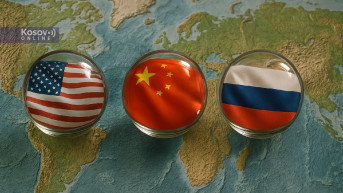
In just over two weeks, spanning the transition from the old year to the new, events on the international stage have unfolded at breakneck speed—from Israel’s recognition of Somaliland, through the “New Year’s” raid by U.S. special forces in Venezuela, the escalation surrounding Greenland, to Germany’s recognition of the independence of the South Pacific island of Niue. Interlocutors speaking to Kosovo Online have no doubt: a new world order is taking shape, with a new balance of power in which the key players will be the United States, Russia, and China. They also note that Denmark’s ordeal over Greenland has confirmed that Serbia was right when it warned the world that recognizing Kosovo would open Pandora’s box.
Written by: Jelena Milenkovic
While the world was still under the impression of New Year celebrations, explosions rocked Caracas on 3 January. It soon emerged that this was a raid by U.S. special forces, followed by the arrest of President Nicolás Maduro and his transfer to the United States. Reactions followed swiftly, and almost all major powers agreed on one point: an incursion into a sovereign state and the arrest of its president run counter to international law.
Shortly thereafter, appeals to international law and the inviolability of internationally recognized borders grew louder—particularly within the European Union—once it became clear that Donald Trump was not abandoning plans to take control of Greenland, citing U.S. interests.
Just before the New Year, Israel became the first country in the world to recognize Somaliland—officially the Republic of Somaliland—an internationally unrecognized entity in the Horn of Africa, located at a geopolitically significant crossroads. Condemnations followed once again, chiefly from the African Union, which stressed that any attempt to undermine Somalia’s unity, sovereignty, and territorial integrity runs contrary to its fundamental principles.
Similarly, the largely unknown South Pacific island of Niue received Germany’s recognition some ten days ago, framed as a political signal from Berlin indicating a desire to deepen cooperation with the so-called “Blue Continent.”
That a global recomposition of power is underway—and that the old order is disappearing before our eyes—was recently highlighted by Serbia’s Foreign Minister Marko Đuric, who cautioned that new rules would be established only after a new balance is reached, something Serbia must be mindful of in order not to pay the price.
Taken together, these events demonstrate that international law applies only until it is overridden by the particular interests of major powers. When those interests prevail, precedents are created.
Everyone Is Now Asking: What Is a Precedent?
Former FR Yugoslavia Ambassador to Germany Zoran Jeremic points out that a new world order is emerging, even though no one has a fully clear idea of its forms or boundaries, but that it is evident a new system of relations is being forged primarily by the great powers—the United States, Russia, and China.
Asked whether developments in Venezuela and the issue of Greenland could affect new recognitions or withdrawals of recognition of Kosovo, Jeremic said they would not have a direct impact, but would certainly influence how countries that participated in creating an independent Kosovo think about what constitutes a precedent.
“Recently, false reports appeared on social media claiming that Denmark was withdrawing its recognition of Kosovo, which proved untrue. That must be considered unrealistic under current circumstances. However, it opened a question that everyone is now considering—what is a precedent,” Jeremic told Kosovo Online.
He explained that the entrenched view in Europe has been that the precedent undermining international law was set by Russia’s aggression against Ukraine, while there is a marked reluctance to recall 24 March 1999, which in fact represents the true starting point of the erosion of international law and opened space for legitimizing numerous violations of territorial integrity in Europe and beyond.
“This issue is now becoming particularly salient, as after Ukraine it is being raised for the first time within Europe itself, which in the case of Denmark and Greenland feels threatened and invokes the preservation of territorial integrity as a sacred principle of international relations, thereby reaffirming the problem,” Jeremic added.
He reiterated that a new world order is clearly emerging, though its forms and boundaries remain unclear, but that a new system of relations undeniably exists, established primarily among the great powers—the United States, Russia, and China.
Jeremic added that there are other aspirants to the role of “great powers,” above all the European Union, which seeks to strengthen its military capabilities to become a significant factor in international relations.
“This phase of establishing new relations among states will not take the form of ceremonial signings or the drafting of charters like the UN Charter. It will more likely involve a system of agreements and, if it comes to that, a division of spheres of interest. These may be more or less clearly defined, but each great power will, despite agreements, try to take as much as possible,” the former ambassador said.
The Phenomenon of Force as a New Element
According to Jeremic, this will not be a rigid system of international relations like the UN Charter and the international law we know. Rather, agreements will constitute the basis and essence of the future system—primarily agreements among great powers, followed by arrangements with less influential actors and those to whom such agreements apply.
“A system of fairness and what we are accustomed to—international law and equality in international relations—will certainly not be a priority in the distribution of power among the great powers. We have seen a shift toward the law of the stronger. The phenomenon of force is becoming a new element in international relations, carrying the same weight as law and rules,” he noted.
Retired diplomat Zoran Milivojevic concurs, observing that the world is in a transitional phase of global relations toward a new balance of power and a redefinition of the international order, in which certain rules will have to apply—whether they are called international law or something else.
He explained that this transitional phase began with Russia’s incursion into Ukraine, marking a departure from the post-World War II order defined by the UN Charter and respect for international law.
“By using force, Russia signaled that it does not accept NATO’s expansion toward its borders via Ukraine. This process has continued under the Trump administration, which has clearly articulated U.S. objectives to reclaim a leading global role through a methodology that is no longer concealed but direct. Venezuela showed us this in the starkest terms, foreshadowing what we may expect elsewhere, including regions defined as part of the West’s sphere of interest—namely Europe,” Milivojevic told Kosovo Online.
He pointed to changes in transatlantic relations and a new projection of U.S. foreign policy centered primarily on American interests, including relations with allies.
“The Greenland issue directly confirms this thesis and the intent to put it into practice. It is an introduction to a new order—a redistribution of power on the global stage within a triangle that is largely defined by hard power: the United States, the Russian Federation, and China,” Milivojevic said.
Within this triangle, he added, we are witnessing a redistribution of power centers and the definition of zones of influence.
“Americans are in some sense the avant-garde in applying this new methodology and a return to the Monroe Doctrine—focusing on areas of direct interest, but projecting outward to Greenland, the Middle East, and other regions where objectives are defined. Reactions to Venezuela indicate that we have entered a phase of defining a new balance of power. The Venezuela case did not end with Nicolás Maduro’s abduction; China and Russia have responded discreetly but visibly. We are precisely at this juncture—transitioning toward a new balance and a redefined international order, where some rules will have to apply, whether termed international law or something else, but grounded in practice and experience,” he explained.
Professor of European law from Pristina, Avni Mazreku, also notes that the world is moving from unipolarity toward multipolarity as part of a new global configuration, which will have legal consequences.
Discussing Venezuela and Greenland, Mazreku said he sees no direct link between events in Venezuela and Kosovo. For him, the Venezuela case illustrates a division of roles among global powers in the context of marginalizing China and Russia.
“We are living in a time when the world is shifting from unipolarity to multipolarity within a new global configuration. We will see further actions reflecting principles on which the United Nations was founded,” Mazreku told Kosovo Online.
He said the U.S. action in Venezuela could be viewed as anti-dictatorial, but also raises questions about violations of UN Charter principles on state sovereignty and non-interference.
“In the end, it always comes down to a conflict between legality and legitimacy,” Mazreku said, recalling that post-World War II arrangements created a bipolar world shaped by the interests of two blocs.
Serbia’s Warning About Pandora’s Box
Asked how the transition toward a new balance of power will affect Kosovo, Milivojevic recalled that Serbia had long warned that NATO’s aggression over Kosovo effectively opened Pandora’s box, and that Denmark’s current struggle to defend its sovereignty and territorial integrity best illustrates today’s reality regarding respect for international law.
“The return to international law shows there are no alternative mechanisms, yet practice demonstrates that Pandora’s box has been opened,” Milivojevic said.
“Some use force, others exploit circumstances or facts on the ground, but the outcome is the same—Pandora’s box is open. This transitional period is therefore crucial, as is the need to define new rules based on a new balance of power. Two-thirds of humanity are trying to stay aligned with the UN Charter and international law, because no other mechanisms exist. One-third—led by the United States—is attempting to impose a different approach. This struggle will determine the foundations of the new international order.”
He added that Denmark’s predicament over Greenland confirms this thesis and exposes Europe’s difficulty in advocating territorial integrity, as it inevitably raises the question of Serbia and Kosovo.
“The strongest argument in defense of Denmark’s territorial integrity would be to withdraw recognition of Kosovo’s self-proclaimed independence. Denmark would be far more successful in defending its integrity if it did so,” Milivojevic argued.
Regarding potential new recognitions sought by Pristina, he said these are now objectively in question, as Western countries lack persuasive arguments in light of Denmark’s case.
“It is no coincidence that Spain challenges the new U.S. methodology—it has its own case in mind. Cyprus likewise gains new arguments. On Northern Cyprus there are far fewer Greeks than there are Serbs in Kosovo and Metohija. Our arguments thus gain strength, not to mention UN Security Council Resolution 1244, which remains valid and binding,” Milivojevic concluded.
Recognition Waves Will Not Change the Dialogue
On how global changes and waves of recognition of smaller states might affect the Belgrade–Pristina dialogue, Jeremic said progress will depend on the EU’s ability to agree internally on its stance and implementation, as well as on the U.S. approach.
“The EU is burdened by its own problems. It will engage in the dialogue only to the extent that it contributes to its own stability or affirms its role as a constructive actor in the Western Balkans,” Jeremic said.
In other words, the EU is not deeply invested in the Serbia–Kosovo dialogue for its own sake, but as a tool to motivate itself or forge a more unified stance applicable elsewhere.
“I do not believe that waves of recognition of new states or micro-states in the Middle East or the Pacific can bring anything new. In the near term, no more significant or active EU role should be expected—rather, continued pressure aimed at advancing the European path for Serbia and Kosovo,” Jeremic assessed.
Asked whether the EU has leverage to demand Kosovo’s recognition from Belgrade, Jeremic replied that it does not, having lost that leverage by invoking various precedents.
“The EU knows this. The mere fact that there are numerous problems within the EU regarding territorial integrity as a sacred principle calls into question its hard line on Kosovo’s recognition as a condition for Serbia’s membership,” he said.
Pressure to Prevent Escalation in the Western Balkans
Mazreku concluded that the world is in a phase of self-development with legal consequences, and that the West cannot allow a new European crisis to escalate—identifying the Balkans, alongside Ukraine, as a neuralgic point.
He pointed to Bosnia and Herzegovina, where the Dayton Agreement ended the war but not governance disputes, and to Serbia–Kosovo relations, marked by diametrically opposed positions on status.
“It appears that political actors in Kosovo and Serbia will face political and diplomatic pressure during this period to avoid escalation in the Western Balkans,” Mazreku concluded.


comments