
"Frozen conflict" between Trump and the EU: Is Kosovo visible from Greenland?
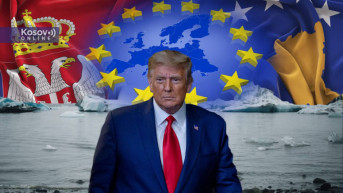
Not much followed after Donald Trump stated that sending troops to Greenland shouldn't be ruled out. Social networks in Serbia were abuzz with humorous comments: "Greenland is the most expensive Danish word," "Next year in Greenland," "Rejoice, Danish storks"... However, European officials were not laughing. France and Germany reacted most sharply, warning that borders should not be changed by force and drawing parallels with Kosovo. Although interpretations of the situation vary, contributors to Kosovo Online believe that the dispute over Arctic territory will not "thaw" the EU's stance on the Kosovo issue, even with the stance of Miroslav Lajčák's successor coming from Denmark.
Written by: Petar Rosic
"The inviolability of borders is a fundamental principle of international law. In the final act of the Conference on Security and Cooperation in Europe in 1975, amid the Cold War, European countries, Eastern bloc countries, and the USA agreed on this issue. Borders must not be changed by force," stated German Chancellor Olaf Scholz.
After Trump reignited the conversation about taking over this part of the Arctic, Danish Prime Minister Mette Frederiksen also responded. She reiterated a firm stance on Greenland's autonomy.
"My position, as well as the government's, is very clear: the future of Greenland will be determined in Greenland. Greenland belongs to the Greenlanders," she declared.
She added that if Greenland ever makes a certain decision, the Danish government will consider it.
On the other hand, Greenland's Prime Minister Mute Egede has called for Greenland's independence, presenting Denmark as a colonial power that has not always treated the indigenous Inuit population well.
"Greenland is for Greenlanders. We don't want to be Danes, we don't want to be Americans. We want to be Greenlanders," he said.
Despite the sharp reaction from Europe, Donald Trump's move caused a real stir in the Serbian public. Comments about the "double standards" of the EU regarding Kosovo were exchanged for days but were overshadowed by remarks about Greenland and Denmark on social media.
"More than autonomy, less than independence," "Greenland needs a community of Danish municipalities," "Greenland is the heart of Denmark," "Hear, Danish volunteers, band of Vikings," "Greenlanders are Illyrians,"... were some of the comments exchanged by Twitter users.
However, Helena Ivanov, a research associate at the Henry Jackson Research Center, unlike social media, doubts that any significant changes on the ground will be seen in reality.
"The international community has had a consistent stance on Kosovo for a very long time. In this, let's say, perpetual conflict between the principles of territorial integrity and the right to self-determination, the international community has chosen the right to self-determination, and I believe that in this context, countries currently supporting Kosovo as an independent state will continue to do so, despite, let's say, an apparently opposite stance they have regarding Greenland," she says for Kosovo Online.
When discussing the new European mediator in the dialogue between Belgrade and Pristina, Danish Peter Sorensen, Ivanov is explicit that regardless of where he comes from, he represents the international community, which has a clear stance on the normalization of relations.
"Therefore, a number of countries recognize Kosovo as an independent state, while some other EU member states do not recognize Kosovo as independent, and this is always a source of tension within the European Union itself. But, when it comes to the normalization processes, things are clearly defined. There are agreements, deals, treaties…, and the international community expects both sides to fulfill their contractual obligations. Whoever represents the international community in disputes between Belgrade and Pristina, I don’t think we should expect any change in stance on this issue," she states.
Petar Donic from the New Third Way also thinks similarly, noting that the historical and political contexts of the two territories are completely different. He highlights for Kosovo Online that Greenland is more of a strategic interest for the USA than for Denmark and Europe.
"One should not expect the EU's stance towards Kosovo to change because the contexts are not the same. Serbia is located in the center of the Balkans, in the heart of Europe. Greenland is an external territory much closer to America and American strategic interests. They are already planning a referendum, have a high degree of autonomy, and the local population doesn't have much of a relationship with the Danes. Greenland is not in the EU; they chose not to be part of the European community back in 1980 due to disagreements over fishing quotas, which are very important to them," he said to Kosovo Online. Commenting on U.S. President Donald Trump's statement about military actions to take control of Greenland, he points out that this is about political pressure, not a real threat.
"As for Donald Trump's statements, they should not be taken literally, that is, in the original text. It's more about a certain type of political pressure. One should not expect that a NATO member would attack another, which has only happened in the case of Greece and Turkey. However, there was no disintegration of the NATO pact in that case. So, it is about a type of political pressure. Bearing in mind the situation where Greenland is a huge territory the size of Mexico and has a population comparable to Mladenovac by Serbian standards, and contains 11 percent of the world's uranium and 70 percent of trade routes between Europe and Northeast Asia. With global warming, this territory would have increasingly strategic interests, much more for America than for Europe and Denmark," Donic explains.
Security expert and retired colonel Hisen Gecaj also believes that the Greenland issue is closely tied to U.S. interests, and he assesses for Kosovo Online that Donald Trump's statements about military intervention were intended to test the EU.
"The Greenland issue is closely related to the interest of the U.S. due to the American air base that controls the territory, and this control serves to reduce Chinese and Russian influence. Trump made the statement before he assumed the presidency, and it was a kind of test of the reactions from Greenland, Denmark, and the European Union. I don't believe Trump will actually attempt to take military action," says our interlocutor.
He believes that Trump would rather try to negotiate with the European Union and Denmark to strengthen control over Greenland.
"Climate change is revealing a lot in that region, and all those mineral riches are very important and interesting also for the United States. I see Trump's statement more as an interest to strengthen control over that territory rather than him actually taking any radical measures, especially not military ones," the analyst from Pristina evaluates.
He points out that the Kosovo issue and Greenland have no direct connection and that Ukraine could have a greater impact on Kosovo.
"There could be some talks between Russia and the U.S., and then some parallels might be drawn between Donbas and those regions in Ukraine and Kosovo, which could somehow maybe affect us. I hope that the great powers will find a more moderate approach in resolving international disputes and that small nations can somehow get through because they are always the victims of great powers, whether they are attacked directly or indirectly as is the case now between Kosovo and Serbia, where Russian, Chinese, and American power are involved," says Gecaj.

0 comments