
Opponent of the war and independence of Kosovo - Is the new President of Slovakia a new blow to the EU and NATO?
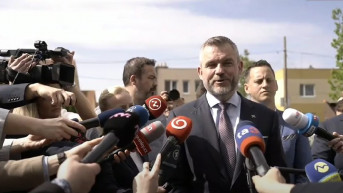
After Peter Pellegrini's victory in the presidential elections in Slovakia, many world media outlets described him as a populist sympathetic to Russia. It seems that his winning statement that he would do everything to keep Slovakia "on the side of peace," however paradoxical it may sound, did not reassure anyone. For many in the West, his election dealt a new blow to the EU, NATO, and Ukraine.
Pellegrini became the new President of Slovakia, winning 53.12% of the vote compared to 46.87% received by his opponent, former Foreign Minister Ivan Korcok, a pro-European and pro-Ukrainian candidate.
Addressing the public after his victory in the elections, Pellegrini stated that he wants to protect and defend Slovakia's national interests and its citizens, calling it his mission.
"I will do everything to ensure that Slovakia, whether someone likes it or not, always remains on the side of peace, not on the side of war," Pellegrini emphasized.
It is precisely in this message that some pro-Western media saw his rejection of war in Eastern Europe and reported that his election dealt a new political blow to European countries, the US, and Ukraine in their desperate attempts to provide political, military, and financial support to Ukraine to continue its fight against Russian forces.
Predrag Rajic from the Center for Social Stability, however, believes that Pellegrini will not make significant foreign policy shifts. He assesses Pellegrini's victory as a culmination of the former government and the return of Robert Fico's Direction-Social Democracy (Smer-SD), which collapsed six years ago when Pellegrini himself left and formed his own political party.
"They split precisely on this issue of Slovakia's foreign policy course, since Fico is very critical generally towards Western governments, towards liberal thought, he is more similar to Orban, although he is nominally leftist, and Orban is a conservative. But he is more similar to Orban on those issues and harbors a very pro-Russian sentiment. Pellegrini is somewhat different, he stepped out back then precisely because of that from Smer-SD and said that he does not identify with such a policy and that he does not see himself as a pro-Russian politician, but rather as pro-Western, and you can see that he has always appeared in public, even at a symbolic level, with the flags of Slovakia and the European Union, emphasizing how he sees the future of Slovakia exclusively within that alliance," our interlocutor points out.
He believes that Slovakia will now adopt a course similar to Hungary's, but that Pellegrini will be the "pro-Western link."
"Since a coalition was formed after the parliamentary elections that took place at the end of last year, which included Robert Fico's Direction-Social Democracy (Smer-SD), Mr. Pellegrini's party, and nationalists from Mr. Danko's Slovak National Party, and since that government has taken a course that can be compared somewhere with the stance of Hungary, we can expect that in the future, now that they have a president from that coalition, they will follow that policy. However, I think that Pellegrini, as a leader, and as someone who holds such views as we have seen in the last few years, will be the pro-Western link within that coalition," says Rajic, emphasizing that he will be the one carrying the message that Slovakia remains within the Western bloc.
"Of all three constituents of that coalition, Fico's Direction and Danko's Slovak National Party are declaratively, and even in deeds, much more inclined towards what can be called pro-Russian, while Pellegrini has always harbored a somewhat, still, moderate pro-Western sentiment, and I think that in the future in Slovak politics he will be the one carrying the message, and that is also Robert Fico's stance, that Slovakia should remain within the Western bloc. We could see in the last few months, whenever, for example, there was a vote on extending sanctions against the Russian Federation, on a new round of sanctions, Slovakia did not veto. So, I don't think there will be a change in Slovak foreign policy, it didn't come after forming a government with Fico, who rhetorically is much closer to that Russian side, so I don't expect it now when Pellegrini, who is within that ruling coalition, is someone who is actually closest to Brussels," explains Rajic.
Scientific associate at the Institute for European Studies, Dr. Stevan Gajic, also finds it absurd to criticize that Slovakia will abandon its pro-Western course and turn to Russia, but on the other hand, he assesses for Kosovo online that Slovak politics did shake NATO.
"Slovakia primarily wants to survive. The question is whether, as Americans call it, the theater of war will spread further into Europe, which is also one of the options, and two Central European countries, Hungary and now Slovakia, that is, two members of the Visegrad Group are against it, i.e., they want to avoid war. In NATO countries, such an atmosphere has been created that if you don't send people to Ukraine together with weapons and all, then you are against peace and then you are 'Putin's agent.' In that sense, of course, those are completely senseless accusations, Slovakia simply wants to be outside of all that, or to disconnect," says Gajic.
He explains that Slovakia has already sent a lot of military aid to Ukraine.
"Let's remember how many of its self-propelled howitzers were sent, they even sent equipment produced in the Soviet Union, 'MiG-29s', the 'S-300' system and who knows what else, so the Slovaks have already somewhat disarmed themselves by sending most of the equipment, but politically, what is more significant, it breaks up unity within NATO and strengthens Orban's position, who was isolated in the Visegrad Group," adds our interlocutor and assesses that the goal of both Slovakia and Hungary is to gain geopolitical independence from both the East and the West.
Director of the Center for Contemporary Politics and editor-in-chief of the portal European Western Balkans, Nemanja Todorovic Stiplija, states for Kosovo online that Slovakia is a very conservative society, and thus the parties that stood behind presidential candidate Pellegrini, both Direction and Hlas, took a position to approach the election campaign very populistically, in a way that yields results in countries of Central and Eastern Europe.
"Slovakia's attitudes, which are very similar to Hungary's in terms of the war in Ukraine and aid to Ukraine, were a central theme of this campaign. Presidential candidates accused each other, on one hand, of supporting Russia, and on the other, of supporting the West, i.e., sending troops to Ukraine, which ultimately is not within the president's competence. Both candidates used mechanisms that are currently popular and something that citizens are sensitive to. However, Slovakia, as a very traditional society, has returned to themes that were populist and nationalist, which Direction and Hlas abused in this campaign, I can freely say," says Stiplija.
When it comes to non-recognition of Kosovo, interlocutors from Kosovo online agree that it is practically impossible to change Slovakia's policy.
"Slovakia's stance on Kosovo has not changed since the day Kosovo declared independence. It has a clear, principled stance on Kosovo and it has been advocated by several Slovak governments coming from different parties. Both Peter Pellegrini and his opponent in the elections, Ivan Korcak, confirmed in previous periods that Slovakia will never recognize Kosovo. While he was prime minister, Pellegrini discussed this with then-Prime Minister of Serbia Ana Brnabic, and Korcak, as state secretary in the Ministry of Foreign Affairs and later as minister, clearly stated that Slovakia will never change its decision," says Stiplija, while Rajic explains that it is not primarily within the president's competence to make such decisions, but the government, and emphasizes that Slovakia, along with Cyprus, is the staunchest in its stance not to recognize Kosovo.
"They even adopted a regulation that without a decision of the parliament, a new state cannot be recognized. So, unlike the Czech Republic, which adopted it at the government level, in Slovakia it cannot happen, the parliament must express its opinion and the majority of the total number of MPs must vote 'for'. That is impossible, it will not happen, especially now it will not happen because neither Pellegrini as president supports the so-called Kosovo, nor Fico as prime minister, nor anyone in that government, and I would say even in the majority of the opposition, there are no attitudes that would go in that direction. In Slovakia, it is quite firm, and I would say that alongside Cyprus, it is probably the firmest among these five EU member states that do not recognize the so-called Kosovo," concludes Rajic.
0 comments