
Osmani at the center of Kosovo’s Political crisis: Search for a solution or a race for a second term?
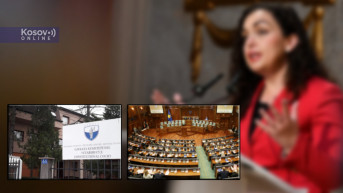
Kosovo President Vjosa Osmani stated, after talks with leaders of key parties, that it is necessary to complete the constitution of the Assembly as soon as possible. Judging by the initial reactions of the main actors, the political crisis hasn’t progressed beyond the starting point. Analysts claim that Osmani has not yet used all the options available to her, but the key question remains how much she herself is stalling, with a clear ambition to secure another presidential term early next year.
Written by: Djordje Barovic
"Osmani called on the leaders to reach an agreement as soon as possible—within the 30-day deadline set by the Constitutional Court—on how to proceed with the formation of the Assembly," her office stated following talks with the leaders of the four largest parties in Kosovo.
A sort of response to her initiative was the 41st failed attempt to constitute the Kosovo parliament, as well as the continuation of mutual accusations between the ruling and opposition parties over who is to blame.
The European Parliament’s Rapporteur for Kosovo, Riho Terras, warned that Kosovo must urgently form new institutions in accordance with the Constitutional Court’s decision, cautioning that failure to do so could further block its path to the EU.
University professor Ardian Kastrati points the finger at President Osmani, claiming that she is "immature in exercising her constitutional role in critical situations."
“In my view, the president is immature in exercising her constitutional functions in critical cases. She lacks decisiveness as an actor with decision-making and strategic weight. Her influence seems limited to increasing her personal bank account,” he said.
Many political analysts believe Osmani is delaying fulfilling her constitutional role.
“The president is late. She’s fallen far from her constitutional role, and I now doubt her power,” said political analyst Halil Matoshi.
Other commentators from Kosovo Online share this opinion.
Legal Responsibilities
Former Deputy President of Kosovo’s Constitutional Court, Kadri Krieziu, told Kosovo Online that he urged Osmani to refer the issue to the Court, because it is her legal and constitutional obligation.
“I suggested she submit a request to the Constitutional Court asking what should happen after the 30-day deadline if the Assembly is not constituted. This is related to forming Kosovo’s institutions. As president and symbol of unity, she is obliged to guarantee the functioning of the institutions,” Krieziu explained.
When asked whether repeat elections, possibly held on the same day as the local elections (12 October), are a likely scenario, Krieziu was skeptical, claiming the opposition would not accept that.
“It cannot happen because the opposition must give its opinion on extraordinary parliamentary elections. As far as I know, the opposition will not agree to hold local and parliamentary elections on the same day,” he said.
Elections and Stalling
Political scientist Ognjen Gogic believes the key word in Kosovo's crisis is “elections”, but adds another—“stalling”.
He is convinced that President Osmani is deliberately not engaging in resolving the institutional crisis because she is playing a tactical game with the aim of re-election next year.
“Her political fate is not in her hands. She doesn't have much political influence but wants to be re-elected. These are her ambitions. She’s now playing tactically to secure her re-election, which depends on how alliances among other parties unfold,” Gogic told Kosovo Online.
He recalls that past consultations with political leaders also ended without resolution and that Osmani has made little effort to resolve the crisis following the February elections.
“She didn’t even use the option of appealing to the Constitutional Court for guidance. Instead, she made several foreign visits as if there were no domestic crisis,” he noted.
Gogic believes this shows that Osmani is tactically waiting for the right moment.
“She may already be thinking about re-election. The presidential vote comes up again around March or April, and she knows the parties will consider who they want to support for president during coalition negotiations. She’s trying to be one of those names.”
In this situation, he said, Osmani benefits from prolonging the crisis, possibly aiming for repeat elections in the spring, when she could run as a parliamentary candidate.
“She likely wants this situation to drag on so that she can participate in parliamentary elections and increase her own leverage. With a few MP seats, she could re-enter negotiations for the presidency. It seems that’s her primary motivation,” Gogic said.
Thus, Osmani is being cautious, trying not to offend any party.
“She doesn’t know which party will be key to her re-election in the spring. That’s why she’s playing it safe and likely contributing to the political crisis lasting longer—waiting for spring when her mandate will be under discussion as part of coalition talks,” he added.
Avoidance and Consequences
Petar Ivic of the Pupin Initiative believes Osmani missed the chance to resolve the crisis in time by not using the constitutional mechanisms at her disposal.
“From her failure to act, we can see she’s being overly cautious and passive. She tries to appear neutral, but in not using her constitutional powers, she missed the opportunity to resolve this crisis,” Ivic said.
He too suspects that her aim is to secure another presidential term.
“She doesn’t want to anger any party, likely because she’s eyeing re-election. But by involving the Constitutional Court, she could remove direct responsibility for calling new parliamentary elections.”
He notes that because of her “don’t-offend-anyone” strategy, Osmani has missed several opportunities to resolve the crisis.
“For instance, dissolving the Assembly within 60 days of failed constitutions—that deadline is long past. She has the role to initiate both the Court’s involvement and political dialogue between parties. Yet she’s done none of that, probably to avoid conflict,” Ivic said.
The “Political Equation”
Security researcher Nikola Vujinovic believes Osmani’s inaction is due to her political alliance with Self-Determination leader Albin Kurti.
“She hasn’t acted any differently than during her entire term. She’s stayed out of internal crises in Kosovo. Critics note that Kurti turned her from a political opponent into a supporter and put her in the presidency. So it’s no surprise she avoids using her powers.”
He says she has the authority to ask the Constitutional Court for clarification on the legality of secret voting for Assembly Speaker, an issue pushed by Self-Determination and opposed by others.
“A decision from 10 years ago allows secret voting, but in Balkan political culture, that usually implies votes were bought. Since opposition parties reject this, it was expected that Osmani would ask the Court for clarification—but she hasn’t.”
Vujinovic also references former Constitutional Court President Enver Hasani, who suggested the same move.
“But someone has to file the request, and Osmani avoids doing it because she’s aligned with Kurti,” he stressed.
He notes that Osmani is in her final year as president but has yet to reveal her plans for the future.
“She hasn’t shown much interest in continuing in politics, but that doesn’t mean she won’t. Still, I believe she’d gain more support from Kosovo Albanians by acting within her powers—no one can criticize her for doing her job. The fact that she isn’t will cost her politically.”
Given the deepening crisis, he does not rule out the possibility that Osmani might eventually turn to the Constitutional Court.
“There’s visible pressure from the EU and U.S. allies for her to do so. Whether she will—we don’t know,” Vujinovic concluded.


comments