
Pre-election coalitions in Kosovo: Which parties will join forces on December 28?
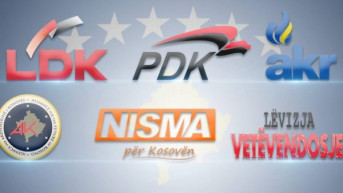
Since the February elections, post-election coalitions have not been possible in order to form a new Kosovo government. While Self-Determiantion, with 48 MPs in the Kosovo Assembly and without genuine willingness to build a strong coalition with any other party, attempted twice to form a government, the second-placed Democratic Party of Kosovo (PDK) chose not even to try taking power. The irreconcilable differences among the parties have brought Kosovo back to the beginning — to new elections on December 28, and to the question of which parties will, even briefly, join forces.
Written by: Milena Miladinovic
In recent days, pre-election coalitions have been a major topic in Kosovo's public sphere, yet none of the significant political parties has so far confirmed any coalition with parties that will take part in the elections. However, there is still time — until November 30.
Talks, negotiations, denials, and political calculations — all this has been heard from representatives of Kosovo’s political parties.
There is no talk of coalitions among the major Albanian parties — Self-Determination, LDK, PDK, and AAK. If the words of Pal Lekaj, Vice President of the Alliance for the Future of Kosovo (AAK), are to be believed, that party will run independently, opening the door for its former coalition partner, the Social Democratic Initiative (Nisma) of Fatmir Limaj — after its “flirting” with Albin Kurti during the formation of the Kosovo parliament — to seek new coalitions.
The first offer to Limaj came from LDK leader Lumir Abdixhiku.
“LDK leadership has decided to run independently, but within the LDK list we will hold talks with individuals, actors, religious groups, and political parties that could be part of the LDK list. All discussions we have had so far have opened the way for inclusion in a large and unifying list in this national election. LDK will make sure to open part of its list to other parties, including Mr. Limaj and his deputies. We will discuss this issue in the coming days, but let us say that we are ready — just as we are ready for other parties: the Christian Democrats, the Justice Party, AKR. We are open both to parties and to individuals,” Abdixhiku said.
Leaders of Nisma and the Family List responded immediately to Abdixhiku’s invitation.
Nisma Presidency member Arberesha Krasniqi stated that Limaj is negotiating with LDK but that no decision has yet been made on joining the LDK list.
“Nisma respects the assessments of any political entity in Kosovo, including the Democratic League of Kosovo… We have not yet discussed this inside the party. But it is true that Mr. Limaj has held talks and met with Abdixhiku frequently, although nothing concrete is ready for the public. We will see what Nisma’s position will be, but we certainly appreciate the correctness of the LDK leader,” Krasniqi said.
Limaj also confirmed today — denying claims of a PDK coalition — that they are in contact with LDK in search of an agreement.
“As you have seen, we are in contact with LDK,” Limaj stated.
On the other hand, the leader of the Family List, Eman Rahmani, said he had met with most political entities to discuss models of cooperation for the December 28 elections.
He said he had held a “constructive meeting” with the LDK chairman, but that a final decision on their political direction will be made in the coming days.
“We had a very constructive meeting, for which I am grateful. I believe we will state our position on possible cooperation in the next two days. Our coalition approach is based on principles and program points, which is more important than anything else,” Rahmani said.
According to Kosovo Online’s interlocutors, it will be interesting to see which party Nisma will join, potentially delivering nearly 20,000 loyal votes.
Attracting Smaller Parties
Political analyst Seb Bytyçi told Kosovo Online that in the snap elections on December 28, the three major political parties — Self-Determination, PDK, and LDK — will attempt to attract smaller parties into pre-election coalitions.
According to him, a coalition between LDK and Nisma is very likely, possibly also with the Alliance for a New Kosovo (AKR).
He added that AAK might also join a coalition, otherwise risking failure to re-enter the next Kosovo parliament.
“The three major parties will try to attract smaller parties into pre-election alliances. It is very likely that we will see a coalition between LDK and Nisma, and potentially AKR. AAK might change its position and join a coalition, because it risks not crossing the threshold to enter parliament,” Bytyçi said.
Major Parties to Run Alone
Miloš Pavkovic, Director of Strategy at the Centre for European Policy in Belgrade, stated for Kosovo Online that the only real question regarding pre-election coalitions ahead of Kosovo’s snap elections is whether the Alliance for the Future of Kosovo (AAK) and Nisma will run together.
When discussing the upcoming elections, Pavkovic says Kosovo has four key political actors:
“Besides Self-Determination, there are PDK, LDK, and the Alliance for the Future of Kosovo, which ran in coalition with Nisma. These four parties will definitely run independently. The only question is whether AAK and Nisma will again appear as a coalition, as they did in February. That is now uncertain, given tensions in the coalition, Nisma’s earlier flirtation with Self-Determination, and possible shifting of alliances. On the other hand, Nisma, if it runs alone, will hardly cross the threshold, so it will likely look for another pre-election partner,” Pavkovic explains.
He adds that post-election coalitions will depend largely on the election results.
“The key will be the results, and based on them the parties will decide with whom they will form a coalition. If I had to predict, I would say that Self-Determination is currently in a negative trend of losing votes, and it seems to me that PDK and LDK will primarily benefit from that. If that happens, I believe we may see a coalition — a large coalition — of opposition parties: PDK and LDK, potentially also with AAK. This would be an ‘anti-Kurti’ coalition, which could theoretically form a government, though in practice it will depend on many other factors,” Pavkovic stated.
Asked which coalitions are unrealistic and which might be conceivable, Pavkovic stressed that in Kosovo’s political scene it is very difficult to label anything as impossible.
“We have seen very unusual coalitions in the past. I wouldn’t dismiss anything as unrealistic. Even a coalition between Self-Determination and one of the opposition parties is possible, depending on the election results. If Self-Determination again gets over 40 percent, it could be an unavoidable partner in forming the next government,” he concluded.
Canaj: A More Natural Coalition with the PDK
Political analyst Blerim Canaj stated that there is a possibility of a pre-election coalition between the Democratic League of Kosovo (LDK) and the Social Democratic Initiative (Nisma), but that it would be more natural for Nisma to join the Democratic Party of Kosovo (PDK).
Canaj assessed that Limaj has a loyal voter base and that he can bring about 20,000 votes to whichever party he enters into coalition with.
According to him, if a coalition between Nisma and the LDK does occur, it would only be a pre-election coalition, whereas a true political merger would be with the PDK.
“It would be more natural for Limaj to join the PDK than the LDK. Whichever party he goes to, he would bring almost 20,000 votes. We have seen that Limaj has a very loyal electorate, especially in Malisevo. I expect that if Limaj moves toward the LDK, it will be only a pre-election coalition. Because a true merger would be more natural with the PDK. They may try to present it as a coalition, but in practice it would look like an absorption, and after the elections there could be a separation,” Canaj concluded.
Nisma with Self-Determination, AAK with PDK?
Coordinator of the National Convention on the EU Working Group for Chapter 35, Dragiša Mijacic, emphasized that if Nisma forms a coalition with LDK or Self-Determination, AAK may align with PDK.
Mijacic told Kosovo Online that he also expects coalitions in the Serbian political camp in Kosovo, noting that the Srpska Lista needs re-branding to become an acceptable political actor in the future government.
“The most interesting thing will be to see whether Nisma and Haradinaj’s party will run together this time or will separate. If Nisma goes with Self-Determination, then AAK will probably go, perhaps with PDK. But this is hard to predict at the moment. On the other hand, Srpska Lista must reform internally, include other political actors, and rebrand itself so it can become an acceptable political partner in future government formation. Therefore, within the Serbian political bloc we can also expect some coalition-building,” Mijacic said.
Asked whether early elections will bring a solution to the political crisis, Mijacic stressed that hope always exists.
“What has happened so far has led to a situation in which a government cannot be formed. When there is no government, processes that depend on it cannot move forward — including those concerning the status of the Serbian community. Therefore, I hope these elections will produce a new coalition government that will include Serbian political representatives and that will be constructive in addressing the long-standing issues awaiting resolution,” Mijacic concluded.



comments