
Raising the issue of Albanians in Presevo, Bujanovac and Medvedja: The position of Serbs in Kosovo and Albanians in the PBM area cannot be compared

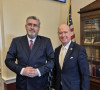
The visit of U.S. Congressmen Keith Self and Suhas Subramanyam to Presevo, Bujanovac and Medvedja (PBM), as well as to Belgrade and Pristina, has prompted differing interpretations across the region. While some of Kosovo Onlinecs interlocutors believe the visit was aimed at assessing the situation of minority communities, others argue that it constitutes political pressure on Belgrade and an attempt to draw a parallel between the position of Albanians in the PBM area and that of Serbs in Kosovo, stressing that the two situations are not directly comparable.
Written by: Veljko Nestorovic
During their visit to Belgrade, the congressmen met with Serbiacs Minister for European Integration Nemanja Starovic, Serbiacs Minister for Human and Minority Rights and Social Dialogue Demo Berisha, and State Secretary at the Ministry of Foreign Affairs Nevena Jovanovic.
In Pristina, they were received by Kosovocs Acting President Albulena Haxhiu and also met with caretaker Prime Minister Albin Kurti. While in Kosovo, they additionally visited Camp Bondsteel.
In Presevo, they held meetings with several officials, including Saip Kamberi, the only Albanian member of the Serbian National Assembly.
It should also be recalled that Congressman Self, together with Congressman Michael Lawler, introduced a resolution in the U.S. House of Representatives expressing support for Kosovocs membership in NATO, while his ties with the Albanian diaspora in the United States are exceptionally strong.
Political scientist Ognjen Gogic, commenting on the visit of the American congressmen to Belgrade, Pristina and Presevo, argues that the position of Serbs in Kosovo and that of Albanians in the PBM area cannot be fully equated.
“When they were in Presevo, they discussed the rights of Albanians, and one of the conclusions was that they support equal rights for all communities in the region. This raises the question of whether there is room for comparing the need to respect the rights of Albanians in Presevo, Bujanovac and Medvedja with the rights of Serbs in Kosovo,” Gogic said.
Our interlocutor recalls that the American delegation, namely the group of congressmen, was led by Republican Congressman Keith Self.
“This is a person who once proposed legislation in Congress concerning the position of Albanians in municipalities in southern Serbia. More recently, he also proposed a resolution on Kosovocs accession to NATO. Therefore, this is a congressman who has been engaged with the Albanian issue in the Balkans for a considerable period of time. It could be said that he is close to the Albanian lobby. He has strong ties with the Albanian diaspora in the United States and it is quite possible that he is counting on Albanian support in his political and electoral activities. Given that he will be seeking re-election to Congress, it is possible that these activities are also part of his election campaign,” Gogic said.
Regarding the position of Albanians in Presevo, Bujanovac, and Medvedja, Gogic notes that for years there has been a tendency to view the status of Albanians in those municipalities and that of Serbs in Kosovo in parallel.
“There is an effort to address these issues simultaneously, to establish a certain symmetry, and to resolve the problems as a package. The authorities in Pristina insist on this approach, believing that the rights enjoyed by Serbs in Kosovo should also be guaranteed to Albanians in southern Serbia. The Albanian community claims that it is discriminated against, insufficiently represented in institutions, and that the right to use the Albanian language is not adequately respected. Particular attention is drawn to the issue of address deactivation. On the other hand, the authorities in Belgrade often argue that part of the problem stems from the fact that Albanians are not sufficiently willing to participate in institutions and have distanced themselves from them. Therefore, the question remains to what extent discrimination exists and to what extent the issue reflects the Albanian communitycs alienation from state institutions,” he said.
Political analyst Nexhmedin Spahiu says that one of the objectives of the recent visit by the two U.S. congressmen, Keith Self and Suhas Subramanyam, who also visited Presevo, was to exert pressure on Serbiacs political leadership.
Spahiu believes that the position of Albanians in Bujanovac, Medvedja, and Presevo is unsatisfactory.
“I have visited the cPresevo Valleyc on several occasions, and their rights cannot be compared to the rights enjoyed by minorities in Kosovo. Nevertheless, they have largely been neglected. Furthermore, the deletion of residential addresses can be viewed as a form of pressure aimed at preventing them from returning to their homes. This is not something that has been invented; it is a real problem. Through the Albanian lobby in the United States, a visit by two congressmen—one Republican and one Democrat—was organized so that they could see the situation in the cPresevo Valleyc firsthand,” Spahiu said.
Speaking about the recent visit of the American congressmen, Demo Berisha, Serbiacs Minister for Human and Minority Rights and Social Dialogue, assessed that the issue of the rights of Albanians in Presevo, Bujanovac, and Medvedja is once again being raised, while efforts are also being made to link it to the rights of Serbs in Kosovo.
“At this moment, this is connected to ongoing processes and developments, as well as future political trends. Above all, it is linked to the influence of the Albanian diaspora living in the United States, something we had the opportunity to hear directly from Mr. Keith Self and his associates during discussions at the Government of the Republic of Serbia. The purpose of such initiatives is to create a rift and disrupt relations between Belgrade and Pristina, as well as between Belgrade and Tirana, which is currently an extremely important political issue,” Berisha said.
He further stated that Serbia will not allow political influence from Albin Kurti, which he claims is currently very evident.
“This is demonstrated by the position of Ragmi Mustafa, who is simultaneously an adviser to Albin Kurti, a municipal councilor in Bujanovac, a political party representative, and a candidate in the upcoming elections. This shows the extent of Kurtics political influence in the region, not only in Presevo and Bujanovac, but also in North Macedonia, where his political structure operates under a different name. All of this constitutes interconnected political processes aimed at destabilizing and weakening Serbia, while also promoting the political integration of Kosovo and Albania. This could also be heard in the remarks of Albaniacs Foreign Minister during his visit to Pristina, when he stated that cwhoever touches Kosovo, touches Albania” Berisha explained.
comments