
Rama dismissed seven ministers: Is he covering up Balluku’s departure or settling scores with rivals?
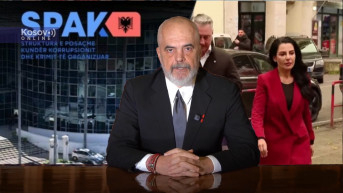
Albanian Prime Minister Edi Rama carried out a major government reshuffle and dismissed seven ministers, including his deputy Belinda Balluku, who is under investigation by the Special Prosecution and faces possible arrest. Analysts told Kosovo Online that the reshuffle is also being used as a political reckoning with potential rivals within the Socialist Party.
By: Bledar Kuka
The Albanian prime minister changed almost the entire cabinet less than six months after forming the new government, and the dismissal of Belinda Balluku, suspended by decision of the Special Court, drew the most attention.
BIRN editor and political analyst Gjergj Erebara says the reshuffle was carried out at the moment when Balluku is becoming a defendant in the proceedings, and that Rama wants to conceal the fact that this was a move imposed by the judicial system.
“The first thing that catches our eye is that we have very little information about the changes in the government, that is, about the reasons for the changes. This is a clear indicator of the overall state of democracy and the political system in Albania. Albanian politics should be read as if we were reading a cup of coffee, or as if we were reading tea leaves. This is because the country is governed by an all-powerful politician who very often does not even bother to inform his close associates in advance when he intends to appoint them as ministers or dismiss them from office,” Erebara says.
In this context, we know nothing and can only assume why this happened.
“The first thing that comes to mind is that it happened because the deputy prime minister was taken on as a defendant. So this is a change imposed by the judicial system, but it is understandable that the prime minister does not want to present this as a forced move, so he presented it as a move that had been planned in advance and that is not happening for that reason. But for him to tell me that this prime minister, less than six months after forming a new government, has drawn conclusions that he did some things wrong in this new government, that simply makes no sense,” Erebara believes.
Rama does not tolerate number “twos”
Another analyst, Ilir Pata, believes that Rama is simultaneously settling scores with potential successors within the party.
“Rama used the opportunity with one move to create several developments. We are not talking only about removing a minister under investigation from the cabinet, but also about a political ‘catharsis’ within the majority, removing those who see themselves as number twos in the Socialist Party. Edi Rama does not like number twos, nor those who call themselves his competitors,” Pata emphasizes.
He states that this involves the elimination or removal of three competitors, that is, three individuals who could be considered potential successors to Edi Rama.
“We have Erion Veliaj, the mayor of Tirana, who is in detention. We have Belinda Balluku, who is no longer in the government and, in my opinion, has ended her political career, and Elisa Spiropali, who also left after only a few months as foreign minister, having previously taken on the role of Speaker of Parliament, and who was mentioned as a possible successor to the prime minister. Edi Rama opened the pre-election campaign by stating that ‘my successor will be a woman’, and that created conflict or rivalry between Elisa Spiropali and Belinda Balluku. However, we can also say that there is a catalyst for all this, and that catalyst is the investigations of SPAK, which will continue. With this move, on this occasion, Rama reshuffled the cabinet by bringing into the government figures who have not had problems with the law,” Pata assesses.
A weakened international position, but not Rama’s majority
Commenting on the expected further course of the case, Pata says the situation creates additional international pressure on the prime minister.
“Politically, I see Balluku in decline because she will be dealing with her own problems. During the trial there will be a legal battle, while for the government the situation is not all roses and flowers, as the Italians say, because we have an action that does not come simply from the Special Prosecution. We have a political and diplomatic problem. Rama has had several clashes, and he said this in his speech. So it seems clear that Germany and Greece are today institutional offices seeking another solution without Rama. Meanwhile, Rama clearly said that this majority has 83 seats in parliament and that he will not leave. We will witness a conflict that will have its price,” Ilir Pata believes.
The EU wants enlargement, but Rama is stalling reforms
Erebara stresses that international partners look at the strategic picture, but that Edi Rama’s style of governance distances Albania from reforms.
“I do not believe they are so concerned with finding a solution here. It is true that international representatives have disproportionate power in Albania, but it is not that they are constantly dealing with our country, and accordingly you cannot conclude that at one moment they like Rama and later they do not. The behavior of international partners is not uniform. Some prefer Rama more, some less, some understand that he has authoritarian tendencies, but perhaps think that it does not concern them,” Erebara explains.
As he says, the world is very complex and there is no fixed rule about what international partners do in relation to Albania.
“What is happening, and has long been known, is that the European Union seeks to be positive regarding enlargement and has singled out two countries, Albania and Montenegro, to bring them closer as soon as possible and to send a message to the rest of the Western Balkans - namely Bosnia, Serbia, Kosovo and Macedonia - that the perspective of European integration for the region is possible, achievable in our lifetime, and that there is no change in Brussels’ position. They have no plan to leave out the Balkans. This context was created by the geopolitical situation, the war in Ukraine,” Erebara says.
He particularly points out that Albania must be careful about what could harm its European perspective.
“We must bear in mind that through our actions we are harming this European perspective, because four years have passed since the situation changed. The war in Ukraine marked four years a few days ago, and we have had four years to move closer to the European Union, which practically means one full governing mandate, and we have moved very little. The reason is that our politicians, especially Rama, while shouting about European integration, are not trying to make even the smallest step toward European integration,” Erebara assesses.
As he says, every journey toward European integration means a legal state and the rule of law.
“This journey toward the European Union puts Rama in a dilemma whether to sacrifice his power for integration or to keep his power and sacrifice integration. So far he has clearly shown that he is ready to sacrifice integration for the sake of his power. For that reason he is delaying the lifting of Ms Balluku’s immunity in parliament,” the analyst believes.
The Socialist Party will not approve the arrest
According to Ilir Pata, the struggle with the new judicial system is only just beginning.
“The Socialist Party has already said that it will not give approval for Balluku’s arrest. Edi Rama’s words were very clear, which means there will no longer be moral resignations, because the majority has lost faith in the new judicial system, since SPAK arrests you, puts you in prison and ‘throws away the key’. It keeps suspected officials in detention, and Edi Rama said we will not give this opportunity to the new judicial system. Even the head of the parliamentary legislative committee, former justice minister Ulsi Manja, clearly said that suspension from office is sufficient. Now Ms Balluku is no longer a minister, she cannot tamper with evidence, and we will not give approval for her arrest,” Ilir Pata says.
Despite pressure, scandals, and clashes with the judiciary, analysts believe that Edi Rama still maintains stable political control thanks to a majority of 83 MPs. According to assessments in Tirana, the opposition does not have the strength to threaten his power in the near future.
Albanian President Bajram Begaj, meanwhile, signed a decree approving the changes in Edi Rama’s government, thereby officially confirming personnel changes in several key sectors, including energy, internal affairs, justice, diplomacy, and defense.


0 comments